00016792682025FYFALSEP10DP10DP10Dhttp://fasb.org/us-gaap/2025#SecuredOvernightFinancingRateSofrMember0.6666670.3333330.6666670.333333http://fasb.org/us-gaap/2025#PropertyPlantAndEquipmentAndFinanceLeaseRightOfUseAssetAfterAccumulatedDepreciationAndAmortizationhttp://fasb.org/us-gaap/2025#PropertyPlantAndEquipmentAndFinanceLeaseRightOfUseAssetAfterAccumulatedDepreciationAndAmortizationhttp://fasb.org/us-gaap/2025#AccruedLiabilitiesAndOtherLiabilitieshttp://fasb.org/us-gaap/2025#AccruedLiabilitiesAndOtherLiabilitieshttp://fasb.org/us-gaap/2025#OtherLiabilitiesNoncurrenthttp://fasb.org/us-gaap/2025#OtherLiabilitiesNoncurrenthttp://fasb.org/us-gaap/2025#RevenueFromContractWithCustomerExcludingAssessedTaxhttp://fasb.org/us-gaap/2025#RevenueFromContractWithCustomerExcludingAssessedTaxP10DP10D.666667.333333.666667.333333iso4217:USDxbrli:sharesiso4217:USDxbrli:sharesiso4217:CADtusk:indemnityLetterOfCreditxbrli:puretusk:helicoptertusk:aircrafttusk:agreementtusk:lawsuittusk:casetusk:segmenttusk:auxiliaryPowerUnit00016792682025-01-012025-12-3100016792682025-06-3000016792682026-03-0300016792682025-10-012025-12-3100016792682024-01-012024-12-3100016792682025-12-3100016792682024-12-310001679268us-gaap:ServiceMemberus-gaap:NonrelatedPartyMember2025-01-012025-12-310001679268us-gaap:ServiceMemberus-gaap:NonrelatedPartyMember2024-01-012024-12-310001679268us-gaap:ServiceMemberus-gaap:RelatedPartyMember2025-01-012025-12-310001679268us-gaap:ServiceMemberus-gaap:RelatedPartyMember2024-01-012024-12-310001679268us-gaap:ProductMember2025-01-012025-12-310001679268us-gaap:ProductMember2024-01-012024-12-310001679268us-gaap:ServiceMember2025-01-012025-12-310001679268us-gaap:ServiceMember2024-01-012024-12-310001679268us-gaap:ProductMemberus-gaap:NonrelatedPartyMember2025-01-012025-12-310001679268us-gaap:ProductMemberus-gaap:NonrelatedPartyMember2024-01-012024-12-310001679268us-gaap:NonrelatedPartyMember2025-01-012025-12-310001679268us-gaap:NonrelatedPartyMember2024-01-012024-12-310001679268us-gaap:RelatedPartyMember2025-01-012025-12-310001679268us-gaap:RelatedPartyMember2024-01-012024-12-310001679268us-gaap:CommonStockMember2023-12-310001679268us-gaap:AdditionalPaidInCapitalMember2023-12-310001679268us-gaap:RetainedEarningsMember2023-12-310001679268us-gaap:AccumulatedOtherComprehensiveIncomeMember2023-12-3100016792682023-12-310001679268us-gaap:CommonStockMember2024-01-012024-12-310001679268us-gaap:AdditionalPaidInCapitalMember2024-01-012024-12-310001679268us-gaap:RetainedEarningsMember2024-01-012024-12-310001679268us-gaap:AccumulatedOtherComprehensiveIncomeMember2024-01-012024-12-310001679268us-gaap:CommonStockMember2024-12-310001679268us-gaap:AdditionalPaidInCapitalMember2024-12-310001679268us-gaap:RetainedEarningsMember2024-12-310001679268us-gaap:AccumulatedOtherComprehensiveIncomeMember2024-12-310001679268us-gaap:CommonStockMember2025-01-012025-12-310001679268us-gaap:AdditionalPaidInCapitalMember2025-01-012025-12-310001679268us-gaap:RetainedEarningsMember2025-01-012025-12-310001679268us-gaap:AccumulatedOtherComprehensiveIncomeMember2025-01-012025-12-310001679268us-gaap:CommonStockMember2025-12-310001679268us-gaap:AdditionalPaidInCapitalMember2025-12-310001679268us-gaap:RetainedEarningsMember2025-12-310001679268us-gaap:AccumulatedOtherComprehensiveIncomeMember2025-12-310001679268us-gaap:DiscontinuedOperationsDisposedOfBySaleMembertusk:TDTransactionMember2025-04-110001679268us-gaap:DiscontinuedOperationsDisposedOfBySaleMembertusk:PressurePumpingTransactionMember2025-06-160001679268us-gaap:DiscontinuedOperationsDisposedOfBySaleMembertusk:EngineeringTransactionMember2025-12-020001679268us-gaap:ChangeInAccountingMethodAccountedForAsChangeInEstimateMember2024-01-012024-12-310001679268currency:CAD2025-12-310001679268srt:MinimumMember2025-01-012025-12-310001679268srt:MaximumMember2025-01-012025-12-310001679268tusk:PuertoRicoElectricPowerAuthorityPREPAMember2024-01-012024-12-310001679268tusk:PuertoRicoElectricPowerAuthorityPREPAMembertusk:CobraAcquisitionsMember2024-04-012024-06-300001679268tusk:PuertoRicoElectricPowerAuthorityPREPAMembertusk:CobraAcquisitionsMember2017-10-190001679268tusk:PuertoRicoElectricPowerAuthorityPREPAMembertusk:CobraAcquisitionsMember2018-05-260001679268tusk:PuertoRicoElectricPowerAuthorityPREPAMembertusk:CobraAcquisitionsMember2025-12-310001679268tusk:PuertoRicoElectricPowerAuthorityPREPAMembertusk:CobraAcquisitionsMember2024-07-220001679268tusk:PuertoRicoElectricPowerAuthorityPREPAMembertusk:CobraAcquisitionsMember2024-07-222024-07-220001679268tusk:PuertoRicoElectricPowerAuthorityPREPAMembersrt:MinimumMembertusk:CobraAcquisitionsMember2024-07-220001679268tusk:PuertoRicoElectricPowerAuthorityPREPAMembertusk:CobraAcquisitionsMember2024-10-010001679268tusk:PuertoRicoElectricPowerAuthorityPREPAMembertusk:CobraAcquisitionsMember2024-10-180001679268us-gaap:LetterOfCreditMembertusk:CobraAcquisitionsMembertusk:PuertoRicoElectricPowerAuthorityPREPAMember2024-10-180001679268us-gaap:FairValueInputsLevel1Member2025-12-310001679268us-gaap:FairValueInputsLevel1Member2024-12-310001679268us-gaap:UnbilledRevenuesMember2025-12-310001679268us-gaap:UnbilledRevenuesMember2024-12-310001679268tusk:CustomerAMemberus-gaap:CustomerConcentrationRiskMemberus-gaap:SalesRevenueNetMember2025-01-012025-12-310001679268tusk:CustomerAMemberus-gaap:CustomerConcentrationRiskMemberus-gaap:SalesRevenueNetMember2024-01-012024-12-310001679268tusk:CustomerAMemberus-gaap:CustomerConcentrationRiskMemberus-gaap:TradeAccountsReceivableMember2025-01-012025-12-310001679268tusk:CustomerAMemberus-gaap:CustomerConcentrationRiskMemberus-gaap:TradeAccountsReceivableMember2024-01-012024-12-310001679268tusk:CustomerBMemberus-gaap:CustomerConcentrationRiskMemberus-gaap:SalesRevenueNetMember2025-01-012025-12-310001679268tusk:CustomerBMemberus-gaap:CustomerConcentrationRiskMemberus-gaap:SalesRevenueNetMember2024-01-012024-12-310001679268tusk:CustomerBMemberus-gaap:CustomerConcentrationRiskMemberus-gaap:TradeAccountsReceivableMember2025-01-012025-12-310001679268tusk:CustomerBMemberus-gaap:CustomerConcentrationRiskMemberus-gaap:TradeAccountsReceivableMember2024-01-012024-12-310001679268tusk:CustomerCMemberus-gaap:CustomerConcentrationRiskMemberus-gaap:SalesRevenueNetMember2025-01-012025-12-310001679268tusk:CustomerCMemberus-gaap:CustomerConcentrationRiskMemberus-gaap:SalesRevenueNetMember2024-01-012024-12-310001679268tusk:CustomerCMemberus-gaap:CustomerConcentrationRiskMemberus-gaap:TradeAccountsReceivableMember2025-01-012025-12-310001679268tusk:CustomerCMemberus-gaap:CustomerConcentrationRiskMemberus-gaap:TradeAccountsReceivableMember2024-01-012024-12-310001679268tusk:CustomerDMemberus-gaap:CustomerConcentrationRiskMemberus-gaap:SalesRevenueNetMember2025-01-012025-12-310001679268tusk:CustomerDMemberus-gaap:CustomerConcentrationRiskMemberus-gaap:SalesRevenueNetMember2024-01-012024-12-310001679268tusk:CustomerDMemberus-gaap:CustomerConcentrationRiskMemberus-gaap:TradeAccountsReceivableMember2025-01-012025-12-310001679268tusk:CustomerDMemberus-gaap:CustomerConcentrationRiskMemberus-gaap:TradeAccountsReceivableMember2024-01-012024-12-310001679268tusk:CustomerEMemberus-gaap:CustomerConcentrationRiskMemberus-gaap:SalesRevenueNetMember2025-01-012025-12-310001679268tusk:CustomerEMemberus-gaap:CustomerConcentrationRiskMemberus-gaap:SalesRevenueNetMember2024-01-012024-12-310001679268tusk:CustomerEMemberus-gaap:CustomerConcentrationRiskMemberus-gaap:TradeAccountsReceivableMember2025-01-012025-12-310001679268tusk:CustomerEMemberus-gaap:CustomerConcentrationRiskMemberus-gaap:TradeAccountsReceivableMember2024-01-012024-12-310001679268us-gaap:DiscontinuedOperationsDisposedOfBySaleMembertusk:TDTransactionMember2025-04-112025-04-110001679268us-gaap:DiscontinuedOperationsDisposedOfBySaleMembertusk:EngineeringTransactionMember2025-12-022025-12-020001679268us-gaap:SegmentDiscontinuedOperationsMembertusk:TDTransactionMember2025-12-310001679268us-gaap:SegmentDiscontinuedOperationsMembertusk:TDTransactionMember2024-12-310001679268us-gaap:SegmentDiscontinuedOperationsMembertusk:PressurePumpingTransactionMember2025-12-310001679268us-gaap:SegmentDiscontinuedOperationsMembertusk:PressurePumpingTransactionMember2024-12-310001679268us-gaap:SegmentDiscontinuedOperationsMembertusk:EngineeringTransactionMember2025-12-310001679268us-gaap:SegmentDiscontinuedOperationsMembertusk:EngineeringTransactionMember2024-12-310001679268us-gaap:SegmentDiscontinuedOperationsMembertusk:TDTransactionMember2025-01-012025-12-310001679268us-gaap:SegmentDiscontinuedOperationsMembertusk:TDTransactionMember2024-01-012024-12-310001679268us-gaap:SegmentDiscontinuedOperationsMembertusk:PressurePumpingTransactionMember2025-01-012025-12-310001679268us-gaap:SegmentDiscontinuedOperationsMembertusk:PressurePumpingTransactionMember2024-01-012024-12-310001679268us-gaap:SegmentDiscontinuedOperationsMembertusk:EngineeringTransactionMember2025-01-012025-12-310001679268us-gaap:SegmentDiscontinuedOperationsMembertusk:EngineeringTransactionMember2024-01-012024-12-310001679268tusk:ShortfallPaymentsMember2024-12-310001679268tusk:ShortfallPaymentsMember2025-12-310001679268tusk:ShortfallPaymentsMember2025-01-012025-12-310001679268tusk:ShortfallPaymentsMember2024-01-012024-12-310001679268tusk:PracticalExpedientsMembersrt:MaximumMember2025-01-012025-12-3100016792682026-01-012025-12-3100016792682025-04-012025-06-3000016792682025-09-012025-09-300001679268srt:MinimumMemberus-gaap:MachineryAndEquipmentMember2025-12-310001679268srt:MaximumMemberus-gaap:MachineryAndEquipmentMember2025-12-310001679268us-gaap:MachineryAndEquipmentMember2025-12-310001679268us-gaap:MachineryAndEquipmentMember2024-12-310001679268srt:MinimumMemberus-gaap:AirTransportationEquipmentMember2025-12-310001679268srt:MaximumMemberus-gaap:AirTransportationEquipmentMember2025-12-310001679268us-gaap:AirTransportationEquipmentMember2025-12-310001679268us-gaap:AirTransportationEquipmentMember2024-12-310001679268srt:MinimumMembertusk:BuildingsAndLeaseholdImprovementsMember2025-12-310001679268srt:MaximumMembertusk:BuildingsAndLeaseholdImprovementsMember2025-12-310001679268tusk:BuildingsAndLeaseholdImprovementsMember2025-12-310001679268tusk:BuildingsAndLeaseholdImprovementsMember2024-12-310001679268srt:MinimumMemberus-gaap:WellsAndRelatedEquipmentAndFacilitiesMember2025-12-310001679268srt:MaximumMemberus-gaap:WellsAndRelatedEquipmentAndFacilitiesMember2025-12-310001679268us-gaap:WellsAndRelatedEquipmentAndFacilitiesMember2025-12-310001679268us-gaap:WellsAndRelatedEquipmentAndFacilitiesMember2024-12-310001679268srt:MinimumMemberus-gaap:TransportationEquipmentMember2025-12-310001679268srt:MaximumMemberus-gaap:TransportationEquipmentMember2025-12-310001679268us-gaap:TransportationEquipmentMember2025-12-310001679268us-gaap:TransportationEquipmentMember2024-12-310001679268srt:MinimumMembertusk:RailImprovementsMember2025-12-310001679268srt:MaximumMembertusk:RailImprovementsMember2025-12-310001679268tusk:RailImprovementsMember2025-12-310001679268tusk:RailImprovementsMember2024-12-310001679268us-gaap:LandMember2025-12-310001679268us-gaap:LandMember2024-12-310001679268srt:MinimumMemberus-gaap:PropertyPlantAndEquipmentOtherTypesMember2025-12-310001679268srt:MaximumMemberus-gaap:PropertyPlantAndEquipmentOtherTypesMember2025-12-310001679268us-gaap:PropertyPlantAndEquipmentOtherTypesMember2025-12-310001679268us-gaap:PropertyPlantAndEquipmentOtherTypesMember2024-12-310001679268tusk:AssetsHeldAndUsedMember2025-12-310001679268tusk:AssetsHeldAndUsedMember2024-12-310001679268tusk:BRIMEquipmentAssetsMembertusk:CobraAviationServicesLLCMember2018-12-212018-12-210001679268tusk:BrimAcquisitionsLLCMembertusk:CobraAviationServicesLLCMember2018-12-210001679268tusk:BrimAcquisitionsLLCMembertusk:WexfordPartnersInvestmentCo.LLCMember2018-12-210001679268tusk:BrimAcquisitionsLLCMember2018-12-210001679268tusk:BrimAcquisitionsLLCMember2018-12-212018-12-210001679268tusk:BrimAcquisitionsLLCMember2025-12-310001679268tusk:BrimAcquisitionsLLCMember2024-12-310001679268tusk:BrimAcquisitionsLLCMember2025-01-012025-12-310001679268tusk:BrimAcquisitionsLLCMember2024-01-012024-12-310001679268us-gaap:RevolvingCreditFacilityMemberus-gaap:LineOfCreditMember2023-10-160001679268us-gaap:RevolvingCreditFacilityMembersrt:MinimumMemberus-gaap:LineOfCreditMember2023-10-160001679268us-gaap:RevolvingCreditFacilityMembersrt:MaximumMemberus-gaap:LineOfCreditMember2023-10-160001679268us-gaap:RevolvingCreditFacilityMemberus-gaap:LineOfCreditMember2025-01-012025-12-310001679268us-gaap:RevolvingCreditFacilityMemberus-gaap:LineOfCreditMember2024-01-012024-12-310001679268us-gaap:RevolvingCreditFacilityMemberus-gaap:LineOfCreditMember2025-12-310001679268us-gaap:RevolvingCreditFacilityMemberus-gaap:LineOfCreditMember2024-12-310001679268us-gaap:LetterOfCreditMemberus-gaap:LineOfCreditMember2025-12-310001679268us-gaap:LetterOfCreditMemberus-gaap:LineOfCreditMember2024-12-310001679268us-gaap:LetterOfCreditMembertusk:CobraAcquisitionsMembertusk:PuertoRicoElectricPowerAuthorityPREPAMember2024-10-160001679268tusk:CobraAcquisitionsMemberus-gaap:LineOfCreditMember2024-10-160001679268tusk:PuertoRicoElectricPowerAuthorityPREPAMembertusk:CobraAcquisitionsMember2024-10-182024-10-180001679268us-gaap:RevolvingCreditFacilityMembertusk:PuertoRicoElectricPowerAuthorityPREPAMembertusk:CobraAcquisitionsMemberus-gaap:LineOfCreditMember2025-04-110001679268us-gaap:RevolvingCreditFacilityMemberus-gaap:LineOfCreditMember2025-07-010001679268us-gaap:RevolvingCreditFacilityMemberus-gaap:LineOfCreditMember2025-07-020001679268us-gaap:RevolvingCreditFacilityMemberus-gaap:LineOfCreditMember2023-10-162023-10-160001679268tusk:NewTermCreditFacilityMemberus-gaap:LineOfCreditMember2023-10-160001679268tusk:NewTermCreditFacilityMemberus-gaap:LineOfCreditMember2023-10-162023-10-160001679268tusk:TermCreditFacilityMemberus-gaap:LineOfCreditMember2024-10-012024-10-010001679268tusk:TermCreditFacilityMemberus-gaap:LineOfCreditMember2024-10-010001679268tusk:DireWolfEnergyServicesLLCMembertusk:CobraAviationServicesLLCMember2025-12-310001679268tusk:PredatorAviationLLCMembertusk:LeopardAviationLLCMember2025-12-310001679268tusk:CobraAviationServicesLLCMember2025-12-310001679268tusk:BrimAcquisitionsLLCMember2025-01-012025-12-310001679268country:CA2025-01-012025-12-310001679268country:CA2024-01-012024-12-310001679268country:PR2025-01-012025-12-310001679268country:PR2024-01-012024-12-310001679268country:US2025-01-012025-12-310001679268country:US2024-01-012024-12-310001679268us-gaap:ForeignCountryMember2025-12-310001679268us-gaap:DomesticCountryMember2025-12-310001679268us-gaap:StateAndLocalJurisdictionMember2025-12-310001679268country:PR2025-12-310001679268stpr:TX2025-01-012025-12-310001679268stpr:TX2024-01-012024-12-310001679268us-gaap:StateAndLocalTaxJurisdictionOtherMember2025-01-012025-12-310001679268us-gaap:StateAndLocalTaxJurisdictionOtherMember2024-01-012024-12-310001679268country:CA2025-12-310001679268tusk:SpecifiedMemberAwardsMember2014-11-240001679268tusk:NonEmployeesMember2019-01-010001679268tusk:A2024EquityIncentivePlanMember2025-12-310001679268tusk:A2024EquityIncentivePlanMemberus-gaap:RestrictedStockUnitsRSUMember2023-12-310001679268tusk:A2024EquityIncentivePlanMemberus-gaap:RestrictedStockUnitsRSUMember2024-01-012024-12-310001679268tusk:A2024EquityIncentivePlanMemberus-gaap:RestrictedStockUnitsRSUMember2024-12-310001679268tusk:A2024EquityIncentivePlanMemberus-gaap:RestrictedStockUnitsRSUMember2025-01-012025-12-310001679268tusk:A2024EquityIncentivePlanMemberus-gaap:RestrictedStockUnitsRSUMember2025-12-310001679268tusk:A2024EquityIncentivePlanMemberus-gaap:RestrictedStockMember2025-12-310001679268tusk:A2024EquityIncentivePlanMemberus-gaap:RestrictedStockMember2025-01-012025-12-310001679268tusk:A2024EquityIncentivePlanMemberus-gaap:RestrictedStockMember2024-01-012024-12-310001679268us-gaap:SellingGeneralAndAdministrativeExpensesMember2025-01-012025-12-310001679268us-gaap:SellingGeneralAndAdministrativeExpensesMember2024-01-012024-12-310001679268us-gaap:RelatedPartyMember2024-12-310001679268us-gaap:RelatedPartyMember2025-12-310001679268tusk:CobraAviationServicesLLCMember2018-12-212018-12-210001679268tusk:LeopardAviationLLCMember2018-12-212018-12-2100016792682024-11-010001679268us-gaap:SegmentContinuingOperationsMember2025-12-310001679268us-gaap:SegmentContinuingOperationsMember2024-12-310001679268tusk:PerformanceAndPaymentBondMember2025-12-310001679268tusk:PerformanceAndPaymentBondMember2024-12-310001679268tusk:OutstandingBidBondMember2025-12-310001679268tusk:OutstandingBidBondMember2024-12-310001679268tusk:PuertoRicoElectricPowerAuthorityPREPAMember2025-12-310001679268us-gaap:LetterOfCreditMembertusk:PuertoRicoElectricPowerAuthorityPREPAMembertusk:CobraAcquisitionsMember2024-10-1800016792682024-04-012024-06-300001679268tusk:ForemanElectricServicesIncMember2021-05-132021-05-130001679268tusk:CobraAcquisitionsMember2025-12-310001679268tusk:CobraAcquisitionsMember2022-11-140001679268tusk:PuertoRicoElectricPowerAuthorityPREPAMembertusk:CobraAcquisitionsMember2022-11-142022-11-140001679268tusk:PuertoRicoElectricPowerAuthorityPREPAMembertusk:CobraAcquisitionsMember2023-03-202023-03-200001679268tusk:CobraAcquisitionsMembertusk:PuertoRicoElectricPowerAuthorityPREPAMember2023-12-182023-12-180001679268tusk:PuertoRicoElectricPowerAuthorityPREPAMember2024-02-152024-02-150001679268tusk:PuertoRicoElectricPowerAuthorityPREPAMembertusk:CobraAcquisitionsMember2025-05-162025-05-200001679268tusk:PuertoRicoElectricPowerAuthorityPREPAMembertusk:CobraAcquisitionsMember2025-05-162025-05-160001679268tusk:PuertoRicoElectricPowerAuthorityPREPAMembertusk:CobraAcquisitionsMember2025-05-202025-05-200001679268tusk:PuertoRicoElectricPowerAuthorityPREPAMembertusk:CobraAcquisitionsMember2025-07-032025-07-030001679268tusk:SPCPGroupMembertusk:CobraAcquisitionsMember2023-12-012023-12-010001679268tusk:SPCPGroupMembertusk:CobraAcquisitionsMember2023-10-060001679268tusk:PuertoRicoElectricPowerAuthorityPREPAMembertusk:CobraAcquisitionsMember2023-10-062023-12-010001679268tusk:CobraAcquisitionsMembertusk:PuertoRicoElectricPowerAuthorityPREPAMember2023-12-010001679268tusk:CobraAcquisitionsMember2023-12-012023-12-010001679268tusk:PuertoRicoElectricPowerAuthorityPREPAMembertusk:CobraAcquisitionsAndSPCPGroupMember2024-01-012024-03-310001679268tusk:SPCPGroupMembertusk:CobraAcquisitionsMember2024-01-012024-03-310001679268tusk:RentalsMember2025-01-012025-12-310001679268tusk:InfrastructureMember2025-01-012025-12-310001679268tusk:SandMember2025-01-012025-12-310001679268tusk:AccommodationsMember2025-01-012025-12-310001679268tusk:DrillingServicesMember2025-01-012025-12-310001679268tusk:OperatingSegmentsExcludingIntersegmentEliminationMember2025-01-012025-12-310001679268us-gaap:IntersegmentEliminationMembertusk:RentalsMember2025-01-012025-12-310001679268us-gaap:IntersegmentEliminationMember2025-01-012025-12-310001679268us-gaap:OperatingSegmentsMembertusk:RentalsMember2025-01-012025-12-310001679268us-gaap:OperatingSegmentsMembertusk:InfrastructureMember2025-01-012025-12-310001679268us-gaap:OperatingSegmentsMembertusk:SandMember2025-01-012025-12-310001679268us-gaap:OperatingSegmentsMembertusk:AccommodationsMember2025-01-012025-12-310001679268us-gaap:OperatingSegmentsMembertusk:DrillingServicesMember2025-01-012025-12-310001679268us-gaap:OperatingSegmentsMember2025-01-012025-12-310001679268tusk:RentalsMember2024-01-012024-12-310001679268tusk:InfrastructureMember2024-01-012024-12-310001679268tusk:SandMember2024-01-012024-12-310001679268tusk:AccommodationsMember2024-01-012024-12-310001679268tusk:DrillingServicesMember2024-01-012024-12-310001679268tusk:OperatingSegmentsExcludingIntersegmentEliminationMember2024-01-012024-12-310001679268us-gaap:IntersegmentEliminationMembertusk:RentalsMember2024-01-012024-12-310001679268us-gaap:IntersegmentEliminationMember2024-01-012024-12-310001679268us-gaap:OperatingSegmentsMembertusk:RentalsMember2024-01-012024-12-310001679268us-gaap:OperatingSegmentsMembertusk:InfrastructureMember2024-01-012024-12-310001679268us-gaap:OperatingSegmentsMembertusk:SandMember2024-01-012024-12-310001679268us-gaap:OperatingSegmentsMembertusk:AccommodationsMember2024-01-012024-12-310001679268us-gaap:OperatingSegmentsMembertusk:DrillingServicesMember2024-01-012024-12-310001679268us-gaap:OperatingSegmentsMember2024-01-012024-12-310001679268us-gaap:CorporateNonSegmentMember2024-01-012024-12-310001679268srt:ConsolidationEliminationsMember2024-01-012024-12-310001679268us-gaap:OperatingSegmentsMemberus-gaap:SegmentContinuingOperationsMembertusk:RentalsMember2025-12-310001679268us-gaap:OperatingSegmentsMemberus-gaap:SegmentContinuingOperationsMembertusk:InfrastructureMember2025-12-310001679268us-gaap:OperatingSegmentsMemberus-gaap:SegmentContinuingOperationsMembertusk:SandMember2025-12-310001679268us-gaap:OperatingSegmentsMemberus-gaap:SegmentContinuingOperationsMembertusk:AccommodationsMember2025-12-310001679268us-gaap:OperatingSegmentsMemberus-gaap:SegmentContinuingOperationsMembertusk:DrillingServicesMember2025-12-310001679268us-gaap:OperatingSegmentsMemberus-gaap:SegmentContinuingOperationsMember2025-12-310001679268us-gaap:CorporateNonSegmentMemberus-gaap:SegmentContinuingOperationsMember2025-12-310001679268us-gaap:OperatingSegmentsMemberus-gaap:SegmentContinuingOperationsMembertusk:RentalsMember2024-12-310001679268us-gaap:OperatingSegmentsMemberus-gaap:SegmentContinuingOperationsMembertusk:InfrastructureMember2024-12-310001679268us-gaap:OperatingSegmentsMemberus-gaap:SegmentContinuingOperationsMembertusk:SandMember2024-12-310001679268us-gaap:OperatingSegmentsMemberus-gaap:SegmentContinuingOperationsMembertusk:AccommodationsMember2024-12-310001679268us-gaap:OperatingSegmentsMemberus-gaap:SegmentContinuingOperationsMembertusk:DrillingServicesMember2024-12-310001679268us-gaap:OperatingSegmentsMemberus-gaap:SegmentContinuingOperationsMember2024-12-310001679268us-gaap:CorporateNonSegmentMemberus-gaap:SegmentContinuingOperationsMember2024-12-310001679268us-gaap:CorporateNonSegmentMember2025-01-012025-12-310001679268country:US2025-01-012025-12-310001679268country:US2024-01-012024-12-310001679268country:CA2025-01-012025-12-310001679268country:CA2024-01-012024-12-310001679268tusk:OtherGeographicMember2025-01-012025-12-310001679268tusk:OtherGeographicMember2024-01-012024-12-310001679268country:US2025-12-310001679268country:US2024-12-310001679268country:CA2025-12-310001679268country:CA2024-12-310001679268us-gaap:SubsequentEventMember2026-01-302026-02-120001679268tusk:AuxiliaryPowerUnitOneMemberus-gaap:SubsequentEventMember2026-01-302026-02-120001679268tusk:AuxiliaryPowerUnitTwoMemberus-gaap:SubsequentEventMember2026-01-302026-02-120001679268us-gaap:SubsequentEventMember2026-03-022026-03-020001679268tusk:RentalEquipmentMemberus-gaap:SubsequentEventMember2026-03-032026-03-03
UNITED STATES
SECURITIES AND EXCHANGE COMMISSION
Washington, D.C. 20549
Form 10-K | | | | | |
| ☒ | ANNUAL REPORT PURSUANT TO SECTION 13 OR 15(d) OF THE SECURITIES EXCHANGE ACT OF 1934 |
FOR THE FISCAL YEAR ENDED DECEMBER 31, 2025 | | | | | |
| ☐ | TRANSITION REPORT PURSUANT TO SECTION 13 OR 15(d) OF THE SECURITIES EXCHANGE ACT OF 1934 |
Commission File No. 001-37917
Mammoth Energy Services, Inc.
(Exact name of registrant as specified in its charter)
| | | | | | | | | | | | | | |
| Delaware | | | 32-0498321 |
(State or other jurisdiction of
incorporation or organization) | | | (I.R.S. Employer
Identification No.) |
| | | | | |
| 14201 Caliber Drive, | Suite 300 | | | |
| Oklahoma City, | Oklahoma | (405) | 608-6007 | 73134 |
| (Address of principal executive offices) | (Registrant’s telephone number, including area code) | (Zip Code) |
| | | | |
| Securities registered pursuant to Section 12(b) of The Act: |
| Title of each class | Trading Symbol(s) | Name of each exchange on which registered |
| Common Stock | TUSK | The Nasdaq Stock Market LLC |
| | | | NASDAQ Global Select Market |
| | Securities registered pursuant to Section 12(g) of the Act: None | |
Indicate by check mark if the registrant is a well-known seasoned issuer, as defined in Rule 405 of the Securities Act. Yes ☐ No ☒
Indicate by check mark if the registrant is not required to file reports pursuant to Section 13 or Section 15(d) of the Act. Yes ☐ No ☒
Indicate by check mark whether the registrant (1) has filed all reports required to be filed by Section 13 or 15(d) of the Securities Exchange Act of 1934 during the preceding 12 months (or for such shorter period that the registrant was required to file such reports), and (2) has been subject to such filing requirements for the past 90 days. Yes ☒ No ☐
Indicate by check mark whether the registrant has submitted electronically every Interactive Data File required to be submitted pursuant to Rule 405 of Regulation S-T (§ 232.405 of this chapter) during the preceding 12 months (or for such shorter period that the registrant was required to submit such files). Yes ☒ No ☐
Indicate by check mark whether the registrant is a large accelerated filer, an accelerated filer, a non-accelerated filer, a smaller reporting company or an emerging growth company. See the definitions of “large accelerated filer,” “accelerated filer,” “smaller reporting company” and “emerging growth company” in Rule 12b-2 of the Exchange Act. | | | | | | | | | | | |
| Large accelerated filer | ☐ | Accelerated filer | ☒ |
| Non-accelerated filer | ☐ | Smaller reporting company | ☒ |
| | Emerging growth company | ☐ |
If an emerging growth company, indicate by check mark if the registrant has elected not to use the extended transition period complying with any new or revised financial accounting standards provided pursuant to Section 13(a) of the Exchange Act. ☐
Indicate by check mark whether the registrant has filed a report on and attestation to its management’s assessment of the effectiveness of its internal control over financial reporting under Section 404(b) of the Sarbanes-Oxley Act (15 U.S.C. 7262(b)) by the registered public accounting firm that prepared or issued its audit report. ☒
If securities are registered pursuant to Section 12(b) of the Act, indicate by check mark whether the financial statements of the registrant included in the filing reflect the correction of an error to previously issued financial statements. ☐
Indicate by check mark whether any of those error corrections are restatements that required a recovery analysis of incentive-based compensation received by any of the registrant’s executive officers during the relevant recovery period pursuant to §240.10D-1(b). ☐
Indicate by check mark whether the registrant is a shell company (as defined in Rule 12b-2 of the Exchange Act). Yes ☐ No ☒
The aggregate market value of common equity held by non-affiliates of the registrant as of June 30, 2025 was approximately $70.7 million, calculated based on the closing price of the common stock on the Nasdaq Global Select Market on that date.
As of March 3, 2026, there were 48,358,315 shares of our $0.01 par value common stock outstanding.
DOCUMENTS INCORPORATED BY REFERENCE
Portions of Mammoth Energy Services, Inc.’s Proxy Statement for the 2026 Annual Meeting of Stockholders are incorporated by reference in Items 10, 11, 12, 13 and 14 of Part III of this Form 10-K.
TABLE OF CONTENTS
| | | | | | | | |
|
| | |
| | | Page |
| | |
| | |
| | |
| |
| Item 1. | | |
| Item 1A. | | |
| Item 1B. | | |
| Item 1C. | | |
| Item 2. | | |
| Item 3. | | |
| Item 4. | | |
| | |
| |
| Item 5. | | |
| Item 6. | | |
| Item 7. | | |
| Item 7A. | | |
| Item 8. | | |
| Item 9. | | |
| Item 9A. | | |
| Item 9B. | | |
| Item 9C. | | |
| | |
| |
| Item 10. | | |
| Item 11. | | |
| Item 12. | | |
| Item 13. | | |
| Item 14. | | |
| | |
| |
| Item 15. | | |
| Item 16. | | |
| | |
| |
GLOSSARY OF OIL AND NATURAL GAS TERMS | | | | | |
| The following is a glossary of certain oil and natural gas and natural sand proppant industry terms used in this Annual Report on Form 10-K (this “annual report” or “report”): |
| Blowout | An uncontrolled flow of reservoir fluids into the wellbore, and sometimes catastrophically to the surface. A blowout may consist of salt water, oil, natural gas or a mixture of these. Blowouts can occur in all types of exploration and production operations, not just during drilling operations. If reservoir fluids flow into another formation and do not flow to the surface, the result is called an underground blowout. If the well experiencing a blowout has significant open-hole intervals, it is possible that the well will bridge over (or seal itself with rock fragments from collapsing formations) down-hole and intervention efforts will be averted. |
| Bottomhole assembly | The lower portion of the drillstring, consisting of (from the bottom up in a vertical well) the bit, bit sub, a mud motor (in certain cases), stabilizers, drill collar, heavy-weight drillpipe, jarring devices (“jars”) and crossovers for various threadforms. The bottomhole assembly must provide force for the bit to break the rock (weight on bit), survive a hostile mechanical environment and provide the driller with directional control of the well. Oftentimes the assembly includes a mud motor, directional drilling and measuring equipment, measurements-while-drilling tools, logging-while-drilling tools and other specialized devices. |
| Directional drilling | The intentional deviation of a wellbore from the path it would naturally take. This is accomplished through the use of whipstocks, bottomhole assembly (BHA) configurations, instruments to measure the path of the wellbore in three-dimensional space, data links to communicate measurements taken down-hole to the surface, mud motors and special BHA components and drill bits, including rotary steerable systems, and drill bits. The directional driller also exploits drilling parameters such as weight on bit and rotary speed to deflect the bit away from the axis of the existing wellbore. In some cases, such as drilling steeply dipping formations or unpredictable deviation in conventional drilling operations, directional-drilling techniques may be employed to ensure that the hole is drilled vertically. While many techniques can accomplish this, the general concept is simple: point the bit in the direction that one wants to drill. The most common way is through the use of a bend near the bit in a down-hole steerable mud motor. The bend points the bit in a direction different from the axis of the wellbore when the entire drillstring is not rotating. By pumping mud through the mud motor, the bit turns while the drillstring does not rotate, allowing the bit to drill in the direction it points. When a particular wellbore direction is achieved, that direction may be maintained by rotating the entire drillstring (including the bent section) so that the bit does not drill in a single direction off the wellbore axis, but instead sweeps around and its net direction coincides with the existing wellbore. Rotary steerable tools allow steering while rotating, usually with higher rates of penetration and ultimately smoother boreholes. |
| Down-hole | Pertaining to or in the wellbore (as opposed to being on the surface). |
| Down-hole motor | A drilling motor located in the drill string above the drilling bit powered by the flow of drilling mud. Down-hole motors are used to increase the speed and efficiency of the drill bit or can be used to steer the bit in directional drilling operations. Drilling motors have become very popular because of horizontal and directional drilling applications and the day rates for drilling rigs. |
| Drilling rig | The machine used to drill a wellbore. |
| Drillpipe or Drill pipe | Tubular steel conduit fitted with special threaded ends called tool joints. The drillpipe connects the rig surface equipment with the bottomhole assembly and the bit, both to pump drilling fluid to the bit and to be able to raise, lower and rotate the bottomhole assembly and bit. |
| Drillstring or Drill string | The combination of the drillpipe, the bottomhole assembly and any other tools used to make the drill bit turn at the bottom of the wellbore. |
| Horizontal drilling | A subset of the more general term “directional drilling,” used where the departure of the wellbore from vertical exceeds about 80 degrees. Note that some horizontal wells are designed such that after reaching true 90-degree horizontal, the wellbore may actually start drilling upward. In such cases, the angle past 90 degrees is continued, as in 95 degrees, rather than reporting it as deviation from vertical, which would then be 85 degrees. Because a horizontal well typically penetrates a greater length of the reservoir, it can offer significant production improvement over a vertical well. |
| Hydrocarbon | A naturally occurring organic compound comprising hydrogen and carbon. Hydrocarbons can be as simple as methane, but many are highly complex molecules, and can occur as gases, liquids or solids. Petroleum is a complex mixture of hydrocarbons. The most common hydrocarbons are natural gas, oil and coal. |
| Mesh size | The size of the proppant that is determined by sieving the proppant through screens with uniform openings corresponding to the desired size of the proppant. Each type of proppant comes in various sizes, categorized as mesh sizes, and the various mesh sizes are used in different applications in the oil and natural gas industry. The mesh number system is a measure of the number of equally sized openings per square inch of screen through which the proppant is sieved. |
| Mud motors | A positive displacement drilling motor that uses hydraulic horsepower of the drilling fluid to drive the drill bit. Mud motors are used extensively in directional drilling operations. |
| Natural gas liquids | Components of natural gas that are liquid at surface in field facilities or in gas processing plants. Natural gas liquids can be classified according to their vapor pressures as low (condensate), intermediate (natural gasoline) and high (liquefied petroleum gas) vapor pressure. |
| Producing formation | An underground rock formation from which oil, natural gas or water is produced. Any porous rock will contain fluids of some sort, and all rocks at considerable distance below the Earth’s surface will initially be under pressure, often related to the hydrostatic column of ground waters above the reservoir. To produce, rocks must also have permeability, or the capacity to permit fluids to flow through them. |
| Proppant | Sized particles mixed with fracturing fluid to hold fractures open after a hydraulic fracturing treatment. In addition to naturally occurring sand grains, man-made or specially engineered proppants, such as resin-coated sand or high-strength ceramic materials like sintered bauxite, may also be used. Proppant materials are carefully sorted for size and sphericity to provide an efficient conduit for production of fluid from the reservoir to the wellbore. |
| | | | | |
| Resource play | Accumulation of hydrocarbons known to exist over a large area. |
| Shale | A fine-grained, fissile, sedimentary rock formed by consolidation of clay- and silt-sized particles into thin, relatively impermeable layers. |
| Tight oil | Conventional oil that is found within reservoirs with very low permeability. The oil contained within these reservoir rocks typically will not flow to the wellbore at economic rates without assistance from technologically advanced drilling and completion processes. Commonly, horizontal drilling coupled with multistage fracturing is used to access these difficult to produce reservoirs. |
| Tight sands | A type of unconventional tight reservoir. Tight reservoirs are those which have low permeability, often quantified as less than 0.1 millidarcies. |
| Tubulars | A generic term pertaining to any type of oilfield pipe, such as drill pipe, drill collars, pup joints, casing, production tubing and pipeline. |
| Unconventional resource/unconventional well | A term for the different manner by which resources are exploited as compared to the extraction of conventional resources. In unconventional drilling, the wellbore is generally drilled to specific objectives within narrow parameters, often across long, lateral intervals within narrow horizontal formations offering greater contact area with the producing formation. Typically, the well is then hydraulically fractured at multiple stages to optimize production. |
| Wellbore | The physical conduit from surface into the hydrocarbon reservoir. |
| Well stimulation | A treatment performed to restore or enhance the productivity of a well. Stimulation treatments fall into two main groups, hydraulic fracturing treatments and matrix treatments. Fracturing treatments are performed above the fracture pressure of the reservoir formation and create a highly conductive flow path between the reservoir and the wellbore. Matrix treatments are performed below the reservoir fracture pressure and generally are designed to restore the natural permeability of the reservoir following damage to the near wellbore area. Stimulation in shale gas reservoirs typically takes the form of hydraulic fracturing treatments. |
CAUTIONARY NOTE REGARDING FORWARD-LOOKING STATEMENTS
Various statements contained in this report that express a belief, expectation, or intention, or that are not statements of historical fact, are forward-looking statements within the meaning of Section 27A of the Securities Act of 1933, as amended, or the Securities Act, and Section 21E of the Securities Exchange Act of 1934, or the Exchange Act and the Private Securities Litigation Reform Act of 1995. In particular, the factors discussed in this report could affect our actual results and cause our actual results to differ materially from expectations, estimates or assumptions expressed, forecasted or implied in such forward-looking statements.
Forward-looking statements may include statements about:
•the levels of capital expenditures by our customers and the impact on utilization and pricing for our services;
•the volatility of oil and natural gas prices and actions by OPEC members and other oil exporting nations, or OPEC+, affecting commodity price and production levels;
•employee retention and increasingly competitive labor market;
•general economic, business or industry conditions and concerns over a potential economic slowdown or recession;
•conditions in the capital, financial and credit markets;
•conditions of U.S. oil and natural gas industry and the effect of U.S. energy, monetary and trade policies;
•U.S. and global economic conditions and political and economic developments, including the energy and environmental policies;
•inflationary pressure on the cost of services, equipment and other goods in our industries and other sectors;
•our ability to comply with the applicable financial covenants and other terms and conditions under our revolving credit facility;
•our ability to execute our business and financial strategies;
•our plans with respect to any stock repurchases under the board of directors’ authorized stock repurchase program;
•our ability to continue to grow our infrastructure services segment;
•any loss of one or more of our significant customers and its impact on our revenue, financial condition and results of operations;
•obsolescence of, or changes in overall demand for, our aircraft and flight equipment;
•asset impairments;
•our ability to identify, complete and integrate acquisitions of assets or businesses;
•our ability to receive, or delays in receiving, permits and governmental approvals and/or payments, and to comply with applicable governmental laws and regulations;
•the failure to receive or delays in receiving the remaining payment under the settlement agreement with the Puerto Rico Electric Power Authority, or PREPA;
•the outcome or settlement of our litigation matters discussed in this report on our financial condition and cash flows;
•any future litigation, indemnity or other claims;
•regional supply and demand factors, delays or interruptions of production, and any governmental order, rule or regulation that may impose production limits on our customers;
•sustained weakness in the natural gas basins in which we operate and adverse impact on demand for our oilfield and natural sand proppant services;
•shortages, delays in delivery and interruptions in supply of major components, replacement parts, or other equipment, supplies or materials;
•changes in U.S. and foreign trade regulations and tariffs, including potential increases of tariffs on goods imported into the U.S., and uncertainty regarding the same;
•extreme weather conditions, wild fires and other natural disasters in areas where we provide our services;
•access to and restrictions on use of sourced or produced water;
•advances in technology;
•civil unrest, war, military conflicts or terrorist attacks;
•cyberattacks and any resulting loss of information;
•competition within the energy services industry;
•payment of any future dividends;
•future operating results; and
•capital expenditures and other plans, objectives, expectations and intentions.
All of these types of statements, other than statements of historical fact included in this annual report, are forward-looking statements. These forward-looking statements may be found in the “Business,” “Risk Factors,” “Management’s Discussion and Analysis of Financial Condition and Results of Operations,” and other sections of this annual report. In some
cases, you can identify forward-looking statements by terminology such as “may,” “will,” “could,” “should,” “would,” “expect,” “plan,” “project,” “budget,” “intend,” “anticipate,” “believe,” “estimate,” “predict,” “potential,” “pursue,” “target,” “seek,” “objective,” “continue,” “will be,” “will benefit,” or “will continue,” the negative of such terms or other comparable terminology.
The forward-looking statements contained in this annual report are largely based on our expectations, which reflect estimates and assumptions made by our management. These estimates and assumptions reflect our best judgment based on currently known market conditions and other factors, which are difficult to predict and many of which are beyond our control. Although we believe such estimates and assumptions to be reasonable, they are inherently uncertain and involve a number of risks and uncertainties that are beyond our control. In addition, our management’s assumptions about future events may prove to be inaccurate. Our management cautions all readers that the forward-looking statements contained in this annual report are not guarantees of future performance, and we cannot assure any reader that such statements will be realized or the forward-looking events and circumstances will occur. Actual results may differ materially from those anticipated or implied in the forward-looking statements due to the many factors including those described in Item 1A. “Risk Factors” and Item 7. “Management’s Discussion and Analysis of Financial Condition and Results of Operations” and elsewhere in this annual report. All forward-looking statements speak only as of the date of this annual report. We do not intend to publicly update or revise any forward-looking statements as a result of new information, future events or otherwise. These cautionary statements qualify all forward-looking statements attributable to us or persons acting on our behalf.
PART I.
Item 1. Business
Overview
We are an integrated, growth-oriented services company focused on providing products and services to our customers primarily in the oil and natural gas, aviation and utility infrastructure industries. Our primary business objective is to drive returns through improved execution by prioritizing asset utilization, margin expansion, and capital efficiency across the portfolio. Our suite of services includes rental services, infrastructure services, natural sand proppant services, accommodation services and drilling services. Our rental services segment provides a wide range of equipment used in oilfield, construction and aviation activities. Our infrastructure services division provides engineering, design, construction, upgrade, maintenance and repair services to the fiber industry. Our natural sand proppant services division mines, processes and sells natural sand proppant used for hydraulic fracturing. Our drilling services segment provides directional drilling to oilfield operators. We believe that the services we offer play a critical role in increasing the ultimate recovery and present value of production streams from unconventional resources as well as in constructing and improving fiber network. Our complementary suite of services provides us with the opportunity to cross-sell our services and expand our customer base and geographic positioning.
We continue to focus on growing our rental business. We believe our portfolio of aviation assets provides an attractive form of aviation asset financing for operators that allows capital deployment and fleet flexibility while eliminating residual value risk for the operators.
Our facilities and service centers are strategically located in Ohio, Texas, Oklahoma, Wisconsin and Alberta, Canada primarily to serve the following areas:
•Eastern Ohio;
•Southern Ohio;
•West Texas;
•The Appalachian Basin in the Northeast;
•The SCOOP and STACK in Oklahoma;
•The Arkoma Basin in Arkansas and Oklahoma;
•The Anadarko Basin in Oklahoma;
•The Marcellus Shale in West Virginia and Pennsylvania;
•Southeastern New Mexico;
•The Barnett Shale in Texas;
•The Granite Wash and Mississippi Shale in Oklahoma and Texas;
•The Cana Woodford and Woodford Shales and the Cleveland Sand in Oklahoma; and
•The oil sands in Alberta, Canada.
Our operational division heads have an extensive track record with an average of over 29 years of services experience. They bring valuable expertise and long-term customer relationships to our business. We provide our rental services, infrastructure services, natural sand proppant, accommodation services and drilling services to a diversified range of both public and private independent oil and natural gas producers, sand suppliers, fiber network owners and aircraft-based passenger and cargo providers.
Our Services
Our revenues, operating income (loss) and identifiable assets are primarily attributable to five reportable segments: rental services, infrastructure services, natural sand proppant services, accommodation services, and drilling services.
Rental Services
Our equipment rental services provide a wide range of equipment used in drilling, flowback and hydraulic fracturing services as well as in construction activities. Our equipment rentals consist of cranes, light plants, generators and other oilfield related equipment. We provide equipment rental in West Texas, Eastern Ohio, Pennsylvania and West Virginia.
Our aviation services include leasing aircraft and aircraft equipment to customers. Aircraft equipment is comprised of auxiliary power units (“APUs”) and engines. As of December 31, 2025, we owned nine regional aircraft, two helicopters, five jet engines, and ten APUs.
Infrastructure Services
Our infrastructure services business provides engineering, design, construction, upgrade, maintenance and repair services to fiber networks. We provide infrastructure services primarily in the southwest and midwest portions of the United States.
Settlement Agreement with PREPA
Since we commenced operations in this line of business, a substantial portion of our infrastructure revenue has been generated from storm restoration work, primarily from the Puerto Rico Electric Power Authority, or PREPA, due to damage caused by Hurricane Maria. On October 19, 2017, Cobra Acquisitions LLC, or Cobra, and PREPA entered into an emergency master services agreement for repairs to PREPA’s electrical grid. The one-year contract, as amended, provided for payments of up to $945 million. On May 26, 2018, Cobra and PREPA entered into a second one-year, $900 million master services agreement to provide additional repair services and begin the initial phase of reconstruction of the electrical power system in Puerto Rico. Our work under each of the contracts with PREPA ended on March 31, 2019. PREPA is currently subject to bankruptcy proceedings, which were filed in July 2017 and are currently pending in the United States District Court for the District of Puerto Rico (the “Title III Court”). As a result, PREPA’s ability to meet its payment obligations under the above-referenced agreements was largely dependent upon funding from the Federal Emergency Management Agency (“FEMA”) or other sources. Since September 30, 2019, Cobra has been pursuing litigation in the Title III Court and other dispute resolution efforts seeking recovery of the amounts owed to Cobra by PREPA for restoration services in Puerto Rico, which proceedings are discussed in more detail in the Company’s prior reports filed with the SEC. PREPA was holding approximately $18.4 million in funds (the “Withheld FEMA Funds”) received from FEMA and considered payable to Cobra but had been withheld due to garnishments asserted by three Puerto Rican municipalities (the “Specified Municipalities”) for certain municipal tax claims discussed in Mammoth’s filings with the SEC (the “Specified Municipal Tax Claims”) and for which Cobra disputed any valid garnishment.
On July 22, 2024, Cobra entered into a release and settlement agreement with PREPA and the Financial Oversight and Management Board for Puerto Rico (“FOMB”), in its capacity as Title III representative for PREPA, to settle all outstanding matters between Cobra and PREPA (the “Settlement Agreement”). Under the terms of the Settlement Agreement, Cobra was allowed an administrative expense claim against PREPA of $170.0 million, plus the $18.4 million in the Withheld FEMA Funds. Cobra’s allowed claim will be paid through three installments: (i) $150.0 million on the later of (A) ten business days following approval of the Settlement Agreement by the Title III Court and (B) August 31, 2024; (ii) $20.0 million within seven days following the effective date of PREPA’s plan of adjustment; and (iii) $18.4 million (subject to providing one or more indemnity letters of credit) in the Withheld FEMA Funds within either (A) ten business days after the deadline for appealing the entry of the settlement order by the Title III Court under the applicable bankruptcy rules of procedure if no such appeal is filed, or (B) if the provisions of the settlement order allowing PREPA to release the Withheld FEMA Funds to Cobra without retaining any liability to the Specified Municipalities are appealed by the Specified Municipalities, within ten business days of the filing of the notice of such appeal.
The Settlement Agreement was approved by the Company’s Board of Directors on July 22, 2024, and was also approved by the PREPA Board and by the FOMB. On September 18, 2024, the Settlement Agreement was approved by the Title III Court overruling all objections thereto and an order was entered the same day (the “Settlement Order”). On October 1, 2024, Cobra received the first installment payment of $150.0 million from the Commonwealth of Puerto Rico in connection with the Settlement Agreement with PREPA. Also on October 1, 2024, certain Puerto Rico municipalities and Foreman Electric Services Inc. that had objected to approval of the Settlement Order each filed timely notices of appeal of the Settlement Order to the United States Court of Appeals for the First Circuit. None of the foregoing parties have sought a stay of the Settlement Order pending such appeals. Although the ultimate outcome of these appeals cannot be predicted with certainty, Cobra believes that the appeals are without merit.
On October 18, 2024, Cobra received a payment from PREPA totaling $18.4 million under the terms of the Settlement Agreement. In connection with the receipt of the $18.4 million from PREPA, Cobra instructed Fifth Third Bank, National Association (“Fifth Third Bank”) to issue a letter of credit to PREPA under the Reimbursement Agreement in the amount of $18.4 million and transferred a total of $19.3 million to a restricted cash account maintained by Fifth Third Bank as collateral for the letter of credit.
As a result of the Settlement Agreement, the Company recorded a non-cash, pre-tax charge of approximately $170.7 million in the second quarter of 2024 to reduce its accounts receivable balance from PREPA of $359.1 million, representing the amount owed to Cobra by PREPA in relation to these agreements as of June 30, 2024, including the accrued but unpaid interest,
prior to the Settlement Agreement, to the amount expected to be received from the Settlement Agreement. Of the $170.7 million, $89.2 million was charged to credit loss expense, which is included in “selling, general and administrative” on the consolidated statements of comprehensive income (loss), and $81.5 million was charged to interest on delinquent accounts receivable, which is included in “other (expense) income, net” on the consolidated statements of comprehensive income (loss) for the year ended December 31, 2024. See Note 2. “Summary of Significant Accounting Policies—Accounts Receivable” and Note 18. “Commitments and Contingencies—Litigation” to our consolidated financial statements included elsewhere in this annual report for more information.
Natural Sand Proppant Services
In our natural sand proppant business, we mine, process and sell sand. In the past, we have also bought processed sand from suppliers on the spot market for resale. Natural sand proppant, also known as frac sand, is the most widely used type of proppant due to its broad applicability in unconventional oil and natural gas wells and its favorable physical characteristics relative to other proppants. Natural frac sand may be used as proppant in all but the highest pressure and temperature environments and is being employed in nearly all major U.S. unconventional oil and natural gas producing basins, including those in which we operate.
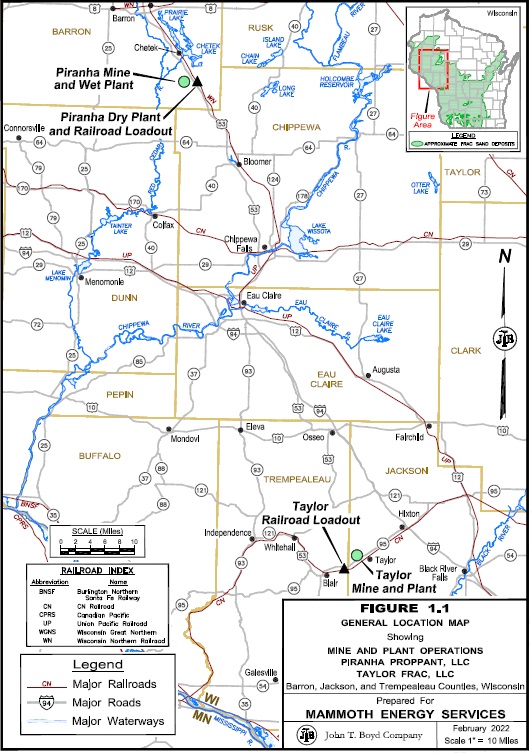
At our Jackson County, Wisconsin plant, we mine and process sand into premium monocrystalline sand, a specialized mineral that is used as frac sand. Until September 2025, we mined and processed out of a plant in Jackson County, Wisconsin. We can also purchase raw or washed sand and process it at our indoor sand processing plant located in Pierce County, Wisconsin; however, this facility has been temporarily idled since September 2018 due to market conditions. We sell sand to our customers for use in their hydraulic fracturing operations to enhance recovery rates from unconventional wells. Our sand processing plants produce a range of frac sand sizes for use in all major North American shale basins, including a majority of the standard proppant sizes as defined by the ISO/API 13503-2 specifications. These grain sizes can be customized to meet the demands of our customers with respect to a specific well. Our supply of Jordan substrate exhibits the physical properties necessary to withstand the completion and production environments of the wells in these shale basins. Our indoor processing plant in Pierce County, Wisconsin is designed for year-round continuous wet and dry plant operation. Our multi-environment processing plants in Barron County and Jackson County, Wisconsin have indoor dry plants designed to operate year-round and outdoor wet plants that generally operate eight months per year.
We also provide logistics solutions to facilitate delivery of our frac sand products to our customers. Our frac sand products out of our Jackson County, Wisconsin plant are primarily shipped by rail to our customers in the Utica Shale, the Montney Shale in British Columbia and Alberta, Canada. The sand products out of our Barron County, Wisconsin plant were primarily shipped by rail to customers in the SCOOP/STACK, DJ Basin and Permian Basin. Our logistics capabilities are important to our customers, who focus on both the reliability and flexibility of product delivery. Because our customers generally find it impractical to store frac sand in large quantities near their well completion sites, they typically prefer product to be delivered where and as needed, which requires predictable and efficient loading and shipping capabilities. We contract with third party providers to transport our frac sand products to railroad facilities for delivery to our customers. We currently lease or have access to origin transloading facilities on the Canadian National Railway Company (CN) rail system and use an in-house railcar fleet that we lease from various third parties to deliver our frac sand products to our customers. Origin transloading facilities on multiple railways allow us to provide predictable and efficient loading and shipping of our frac sand products.
Accommodation Services
Our remote accommodations business provides housing, kitchen and dining, and recreational service facilities for oilfield workers located in remote areas away from readily available lodging. We provide a turnkey solution for our customers’ accommodation needs. These modular camps, when assembled together, form large dormitories, with kitchen/dining facilities and recreation areas. These camps are operated as “all inclusive,” where meals are prepared and provided for the guests. The primary revenue source for these camps is lodging fees. As of December 31, 2025, we had a capacity of 764 rooms, 612 of which are at Sand Tiger Lodge, our camp in northern Alberta, Canada, and 152 of which are available to be leased as rental equipment to a third party. On average, 186 rooms were utilized per night during the year ended December 31, 2025.
Drilling Services
Our directional drilling services provide for the efficient drilling and production of oil and natural gas from unconventional resource plays. Our directional drilling equipment includes mud motors used to propel drill bits and kits for measurement-while-drilling, or MWD, and electromagnetic, or EM, technology. MWD kits are down-hole tools that provide
real-time measurements of the location and orientation of the bottom-hole assembly, which is necessary to adjust the drilling process and guide the wellbore to a specific target. This technology, coupled with our complementary services, allows our customers to drill wellbores to specific objectives within narrow location parameters within target horizons. The evolution of unconventional resource reserve recovery has increased the need for the precise placement of a wellbore. Wellbores often travel across long-lateral intervals within narrow formations as thin as ten feet. Our personnel are involved in all aspects of a well from the initial planning of a customer’s drilling program to the management and execution of the horizontal or directional drilling operation.
As of December 31, 2025, we owned four MWD kits and one EM kit used in vertical, horizontal and directional drilling applications, 89 mud motors, nine air motors and an inventory of related parts and equipment. Currently, we perform our directional drilling services in the Anadarko Basin, Arkoma Basin, Powder River Basin and Permian Basin.
Business Developments
During 2025, we completed four strategic divestitures. On April 11, 2025, we sold a portion of our infrastructure services entities, including our distribution, transmission and substation operations, for aggregate proceeds of approximately $108.7 million, subject to customary post-closing adjustments. On June 16, 2025, we sold all of the equipment previously used in our hydraulic fracturing services for $15.0 million. On September 15, 2025, the Company completed the sale of assets related to its natural sand proppant operations at its Piranha Proppant LLC processing plant. On December 2, 2025, we completed the sale of our engineering services business, Aquawolf, for approximately $30.0 million, also subject to customary post-closing adjustments. The results of operations, financial position and cash flows for these businesses are reported as discontinued operations for all periods presented and discussed in this report. Unless otherwise indicated, the information presented in this Management’s Discussion and Analysis relates only to our continuing operations.
To reflect on how management evaluates the business following these divestitures, prior period segment information presented in our results of operations below has been recast to conform with our segment composition as of December 31, 2025. See Note 3. “Discontinued Operations” to our consolidated financial statements included elsewhere in this annual report for more information.
Our Industries
Aircraft Industry
The operating environment for the lease of aircraft and aircraft assets is currently favorable. Factors such as population growth as well as improved global economic health and development are positively influencing both passenger and freight demand. In addition, factors and trends including Original Equipment Manufacturer (“OEM”) supply chain challenges and backlogs, the financing needs of airlines and the availability of maintenance facilities as well as repair timelines may increase the demand for our aircraft and aircraft equipment.
Oil and Natural Gas Industry
The oil and natural gas industry has traditionally been volatile and is influenced by a combination of long-term, short-term and cyclical trends, including the domestic and international supply and demand for oil and natural gas, current and expected future prices for oil and natural gas and the perceived stability and sustainability of those prices, production depletion rates and the resultant levels of cash flows generated and allocated by exploration and production companies to their drilling, completion and related services and products budgets. The oil and natural gas industry is also impacted by general domestic and international economic conditions, political instability in oil producing countries, government regulations (both in the United States and elsewhere), levels of customer demand, the availability of pipeline capacity, storage capacity, shortages of equipment and materials and other conditions and factors that are beyond our control.
Demand for most of our oil and natural gas products and services depends substantially on the level of expenditures by companies in the oil and natural gas industry. The levels of capital expenditures of our customers are driven by many factors, including the prices of oil and natural gas. Throughout 2025 and 2024, we experienced challenges in our oil and gas businesses as a result of a generally declining rig count combined with elevated oil and natural gas production in the U.S. We expect 2026 activity to remain steady during the first half of the year with potential for upside in the back half of the year. Positive trends that may contribute to increased activity will come from LNG export capacity coming online and general electricity and power demand enhancements. We will be strategically positioned to capitalize on this anticipated demand if and when it ramps up.
In response to prior market conditions, we previously idled several service lines, including cementing, acidizing, flowback, contract drilling, rig hauling, coil tubing, pressure control, full‑service transportation, and crude oil hauling. Based on the demand environment described above, these service lines have remained idled, and we continue to assess whether market conditions will support their recommencement.
Natural Sand Proppant Industry
Increased demand from oil and gas companies in 2022 resulted in higher demand and pricing for our sand compared to 2021, which continued throughout the first quarter of 2023. Demand for our natural sand proppant was adversely impacted in the second quarter of 2023 by the wildfires in Canada, which hindered our ability to transport sand. As discussed above, pricing for crude oil and natural gas declined from levels seen in 2022, which slowed down completion activities and adversely impacted demand for our sand proppant services in the second half of 2023. Activity remained suppressed throughout 2024 and 2025. As discussed above, we expect 2026 activity to be relatively steady, with the potential for moderate upside compared to 2025 driven by increases in natural gas demand to support power demand and LNG exports.
Our proppant sand reserves consist of Northern White silica sand, giving us access to a range of high-quality sand grades meeting or exceeding all API specifications, including a mix between concentrations of coarse grades (20/40 and 30/50 mesh size) and finer grades (40/70 and 100 mesh size). Our sample boring data and our historical production data have indicated that our reserves contain deposits of approximately 60% 40 mesh size or finer substrate. The coarseness and conductivity of Northern White frac sand significantly enhances recovery of oil and liquids-rich gas by allowing hydrocarbons to flow more freely than is sometimes possible with native sand. The low acid-solubility increases the integrity of Northern White frac sand relative to other proppants with higher acid-solubility, especially in shales where hydrogen sulfide and other acidic chemicals are co-mingled with the targeted hydrocarbons. In addition, its crush resistant properties enable Northern White frac sand to be used in deeper drilling applications than the frac sand produced from many native mineral deposits.
We believe that the coarseness, conductivity, sphericity, acid-solubility, and crush-resistant properties of our Northern White sand reserves and our facilities’ connectivity to rail and other transportation infrastructure grant us logistical access to the Utica, Marcellus and Montney shale basins compared to many of our competitors and make us one of a select group of sand producers capable of delivering high volumes of frac sand that is optimal for oil and natural gas production to those basins.
Infrastructure Industry
The infrastructure industry involves the construction and maintenance of fiber networks. Demand for our services is driven by artificial intelligence ("AI") and data center projects.
Certain barriers to entry exist in the markets in which we operate, including adequate financial resources, technical expertise, high safety ratings and a proven track record of operational success. We compete based upon our industry experience, technical expertise, financial and operational resources, geographic presence, industry reputation, safety record and customer service. While we believe our customers consider a number of factors when selecting a service provider, they generally award most of their work through a bid process. Consequently, price is often a principal factor in determining which service provider is selected.
We believe that AI and high-performance computing will drive the upgrade and overbuild of fiber networks in order to increase data capacity. Funding for projects in the infrastructure space remains strong with added opportunities since the Infrastructure Investment and Jobs Act ("IIJA") was signed into law on November 15, 2021. Federal and state agencies continue to implement multi‑year funding programs established under the IIJA, including substantial investments through Broadband Equity, Access and Deployment ("BEAD") program. These programs continue to support planned investment in broadband, utility, transportation, and clean‑energy projects. Although these programs were enacted several years ago, the implementation and distribution of funds remain ongoing and are expected to continue well into the latter half of the decade. Market participants across telecommunications, power, and energy‑transition sectors have announced substantial capital plans aligned with these programs, supported by federal incentives and growing private‑sector investment in areas such as fiber deployment, grid modernization, electrification, and data‑center‑related power demand.
Our Strengths
Our primary business objective is to grow our operations and create value for our stockholders through organic growth opportunities and accretive acquisitions. We believe that the following strengths position us well to capitalize on activity in unconventional resource plays and achieve our primary business objective:
•Narrowed focus following divestitures. We believe we can drive returns through improved execution by prioritizing asset utilization, margin expansion, and capital efficiency across the portfolio.
•Strategic geographic positioning. We currently operate facilities and service centers to support our oilfield service operations in major unconventional resource plays in the United States, including the Utica Shale in Eastern Ohio, the Permian Basin in West Texas and Southeastern New Mexico, the SCOOP/STACK in Oklahoma, the Marcellus Shale in West Virginia, the Granite Wash in Oklahoma and Texas, the Cana Woodford Shale in Oklahoma and the oil sands in Alberta, Canada. We believe our geographic positioning within active oil and natural gas liquids resource plays will benefit us strategically as activity increases in these unconventional resource plays. We currently operate infrastructure facilities and service centers to support our infrastructure operations in the southwestern and midwestern portions of the United States.
•Experienced management and operating team. Our operational division heads have an extensive track record in the service businesses with an average of over 29 years of services experience. In addition, our field managers have expertise in the areas in which they operate and understand the challenges that our customers face. We believe their knowledge of our industries and business lines enhances our ability to provide innovative, client-focused and basin-specific customer service, which we also believe strengthens our relationships with our customers.
Our Business Strategy
We intend to achieve our primary business objective by the successful execution of our business plan to strategically deploy our equipment and personnel to provide rental services, natural sand proppant services and other energy services in unconventional resource plays, including the Utica Shale in Ohio, the SCOOP/STACK in Oklahoma and the Marcellus Shale in West Virginia. We intend to achieve our primary business objective in connection with our infrastructure services by the successful execution of our business plan to strategically deploy equipment and personnel to provide infrastructure services in the southwestern and midwestern portions of the United States. We believe our infrastructure services optimize our customers’ ability to maintain, improve and expand their fiber networks and that our oil and natural gas services optimize our customers’ ultimate resources recovery and present value of hydrocarbon reserves. We seek to create cost efficiencies for our customers by providing a suite of complementary services designed to address a wide range of our customers’ needs. Specifically, we strive to create value for our stockholders through the following strategies:
•Leverage our broad range of services for cross-selling opportunities. We offer a complementary suite of services and products. Our infrastructure services division provides engineering, design, construction, upgrade, maintenance and repair services for the infrastructure industry, with a specialization in fiber-optic network projects. Our natural sand proppant services division mines, processes and sells natural sand proppant for hydraulic fracturing. We intend to leverage our existing customer relationships and operational track record to cross sell our services and increase our exposure and product offerings to our existing customers, broaden our customer base and expand opportunistically to other geographic regions in which our customers have operations, as well as to create operational efficiencies for our customers.
•Expand our infrastructure business. On November 15, 2021, President Biden signed the Infrastructure Investment and Jobs Act into law. This has brought new opportunities in the infrastructure industry, including new fiber-related projects. We consistently monitor market conditions and intend to expand the capacity and scope of our infrastructure services as demand warrants in geographic areas in which we currently operate, as well as in new geographic areas.
•Maintain a conservative balance sheet. We seek to maintain a conservative balance sheet, which allows us to better react to changes in commodity prices and related demand for our services, as well as overall market conditions. We used a portion of the proceeds received from our Settlement Agreement with PREPA to pay, in full, all amounts owed under our term credit facility and terminated the facility. As of December 31, 2025, we had no outstanding debt and unrestricted cash of $102.0 million.
•Leverage our experienced operational management team expertise. We seek to manage the services we provide as closely as possible to the needs of our customer base. Our operational division heads have long-term relationships with our largest customers. We intend to leverage these relationships and our operational management team’s expertise to deliver innovative, client-focused services to our customers.
•Expand through selected, accretive acquisitions. To complement our organic growth, we intend to pursue selected, accretive acquisitions of businesses and assets, primarily related to our infrastructure services and industrial based
companies that can meet our targeted returns on invested capital and enhance our portfolio of products and services, market positioning and/or geographic presence. We believe this approach will help facilitate the strategic expansion of our customer base, geographic presence and service offerings. We also believe that our industry contacts and those of Wexford Capital LP (“Wexford”), our largest stockholder, may help us identify acquisition opportunities. We may use our common stock as consideration for accretive acquisitions.
Marketing and Customers
Our customers consist primarily of independent oil and natural gas producers, sand suppliers and fiber network owners in North America. For the years ended December 31, 2025 and 2024, we had approximately 142 and 151 customers, respectively, including Source Energy Services Proppants, Hangingstone Demo Limited Partnership, Ascent Resources, Vero Fiber Networks and 24/7 Sands LLC. Our top five customers accounted for approximately 55% and 58%, respectively, of our revenue for the years ended December 31, 2025 and 2024. Although we believe we have a broad customer base and wide geographic coverage of operations, it is likely that we will continue to derive a significant portion of our revenue from a relatively small number of customers in the future. If a major customer decides not to continue to use our services and is not replaced by new or existing customers, our revenue would decline and our operating results and financial condition would be harmed.
Operating Risks and Insurance
Our operations are subject to hazards inherent in the services industry, such as accidents, blowouts, explosions, fires and spills and releases that can cause:
•personal injury or loss of life;
•damage or destruction of property, equipment, natural resources and the environment; and
•suspension of operations.
In addition, claims for loss of oil and natural gas production and damage to formations can occur in the oilfield services industry. If a serious accident were to occur at a location where our equipment and services are being used, it could result in us being named as a defendant in lawsuits asserting large claims.
Because our business involves the transportation of heavy equipment and materials, we may also experience traffic accidents which may result in spills, property damage and personal injury.
Despite our efforts to maintain safety standards, from time to time we have suffered accidents in the past and anticipate that we could experience accidents in the future. In addition to the property damage, personal injury and other losses from these accidents, the frequency and severity of these incidents affect our operating costs and insurability and our relationships with customers, employees, regulatory agencies and other parties. Any significant increase in the frequency or severity of these incidents, or the general level of compensation awards, could adversely affect the cost of, or our ability to obtain, workers’ compensation and other forms of insurance, and could have other material adverse effects on our financial condition and results of operations.
We maintain commercial general liability, workers’ compensation, business auto, commercial property, motor truck cargo, umbrella liability, professional liability, cybersecurity, in certain instances, excess liability, and directors and officers insurance policies providing coverages of risks and amounts that we believe to be customary in our industry. With respect to our hydraulic fracturing operations, coverage would be available under our policy for any surface or subsurface environmental clean-up and liability to third parties arising from any surface or subsurface contamination. We also have certain specific coverages for some of our businesses, including our remote accommodation services and directional drilling services.
Although we maintain insurance coverage of types and amounts that we believe to be customary in the industry, we are not fully insured against all risks, either because insurance is not available or because of the high premium costs relative to perceived risk. Further, insurance rates have in the past been subject to wide fluctuation and changes in coverage could result in less coverage, increases in cost or higher deductibles and retentions. Liabilities for which we are not insured, or which exceed the policy limits of our applicable insurance, could have a material adverse effect on us. See Item 1A. “Risk Factors” for a description of certain risks associated with our insurance policies.
Safety and Remediation Program
In the services industry, an important competitive factor in establishing and maintaining long-term customer
relationships is having an experienced and skilled workforce. Many of our larger customers place an emphasis not only on pricing, but also on safety records and quality management systems of contractors. We have committed resources toward employee safety and quality management training programs. Our field employees are required to complete both technical and safety training programs.
Historically, we used third-party contractors to provide remediation and spill response services when necessary to address spills that were beyond our containment capabilities. None of these prior spills were significant, and we have not experienced any material incidents, citations or legal proceeding relating to our hydraulic fracturing or crude hauling services for environmental concerns.
Competition
The markets in which we operate are highly competitive. To be successful, a company must provide services and products that meet the specific needs of oil and natural gas exploration and production companies, drilling services contractors, private utilities, IOUs and Co-Ops at competitive prices.
We provide our services and products across the United States and in Alberta, Canada and we compete against different companies in each geographic area and service and product line we offer. Our competition includes many large and small energy service companies, including the largest integrated oilfield services companies and infrastructure companies. Our major competitors in our infrastructure services business include Quanta Services, Inc. and MasTec, Inc. Our major competitors in our natural sand proppant services business are Badger Mining Corporation, Covia Holdings Corporation, Hi-Crush Partners LP, Capital Sand Proppants LLC, Athabasca Minerals Inc., Source Energy Services Ltd., and U.S. Silica Holdings Inc.
We believe that the principal competitive factors in the market areas that we serve are quality of service and products, reputation for safety, technical proficiency, availability and price. While we must be competitive in our pricing, we believe our customers select our services and products based on the local leadership and expertise that our field management and operating personnel use to deliver quality services and products.
Regulation
We operate under the jurisdiction of a number of regulatory bodies that regulate worker safety standards, permitting and inspection requirements applicable to construction projects, building and electrical codes regulations, government project regulations, the handling of hazardous materials, the transportation of explosives, the protection of human health and the environment and driving standards of operation. Regulations concerning equipment certification create an ongoing need for regular maintenance which is incorporated into our daily operating procedures. The oil and natural gas and infrastructure industries are subject to environmental and other regulation pursuant to local, state and federal legislation.
Aviation Industry Regulation
We engage in the leasing of small passenger aircraft, jet engines, and APUs to regional and other airlines. Although we do not operate aircraft ourselves, our aviation leasing activities are subject to certain regulatory requirements in the United States and abroad. Aircraft we lease must be registered with the applicable civil aviation authority and must maintain a valid Certificate of Airworthiness. Our lessees are responsible for complying with all operational, safety, and maintenance regulations necessary to keep these certificates in force.
In addition, U.S. export‑control and sanctions laws, including rules administered by the Departments of Commerce and Treasury (OFAC), may apply to the leasing and export of aircraft, engines, and related parts to foreign operators. These laws restrict transactions with sanctioned jurisdictions or parties, and we maintain compliance processes to ensure that aircraft and engines we lease are not used in prohibited locations or by restricted counterparties.
Transportation Matters
In connection with the transportation and relocation of our equipment and general cargo, we operate trucks and other heavy equipment. As such, we operate as a motor carrier in providing certain of our services and therefore are subject to regulation by the United States Department of Transportation and by various state agencies. These regulatory authorities exercise broad powers, governing activities such as the authorization to engage in motor carrier operations, driver licensing and insurance requirements, financial reporting and review of certain mergers, consolidations and acquisitions, and transportation of hazardous materials (HAZMAT). Our trucking operations are subject to possible regulatory and legislative changes that may increase our costs. Some of these possible changes include increasingly stringent environmental regulations, changes in the
hours of service regulations which govern the amount of time a driver may drive or work in any specific period, onboard black box recorder device requirements or limits on vehicle weight and size.
Interstate motor carrier operations are subject to safety requirements prescribed by the Federal Motor Carrier Safety Administration, or FMCSA, a unit within the United States Department of Transportation. To a large degree, intrastate motor carrier operations are subject to state safety regulations that mirror federal regulations. Matters such as the weight and dimensions of equipment are also subject to federal and state regulations. From time to time, various legislative proposals are introduced, including proposals to increase federal, state or local taxes, including taxes on motor fuels, which may increase our costs or adversely impact the recruitment of drivers. We cannot predict whether, or in what form, any increase in such taxes applicable to us will be enacted.
Certain motor vehicle operators require registration with the Department of Transportation. This registration requires an acceptable operating record. The Department of Transportation periodically conducts compliance reviews and may revoke registration privileges based on certain safety performance criteria which could result in a suspension of operations. The rating scale consists of “satisfactory,” “conditional” and “unsatisfactory” ratings. As of December 31, 2025, all of our trucking operations have “satisfactory” ratings with the Department of Transportation. We have undertaken comprehensive efforts that we believe are adequate to comply with the regulations. Further information regarding our safety performance is available at the FMCSA website at www.fmcsa.dot.gov.
In December 2010, the FMCSA launched a program called Compliance, Safety, Accountability, or CSA, in an effort to improve commercial truck and bus safety. A component of CSA is the Safety Measurement System, or SMS, which analyzes all safety violations recorded by federal and state law enforcement personnel to determine a carrier’s safety performance. The SMS is intended to allow FMCSA to identify carriers with safety issues and intervene to address those problems. However, the
agency has announced its intention to revise its safety rating system to ensure greater consistency in results, continually
improve the quality of data used and help motor carriers better understand their results. These changes are expected to go into
effect in 2026. At this time, we cannot predict the effect these revisions may have on our safety rating.
Environmental Matters and Regulation
Our operations are subject to stringent laws and regulations governing the discharge of materials into the environment or otherwise relating to environmental protection. Numerous federal, state and local governmental agencies, such as the U.S. Environmental Protection Agency, or the EPA, issue regulations that often require difficult and costly compliance measures that carry substantial administrative, civil and criminal penalties and may result in injunctive obligations for non-compliance. These laws and regulations may require the acquisition of a permit before commencing operations, restrict the types, quantities and concentrations of various substances that can be released into the environment in connection with our operations, limit or prohibit construction or drilling activities on certain lands lying within wilderness, wetlands, ecologically or seismically sensitive areas and other protected areas, require action to prevent or remediate pollution from current or former operations, such as plugging abandoned wells or closing pits, result in the suspension or revocation of necessary permits, licenses and authorizations, require that additional pollution controls be installed and impose substantial liabilities for pollution resulting from our operations or related to our owned or operated facilities. Liability under such laws and regulations is strict (i.e., no showing of “fault” is required) and can be joint and several. Moreover, it is not uncommon for neighboring landowners and other third parties to file claims for personal injury and property damage allegedly caused by the release of hazardous substances, hydrocarbons or other waste products into the environment. Changes in environmental laws and regulations occur frequently, and any changes that result in more stringent and costly pollution control or waste handling, storage, transport, disposal or cleanup requirements could materially adversely affect our operations and financial position, as well as the oil and natural gas industry and infrastructure industry in general. We have not experienced any material adverse effect from compliance with these environmental requirements. This trend, however, may not continue in the future.
Waste Handling. We handle, transport, store and dispose of wastes that are subject to the federal Resource Conservation and Recovery Act, as amended, or RCRA, and comparable state statutes and regulations promulgated thereunder, which affect our activities by imposing requirements regarding the generation, transportation, treatment, storage, disposal and cleanup of hazardous and non-hazardous wastes. With federal approval, the individual states administer some or all of the provisions of RCRA, sometimes in conjunction with their own, more stringent requirements. Although certain petroleum production wastes are exempt from regulation as hazardous wastes under RCRA, such wastes may constitute “solid wastes” that are subject to the less stringent requirements of non-hazardous waste provisions.
Administrative, civil and criminal penalties can be imposed for failure to comply with waste handling requirements. Moreover, the EPA or state or local governments may adopt more stringent requirements for the handling of non-hazardous wastes or categorize some non-hazardous wastes as hazardous for future regulation. Indeed, legislation has been proposed from
time to time in Congress to re-categorize certain oil and natural gas exploration, development and production wastes as “hazardous wastes.” Several environmental organizations have also petitioned the EPA to modify existing regulations to recategorize certain oil and natural gas exploration, development and production wastes as “hazardous.” Also, in December 2015, the EPA agreed in a consent decree to review its regulation of oil and gas waste. However, in April 2019, the EPA concluded that revisions to the federal regulations for the management of oil and gas waste are not necessary at this time. Any such changes in the laws and regulations could have a material adverse effect on our capital expenditures and operating expenses. Although we do not believe the current costs of managing our wastes, as presently classified, to be significant, any legislative or regulatory reclassification of oil and natural gas exploration and production wastes could increase our costs to manage and dispose of such wastes.
Remediation of Hazardous Substances. The Comprehensive Environmental Response, Compensation and Liability Act, as amended, which we refer to as CERCLA, or the “Superfund” law, and analogous state laws, generally imposes liability, without regard to fault or legality of the original conduct, on classes of persons who are considered to be responsible for the release of a “hazardous substance” into the environment. These persons include the current owner or operator of a contaminated facility, a former owner or operator of the facility at the time of contamination and those persons that disposed or arranged for the disposal of the hazardous substance at the facility. Under CERCLA and comparable state statutes, persons deemed “responsible parties” are subject to strict liability, that, in some circumstances, may be joint and several for the costs of removing or remediating previously disposed substances (including substances disposed of or released by prior owners or operators) or property contamination (including groundwater contamination), for damages to natural resources and for the costs of certain health studies. In addition, it is not uncommon for neighboring landowners and other third parties to file claims for personal injury and property damage allegedly caused by the hazardous substances released into the environment. In the course of our operations, we use materials that, if released, would be subject to CERCLA and comparable state statutes. Therefore, governmental agencies or third parties may seek to hold us responsible under CERCLA and comparable state statutes for all or part of the costs to clean up sites at which such “hazardous substances” have been released.
NORM. In the course of our operations, some of our equipment may be exposed to naturally occurring radioactive materials associated with oil and gas deposits and, accordingly may result in the generation of wastes and other materials containing naturally occurring radioactive materials, or NORM. NORM exhibiting levels of naturally occurring radiation in excess of established state standards are subject to special handling and disposal requirements, and any storage vessels, piping and work area affected by NORM may be subject to remediation or restoration requirements. Because certain of the properties presently or previously owned, operated or occupied by us may have been used for oil and gas production operations, it is possible that we may incur costs or liabilities associated with NORM.
Water Discharges. The Federal Water Pollution Control Act of 1972, as amended, also known as the “Clean Water Act,” the Safe Drinking Water Act, the Oil Pollution Act and analogous state laws and regulations promulgated thereunder impose restrictions and strict controls regarding the unauthorized discharge of pollutants, including produced waters and other gas and oil wastes, into navigable waters of the United States, as well as state waters. The discharge of pollutants into regulated waters is prohibited, except in accordance with the terms of a permit issued by the EPA or the state. The Clean Water Act and regulations implemented thereunder also prohibit the discharge of dredge and fill material into regulated waters, including jurisdictional wetlands, unless authorized by a permit issued by the U.S. Army Corps of Engineers, which we refer to as the Corps. The scope of waters regulated under the CWA has fluctuated in recent years. On June 29, 2015, the EPA and the Corps jointly promulgated final rules expanding the scope of waters protected under the Clean Water Act. However, on October 22, 2019, the agencies published a final rule to repeal the 2015 rules, and then, on April 21, 2020, the EPA and the Corps published a final rule replacing the 2015 rules, and significantly reducing the waters subject to federal regulation under the Clean Water Act. On August 30, 2021, a federal court struck down the replacement rule and, on January 18, 2023, the EPA and the Corps published a final rule that would restore water protections that were in place prior to 2015. However on May 25, 2023, the Supreme Court issued an opinion substantially narrowing the scope of “waters of the United States” protected by the CWA. On September 8, 2023, the EPA and the Corps published a final rule conforming their regulations to the Supreme Court decision. These recent actions have provided some clarity. However, to the extent the EPA and the Corps broadly interpret their jurisdiction and expand the range of properties subject to the Clean Water Act’s jurisdiction, certain energy companies could face increased costs and delays with respect to obtaining permits for dredge and fill activities in wetland areas. The current administration have clarified and, in certain respects, narrowed enforcement of the Clean Water Act, which may mitigate permitting and enforcement risk for some projects.
The EPA has also adopted regulations requiring certain oil and natural gas exploration and production facilities to obtain individual permits or coverage under general permits for storm water discharges. In addition, on June 28, 2016, the EPA published a final rule prohibiting the discharge of wastewater from onshore unconventional oil and gas extraction facilities to publicly owned wastewater treatment plants. Costs may be associated with the treatment of wastewater or developing and implementing storm water pollution prevention plans, as well as for monitoring and sampling the storm water runoff from
certain of our facilities. Also, spill prevention, control and countermeasure plan requirements under federal law require appropriate containment berms and similar structures to help prevent the contamination of navigable waters. Some states also maintain groundwater protection programs that require permits for discharges or operations that may impact groundwater conditions. Noncompliance with these requirements may result in substantial administrative, civil and criminal penalties, as well as injunctive obligations.
Air Emissions. The federal Clean Air Act, as amended, and comparable state laws and regulations, regulate emissions of various air pollutants through the issuance of permits and the imposition of other requirements. The EPA has developed, and continues to develop, stringent regulations governing emissions of air pollutants at specified sources. New facilities may be required to obtain permits before work can begin, and existing facilities may be required to obtain additional permits and incur capital costs in order to remain in compliance. For example, our sand proppant services operations are subject to air permits issued by the Wisconsin Department of Natural Resources regulating our emission of fugitive dust and other constituents. These and other laws and regulations may increase the costs of compliance for some facilities where we operate, and federal and state regulatory agencies can impose administrative, civil and criminal penalties for non-compliance with air permits or other requirements of the federal Clean Air Act and associated state laws and regulations. Obtaining or renewing permits has the potential to delay the development of oil and natural gas and infrastructure projects.
Climate Change. In recent years, federal, state and local governments have taken steps to reduce emissions of carbon dioxide, methane and other greenhouse gases, collectively referred to as GHGs. The EPA has also finalized a series of GHG monitoring, reporting and emissions control rules for the oil and natural gas industry, and almost one-half of the states have taken measures to reduce emissions of GHGs primarily through the development of GHG emission inventories and/or regional GHG cap-and-trade programs. Also, states have imposed increasingly stringent requirement related to the venting or flaring of gas during oil and gas operations.
At the international level, in December 2015, the United States participated in the 21st Conference of the Parties of the United Nations Framework Convention on Climate Change in Paris, France. The resulting Paris Agreement calls for the parties to undertake “ambitious efforts” to limit the average global temperature, and to conserve and enhance sinks and reservoirs of GHGs. The Paris Agreement went into effect on November 4, 2016. On April 21, 2021, the United States announced that it was setting an economy-wide target of reducing its greenhouse gas emissions by 50 to 52 percent below 2005 levels in 2030. In November 2021, in connection with the 26th Conference of the Parties in Glasgow, Scotland, the United States and other world leaders made further commitments to reduce greenhouse gas emission, including reducing global methane emissions by at least 30 percent by 2030 (from 2020 levels) to meet this objective. More than 150 countries have now signed on to this pledge. Most
recently, at the 28th Conference of the Parties in the United Arab Emirates, world leaders agreed to transition away from fossil fuels in a just, orderly and equitable manner and to triple renewables and double energy efficiency globally by 2030. Furthermore, many state and local leaders have stated their intent to intensify efforts to support the international commitments. On January 27, 2026, the United States withdrew from the 2015 Paris Agreement.
In addition, there have also been efforts in recent years to influence the investment community, including investment advisors and certain sovereign wealth, pension and endowment funds promoting divestment of fossil fuel equities and pressuring lenders to limit funding to companies engaged in the extraction of fossil fuel reserves. Such environmental activism and initiatives aimed at limiting climate change and reducing air pollution could interfere with our business activities, operations and ability to access capital. Furthermore, claims have been made against certain energy companies alleging that GHG emissions from oil and natural gas operations constitute a public nuisance under federal and/or state common law. As a result, private individuals or public entities may seek to enforce environmental laws and regulations against certain energy companies and could allege personal injury, property damages or other liabilities. While our business is not a party to any such litigation, we could be named in actions making similar allegations. An unfavorable ruling in any such case could significantly impact our operations and could have an adverse impact on our financial condition.
Moreover, climate change may cause more extreme weather conditions such as more intense hurricanes, thunderstorms, tornadoes and snow or ice storms, as well as rising sea levels and increased volatility in seasonal temperatures. Extreme weather conditions can interfere with our productivity and increase our costs and damage resulting from extreme weather may not be fully insured. However, at this time, we are unable to determine the extent to which climate change may lead to increased storm or weather hazards affecting our operations.
Regulation of Natural Sand Proppant Services
The MSHA has primary regulatory jurisdiction over commercial silica operations, including quarries, surface mines, underground mines and industrial mineral processing facilities. MSHA representatives perform at least two annual inspections of our production facilities to ensure employee and general site safety. To date, these inspections have not resulted in any citations for material violations of MSHA standards, and we believe we are in material compliance with MSHA requirements.
Other Regulation of the Oil and Natural Gas Industry
The oil and natural gas industry is extensively regulated by numerous federal, state and local authorities. Legislation affecting the oil and natural gas industry is under constant review for amendment or expansion, frequently increasing the regulatory burden. Also, numerous departments and agencies, both federal and state, are authorized by statute to issue rules and regulations that are binding on the oil and natural gas industry and its individual members, some of which carry substantial penalties for failure to comply. These binding rules and regulations are subject to changes in interpretation or enforcement. Although changes to the regulatory burden on the oil and natural gas industry could affect the demand for our services, we would not expect to be affected any differently or to any greater or lesser extent than other companies in the industry with similar operations.
Drilling. Our operations are subject to various types of regulation at the federal, state and local level. These types of regulation include requiring permits for the drilling of wells, drilling bonds and reports concerning operations. The states, and some counties and municipalities, in which we operate also regulate one or more of the following:
•the location of wells;
•the method of drilling and casing wells;
•the timing of construction or drilling activities, including seasonal wildlife closures;
•the surface use and restoration of properties upon which wells are drilled;
•the plugging and abandoning of wells; and
•notice to, and consultation with, surface owners and other third parties.
Federal, state and local regulations provide detailed requirements for the plugging and abandonment of wells, closure or decommissioning of production facilities and pipelines and for site restoration in areas where we operate. Although the Corps does not require bonds or other financial assurances, some state agencies and municipalities do have such requirements.
State Regulation. The states in which we or our customers operate regulate the drilling for, and the production and gathering of, oil and natural gas, including through requirements relating to the method of developing new fields, the spacing and operation of wells and the prevention of waste of oil and natural gas resources. States may also regulate rates of production and may establish maximum daily production allowable from oil and natural gas wells based on market demand or resource conservation, or both. States do not regulate wellhead prices or engage in other similar direct economic regulation, but they may do so in the future. The effect of these regulations may be to limit the amount of oil and natural gas that may be produced from wells and to limit the number of wells or locations our customers can drill.
The petroleum industry is also subject to compliance with various other federal, state and local regulations and laws. Some of those laws relate to resource conservation and equal employment opportunity. We do not believe that compliance with these laws will have a material adverse effect on us.
Regulation of Infrastructure Services
In our infrastructure business, our operations are subject to various federal, state and local laws and regulations including:
•licensing, permitting and inspection requirements applicable to contractors;
•regulations governing environmental and conservation matters;
•regulations relating to worker safety;
•permitting and inspection requirements applicable to construction projects;
•wage and hour regulations;
•building and electrical codes; and
•special bidding, procurement and other requirements on government projects.
We believe that we have all the licenses required to conduct our infrastructure services and that we are in substantial compliance with applicable regulatory requirements. Our failure to comply with applicable regulations could result in substantial fines or revocation of our operating licenses, as well as give rise to termination or cancellation rights under our contracts or disqualify us from future bidding opportunities.
OSHA Matters
We are also subject to the requirements of the federal Occupational Safety and Health Act, or OSHA, and comparable state statutes that regulate the protection of the health and safety of workers. In addition, the OSHA hazard communication standard requires that information be maintained about hazardous materials used or produced in operations and that this information be provided to employees, state and local government authorities and the public. Compliance with these laws and regulations has not had a material adverse effect on our operations or financial position.
Employees, Safety and Diversity
As of December 31, 2025, we had 115 full time employees. The number of employees fluctuates depending on the current and expected demand for our services. None of our employees are represented by labor unions or covered by any collective bargaining agreements. We also hire independent contractors and consultants involved in land, technical, regulatory and other disciplines to assist our full-time employees. Further, we invest in the learning and development of our employees. We strive to identify talent and to provide employees who demonstrate exceptional performance with opportunities and training to progress to higher levels within the organization.
We maintain a culture of safety, committed to the protection of the health and safety of our employees as well as preserving the environment and our relationships with the communities in which we operate. We place a strong emphasis on the safe execution of our operations, including safety training for our employees. We have a comprehensive approach to formulating and managing training requirements for our operational employees. This includes periodic environmental, health and safety meetings, a combination of live in-person training and computer-based training tailored to specific job duties and operational activities, and comprehensive safety reference material. In addition, our safety recognition program encourages employees throughout our organization to focus on conducting operations in accordance with our strict safety standards. Further, we work closely with federal, state and local governments and community organizations to help ensure that our operations comply with legal requirements and community standards. Lastly, when our employees identify a heightened safety risk, we respond quickly to mitigate the risk through communication, coordination and, if appropriate, a change in policy, procedures and training. We believe that our customers select their operational partners based in part on the quality of their safety and compliance records, and therefore, we will continue to make investments in this area. We also empower all personnel with stop-work authority (“SWA”) as a tool for helping ensure safety. Our SWA policy empowers our employees to stop work whenever they identify unsafe work conditions. When SWA is employed, operations cease until the risk is addressed and both the employee and management agree that it is safe to resume work. See also “Safety and Remediation Program” below for additional information.
Availability of Company Reports
Our annual report on Form 10-K, quarterly reports on Form 10-Q, current reports on Form 8-K and all amendments to those reports filed or furnished pursuant to Section 13(a) or 15(d) of the Exchange Act are made available free of charge on the Investor Relations page of our website at www.mammothenergy.com as soon as reasonably practicable after such material is electronically filed with, or furnished to, the SEC. Information contained on our website, or on other websites that may be linked to our website, is not incorporated by reference into this annual report on Form 10-K and should not be considered part of this report or any other filing that we make with the Securities and Exchange Commission (the “SEC”) .
Risk Factors Summary
The following is a summary of the principal risks that could adversely affect our business, operations and financial results. Please refer to Item 1A “Risk Factors” of this Form 10-K below for additional discussion of the risks summarized in this Risk Factors Summary.
Risks Related to Our Business and the Industries We Serve
•Our customer base is concentrated and the loss of one or more of our significant customers, or their failure to pay the amounts they owe us, could cause our revenue to decline substantially.
•We may experience losses in excess of our recorded reserves for receivables.
•We cannot predict the impact of the ongoing war in Ukraine, the instability in the Middle East and actions by the United States in Venezuela on the global economy, energy markets, geopolitical stability, industries in which we operate and our business.
•Cobra, one of our infrastructure services subsidiaries, was party to service contracts with PREPA. Due to PREPA’s bankruptcy proceedings, PREPA’s ability to meet its payment obligations under the contracts is largely dependent upon funding from the FEMA or other sources. In the event that PREPA does not pay the remaining amount owed to us under the Settlement Agreement, our financial condition, results of operations and cash flows may be materially and adversely affected.
•If our portfolio of aircraft assets becomes obsolete or experiences a decline in customer demand, our ability to lease or sell our portfolio of aircraft assets and our results of operations may be negatively impacted and may result in impairment charges.
•Our revolving credit facility impose restrictions on us that may affect our ability to successfully operate our business.
•A portion of our business depends on the oil and natural gas industry and particularly on the level of exploration and production activity within the United States and Canada, and continued volatility in the oil and natural gas markets have impacted, and are likely to continue to impact, our oilfield services and, as a result, our business, financial condition, results of operations, cash flows and stock price.
•The cyclicality of the oil and natural gas industry may cause our operating results to fluctuate.
•If oil prices or natural gas prices decline, the demand for our oil and natural gas services could be adversely affected.
•Failure to effectively and timely address the energy transition to a lower carbon footprint could adversely affect our oil and gas business.
•Shortages, delays in delivery and interruptions in supply of major components, replacement parts or, other equipment, supplies or materials may adversely affect our rental business.
•Oilfield services equipment, refurbishment and new asset construction projects, as well as the reactivation of oilfield service assets that have been idle for six months or longer, are subject to risks which could cause delays or cost overruns and adversely affect our business, cash flows, results of operations and financial position.
•Advancements in oilfield service technologies could have a material adverse effect on our business, financial condition, results of operations and cash flows.
•Our business depends upon our ability to obtain specialized equipment and parts from third-party suppliers, and we may be vulnerable to delayed deliveries and future price increases.
•We may not accurately estimate the costs associated with infrastructure services provided under fixed price contracts, which could have an adverse effect on our financial condition, results of operations and cash flows.
•We may be unable to obtain sufficient bonding capacity to support certain service offerings, and the need for performance and surety bonds could reduce availability under our revolving credit facility.
•The nature of our infrastructure services business exposes us to potential liability for warranty claims and faulty engineering, which may reduce our profitability.
•The timing of new contracts and termination of existing contracts may result in unpredictable fluctuations in our cash flows and financial results.
•Delays and reductions in government appropriations can negatively impact infrastructure engineering, design, construction, maintenance and repair projects and may impair the ability of our infrastructure customers to timely pay for products or services provided or result in their insolvency or bankruptcy, any of which exposes us to credit risk of our infrastructure customers.
•An increase in the prices of certain materials used in our businesses could adversely affect our business, financial condition, results of operation and cash flows.
•Inaccuracies in estimates of volumes and qualities of our sand reserves could result in lower than expected sales and higher than expected production costs.
•As part of our natural sand proppant services business, we rely on third parties for raw materials and transportation, and the suspension or termination of our relationship with one or more of these third parties could adversely affect our business, financial conditions, results of operations and cash flows.
•Future performance of our natural sand proppant services business will depend on our ability to succeed in competitive markets, and on our ability to appropriately react to potential fluctuations in the demand for and supply of frac sand.
•Demand for our frac sand products could be reduced by changes in well stimulation processes and technologies, as well as changes in governmental regulations and other applicable law.
•We face distribution and logistics challenges in our business.
•Increasing transportation and related costs could have a material adverse effect on our business.
•Diminished access to water and inability to secure or maintain necessary permits may adversely affect operations of our frac sand processing plants.
•The customized nature, and remote location, of the modular camps that we provide and service present unique challenges that could adversely affect our ability to successfully operate our remote accommodations business.
•Health and food safety issues and food-borne illness concerns could adversely affect our remote accommodations business.
•Development of permanent infrastructure in the Canadian oil sands region or other locations where we locate our remote accommodations could negatively impact our remote accommodations business.
•Revenue generated and expenses incurred by our remote accommodation business are denominated in the Canadian dollar and could be negatively impacted by currency fluctuations.
•In the course of our business, we may become subject to lawsuits, indemnity or other claims, which could materially and adversely affect our business, results of operations and cash flows.
•We rely on a few key employees whose absence or loss could adversely affect our business.
•If we are unable to employ a sufficient number of skilled and qualified workers, our capacity and profitability could be diminished and our growth potential could be impaired.
•Unionization efforts could increase our costs or limit our flexibility.
•Our operations may be limited or disrupted in certain parts of the continental U.S. and Canada during severe weather conditions, which could have a material adverse effect on our financial condition and results of operations.
•Concerns over general economic, business or industry conditions may have a material adverse effect on our results of operations, liquidity and financial condition.
•Public health emergencies and resulting adverse economic conditions have had, and may continue to have, a material adverse effect on our financial condition, results of operations, and cash flows.
•A terrorist attack or armed conflict could harm our business.
•Our operations require substantial capital and we may be unable to obtain needed capital or financing on satisfactory terms or at all, which could limit our ability to grow or conduct our business.
•The growth of our business through acquisitions may expose us to various risks, including those relating to difficulties in identifying suitable, accretive acquisition opportunities and integrating businesses, assets and personnel, as well as difficulties in obtaining financing for targeted acquisitions and the potential for increased leverage or debt service requirements.
•We may have difficulty managing growth in our business, which could adversely affect our financial condition and results of operations.
•If our intended expansion of our business is not successful, our financial condition, profitability and results of operations could be adversely affected, and we may not achieve increases in revenue and profitability that we hope to realize.
•Our revolving credit facility provides for fluctuating interest rates, which may increase or decrease our interest expense.
•We may not be able to provide services that meet the specific needs of oil and natural gas exploration and production companies or utilities at competitive prices.
•Our operations are subject to hazards inherent in the oil and natural gas and infrastructure industries, which could expose us to substantial liability and cause us to lose customers and substantial revenue.
•We are subject to extensive environmental, health and safety laws and regulations that may subject us to substantial liability or require us to take actions that will adversely affect our results of operations.
•Legislation or regulatory initiatives intended to address seismic activity could restrict our drilling and production activities, as well as our ability to dispose of produced water gathered from such activities, which could have a material adverse effect on our business.
•Our operations in our natural sand proppant services business are dependent on our rights and ability to mine our properties and on our having renewed or received the required permits and approvals from governmental authorities and other third parties.
•Penalties, fines or sanctions that may be imposed by the U.S. Mine Safety and Health Administration could have a material adverse effect on our proppant production and sales business and our overall financial condition, results of operations and cash flows.
•Increasing trucking regulations may increase our costs and negatively impact our results of operations.
•Conservation measures and technological advances could reduce demand for oil and natural gas and our services.
•Changes in tax laws and regulations or adverse outcomes resulting from examination of our tax returns may adversely affect our business, results of operations, financial condition and cash flow.
•Losses and liabilities from uninsured or underinsured activities could have a material adverse effect on our financial condition and operations.
•We may be subject to claims for personal injury and property damage, which could materially adversely affect our financial condition and results of operations.
•Loss of our information and computer systems could adversely affect our business.
•We are subject to cyber security risks. Cyber incidents or intrusions may result in information theft, data corruption, operational disruption and/or financial loss.
Risks Inherent to Our Common Stock
•Our largest stockholder controls a significant percentage of our common stock, and its interests may conflict with those of our other stockholders.
•A significant reduction by Wexford of its ownership interests in us could adversely affect us.
•We are subject to certain requirements of Section 404 of the Sarbanes-Oxley Act. If we are unable to continue to comply with Section 404 or if the costs related to compliance are significant, our profitability, stock price, results of operations and financial condition could be materially adversely affected.
•The corporate opportunity provisions in our certificate of incorporation could enable Wexford or other affiliates of ours to benefit from corporate opportunities that might otherwise be available to us.
•We have engaged and expect to continue to engage in transactions with our affiliates and expect to do so in the future. The terms of such transactions and the resolution of any conflicts that may arise may not always be in our or our common stockholders’ best interests.
•If the price of our common stock fluctuates significantly, your investment could lose value.
•Wexford beneficially owns a substantial amount of our common stock and may sell such common stock in the public or private markets. Sales of these shares of common stock or sales of substantial amounts of our common stock by other stockholders, or the perception that such sales may occur, could adversely affect the prevailing market price of our common stock.
•If securities or industry analysts do not publish research or reports about our business, if they adversely revise their recommendations regarding our stock or if our operating results do not meet their expectations, the price of our stock could decline.
•We may issue preferred stock whose terms could adversely affect the voting power or value of our common stock.
•Provisions in our certificate of incorporation and bylaws and Delaware law make it more difficult to effect a change in control of the company, which could adversely affect the price of our common stock.
•Our certificate of incorporation designates courts in the State of Delaware as the sole and exclusive forum for certain types of actions and proceedings that may be initiated by our stockholders, which could limit our stockholders’ ability to obtain a favorable judicial forum for disputes with us or our directors, officers or other employees.
•The declaration of dividends on our common stock is within the discretion of our board of directors based upon a review of relevant considerations, and there is no guarantee that we will pay any dividends in the future or at levels anticipated by our stockholders.
•Our ability to repurchase stock may be limited and no assurance can be given that we will be able to effectuate our stock repurchase program in the future at indicated levels or at all.
Item 1A. Risk Factors
Described below are certain risks that we believe apply to our business and the industries in which we operate. You should carefully consider each of the risks described below in conjunction with other information including the financial statements and related notes provided in this Annual Report and in our other public disclosures. The risks described below highlight potential events, trends or other circumstances that could adversely affect our business, financial condition, results of operations, cash flows, liquidity, and consequently, the market value of our common stock. These risks could cause our future results to differ materially from historical results and from guidance we may provide regarding our expectations of future financial performance. The risks described below are those that we have identified as material and is not an exhaustive list of all the risks we face. There may be other risks and uncertainties not currently known to us or that we currently deem to be immaterial which may also materially and adversely affect our business operations in the future. Please refer to the explanation of the qualifications and limitation on forward-looking statements set forth on page iv hereof.
Risks Related to Our Business and the Industries We Serve
Our customer base is concentrated and the loss of one or more of our significant customers, or their failure to pay the amounts they owe us, could cause our revenue to decline substantially.
When a major customer discontinues the use our services, our revenue will decline and our operating results and financial condition will be harmed unless such loss is offset by new business. Our top five customers accounted for approximately 55% and 58%, respectively, of our revenue for the years ended December 31, 2025 and 2024. It is likely that we will continue to derive a significant portion of our revenue from a relatively small number of customers in the future. In addition, we are subject to credit risk due to the concentration of our customer base. Any nonperformance by our counterparties, including their failure to pay the amounts they owe us on a timely basis or at all, either as a result of changes in financial and economic conditions or otherwise, could have a material adverse impact on our operating results and could adversely affect our liquidity.
We may experience losses in excess of our recorded reserves for receivables.
We evaluate the collectability of our receivables based on consideration of a customer’s ability to make required payments, payment history, economic events and other factors. Recorded reserves represent our estimate of current expected credit losses on existing receivables and are determined based on historical customer reviews, current financial conditions and reasonable and supportable forecasts. An unexpected change in customer financial condition or future economic uncertainty could result in additional requirements for specific reserves, which could have a material effect on our business, financial condition, results of operations and cash flows.
We cannot predict the impact of the ongoing war in Ukraine, the instability in the Middle East and actions by the United States in Venezuela on the global economy, energy markets, geopolitical stability, industries in which we operate and our business.
Broader consequences of the Russian-Ukrainian conflict, instability in the Middle East and actions by the United States in Venezuela may increase volatility in the price and demand for oil and natural gas, which would adversely impact the oilfield services industry, increase exposure to cyberattacks, cause disruptions in global supply chains, increase foreign currency fluctuations, cause constraints or disruption in the capital markets and limit sources of liquidity. We cannot predict the extent of these wars’ effect on our business and results of operations as well as on the global economy, energy markets and industries in which we operate.
Cobra was party to service contracts with PREPA. Due to PREPA’s bankruptcy proceedings, PREPA’s ability to meet its payment obligations under the contracts is largely dependent upon funding from the FEMA or other sources. In the event that PREPA does not pay the remaining amount owed to us under the Settlement Agreement, our financial condition, results of operations and cash flows may be materially and adversely affected.
On October 19, 2017, Cobra Acquisitions LLC, or Cobra, and PREPA entered into an emergency master services agreement for repairs to PREPA’s electrical grid. The one-year contract, as amended, provided for payments of up to $945 million. On May 26, 2018, Cobra and PREPA entered into a second one-year, $900 million master services agreement to provide additional repair services and begin the initial phase of reconstruction of the electrical power system in Puerto Rico. Our work under each of the contracts with PREPA ended on March 31, 2019. As of December 31, 2025, $20.0 million remained outstanding from PREPA. PREPA is currently subject to bankruptcy proceedings, which were filed in July 2017 and are currently pending in the United States District Court for the District of Puerto Rico (the “Title III Court”). As a result, PREPA’s ability to meet its payment obligations under the above-referenced agreements was largely dependent upon funding from the Federal Emergency Management Agency (“FEMA”) or other sources. Since September 30, 2019, Cobra has been pursuing litigation in the Title III Court and other dispute resolution efforts seeking recovery of the amounts owed to Cobra by PREPA for restoration services in Puerto Rico, which proceedings are discussed in more detail in the Company’s prior reports filed with the SEC. On July 22, 2024, Cobra entered into a release and settlement agreement with PREPA and the FOMB, in its capacity as Title III representative for PREPA, to settle all outstanding matters between Cobra and PREPA.
Under the terms of the Settlement Agreement, Cobra was allowed an administrative expense claim against PREPA of $170.0 million, plus the $18.4 million in the Withheld FEMA Funds, as defined herein. During October 2024, Cobra received the first installment payment of $150.0 million from the Commonwealth of Puerto Rico and the $18.4 million in the Withheld FEMA Funds. As of December 31, 2025, $20.0 million remained outstanding from PREPA. Under the terms of the Settlement Agreement, this amount is required to be paid to Cobra within seven days following the effective date of PREPA’s plan of adjustment. In the event PREPA (i) does not have or does not obtain the funds necessary to satisfy its obligations to Cobra under the Settlement Agreement, (ii) obtains the necessary funds but refuses to pay the amounts owed to us or (iii) otherwise does not pay amounts owed to us under the Settlement Agreement, the receivable may not be collected and our financial condition, results of operations and cash flows may be materially and adversely affected. Further, as noted above, our contracts with PREPA have concluded and we have not obtained, and there can be no assurance that we will be able to obtain, one or more contracts with other customers to replace the level of services that we provided to PREPA.
If our portfolio of aircraft assets becomes obsolete or experiences a decline in customer demand, our ability to lease or sell our portfolio of aircraft assets and our results of operations may be negatively impacted and may result in impairment charges.
Aircraft assets are long-lived assets, requiring long lead times to develop and manufacture, with some components and models becoming obsolete or less in demand over time, in particular when newer, more advanced aircraft are manufactured.
Our portfolio of aircraft assets, as well as aircraft assets we might acquire, have exposure to a decline in customer demand or obsolescence, particularly if unanticipated events occur which shorten the life cycle of aircraft types, including: the introduction of superior aircraft or technology, such as new airframes or engines with higher fuel efficiency; the entrance of new manufacturers which could offer aircraft and/or components that are more attractive to our target lessees, including manufacturers of alternative technology aircraft and/or components; the advent of alternative transportation technologies which could make travel by air less desirable; government regulations, including those limiting noise and emissions and the age of aircraft operating in a jurisdiction; the costs of operating an aircraft, including maintenance which increases with aircraft age; and compliance with airworthiness directives. Obsolescence of certain aircraft assets may also trigger impairment charges, increase depreciation expense or result in losses related to aircraft asset value.
The demand for our portfolio of aircraft assets is also affected by other factors outside of our control, including: air passenger demand; air cargo demand; air travel restrictions; airline financial health; changes in fuel costs, interest rates, foreign currency, inflation and general economic conditions; technical problems associated with a particular aircraft or engine model; airport and air traffic control infrastructure constraints; and the availability and cost of financing.
As demand for particular aircraft declines, lease rates for both the aircraft and components of that type of aircraft are likely to correspondingly decline, the residual values of that type of aircraft and/or aircraft components could be negatively impacted, and we may be unable to lease or sell such aircraft assets on favorable terms, if at all. In addition, the risks associated with a decline in demand for a particular aircraft model or type increase if we acquire a high concentration of such aircraft and/or aircraft components.
If demand declines for a model or type of aircraft and/or components of which we own or of which we have a relatively high concentration, or should the aircraft model or type become obsolete, our ability to lease or sell those aircraft and/or aircraft components and our results of operations may be negatively impacted and may result in impairment charges.
Our revolving credit facility impose restrictions on us that may affect our ability to successfully operate our business.
Our revolving credit facility limits our ability to take various actions, such as:
•incurring additional indebtedness;
•paying dividends;
•creating certain additional liens on our assets;
•entering into sale and leaseback transactions;
•making investments;
•entering into transactions with affiliates;
•making material changes to the type of business we conduct or our business structure;
•making guarantees;
•entering into hedges;
•disposing of assets in excess of certain permitted amounts;
•merging or consolidating with other entities; and
•selling all or substantially all of our assets.
A portion of our business depends on the oil and natural gas industry and particularly on the level of exploration and production activity within the United States and Canada, and continued volatility in the oil and natural gas markets have impacted, and are likely to continue to impact, our oilfield services and, as a result, our business, financial condition, results of operations, cash flows and stock price.
Demand for our oil and natural gas products and services depends substantially on the level of capital expenditures by companies in the oil and natural gas industry. The levels of capital expenditures of our customers are driven by many factors, including the prices of oil and natural gas. Throughout 2024 and 2025, we experienced persistent challenges in our oilfield services associated with lower U.S. onshore activity and sustained weakness in the natural gas basins in which we operate. Other significant factors that are likely to continue to affect commodity prices in current and future periods include, but are not limited to, the effect of U.S. energy, monetary and trade policies, U.S. and global political developments, conditions in the U.S. oil and gas industry, actions of OPEC+ members, the impact of the ongoing war in Ukraine and the instability in the Middle East on the global energy and capital markets and global stability and other factors. We anticipate demand for our oil and natural gas services and products will continue to be dependent on the level of capital expenditures by companies in the oil and natural gas industry and, ultimately, commodity prices. While we still expect commodity prices to be the primary driver of capital spending and industry activity levels in the future, other factors, such as debt repayment obligations and access to the capital markets, may play a significant role in the ultimate level of capital expenditures by the companies that use our completion and production, natural sand proppant and contract land and directional drilling service lines. Industry conditions are dynamic and the weakening of commodity prices may result in a material adverse impact on certain of our customers’ liquidity and financial position resulting in spending reductions, delays in the collection of amounts owing to us and similar impacts. These conditions, and others, have had and may continue to have an adverse impact on our financial condition, results of operations and cash flows, and it is difficult to predict how long the current commodity price environment will continue.
Many factors over which we have no control affect the supply of and demand for, and our customers’ willingness to explore, develop and produce oil and natural gas, and therefore, influence prices for our products and services, including:
•the domestic and foreign supply of and demand for oil and natural gas;
•the level of prices, and expectations about future prices, of oil and natural gas;
•the level of global oil and natural gas exploration and production;
•the cost of exploring for, developing, producing and delivering oil and natural gas;
•the expected decline rates of current production;
•the price and quantity of foreign imports;
•political and economic conditions in oil producing countries, including the Middle East, Africa, South America and Russia, including the impact of the war in Ukraine, instability in the Middle East and actions by the United States in Venezuela on the global energy and capital markets and global stability;
•the ability of members of the Organization of Petroleum Exporting Countries to agree to and maintain oil price and production controls;
•speculative trading in crude oil and natural gas derivative contracts;
•the level of consumer product demand;
•the discovery rates of new oil and natural gas reserves;
•contractions in the credit market;
•the strength or weakness of the U.S. dollar;
•available pipeline and other transportation capacity;
•the levels of oil and natural gas storage;
•weather conditions and other natural disasters;
•political instability in oil and natural gas producing countries;
•domestic and foreign tax policy;
•domestic and foreign tariffs;
•domestic and foreign governmental approvals and regulatory requirements and conditions;
•the continued threat of terrorism and the impact of military and other action, including military action in the Middle East;
•technical advances affecting energy consumption;
•the proximity and capacity of oil and natural gas pipelines and other transportation facilities;
•the price and availability of alternative fuels;
•the ability of oil and natural gas producers to raise equity capital and debt financing;
•global or national health concerns, including the outbreak of pandemic or contagious diseases;
•merger and divestiture activity among oil and natural gas producers;
•governmental laws, policies, regulations, subsidies, and other actions, including initiatives to promote the use of renewable energy sources; and
•overall domestic and global economic conditions.
These factors and the volatility of the energy markets make it extremely difficult to predict future oil and natural gas price movements with any certainty. Any of the above factors could impact the level of oil and natural gas exploration and production activity and could ultimately have a material adverse effect on our business, financial condition, results of operations and cash flows. Further, future weakness in commodity prices could impact our business going forward, and we could encounter difficulties such as an inability to access needed capital on attractive terms or at all, recognizing asset impairment charges, an inability to meet financial ratios contained in our debt agreements, a need to reduce our capital spending and other similar impacts.
The cyclicality of the oil and natural gas industry may cause our operating results to fluctuate.
We derive a portion of our revenues from companies in the oil and natural gas exploration and production industry, a historically cyclical industry with levels of activity that are significantly affected by the levels and volatility of oil and natural gas prices. We have, and may in the future, experience significant fluctuations in operating results as a result of the reactions of our customers to changes in oil and natural gas prices. In addition, a majority of the service revenue we earn is based upon a charge for a relatively short period of time (e.g., an hour, a day, a week) for the actual period of time the service is provided to our customers. By contracting services on a short-term basis, we are exposed to the risks of a rapid reduction in market prices and utilization, with resulting volatility in our revenues.
If oil prices or natural gas prices decline, the demand for our oil and natural gas services could be adversely affected.
The demand for our oil and natural gas services is primarily determined by current and anticipated oil and natural gas prices and the related general production spending and level of drilling activity in the areas in which we have operations. Volatility or weakness in oil prices or natural gas prices (or the perception that oil prices or natural gas prices will decrease) affects the spending patterns of our customers and may result in the drilling of fewer new wells or lower production spending on existing wells. This, in turn, could result in lower demand for our services and may cause lower rates and lower utilization of our well service equipment.
Any future decline in oil and gas prices could materially affect the demand for our services. Prices for oil and natural gas historically have been extremely volatile and are expected to continue to be volatile in the years to come. During 2025, West Texas Intermediate posted prices ranged from $55.27 to $80.04 per barrel and the New York Mercantile Exchange natural gas futures prices ranged from $2.70 to $5.29 per MMBtu. If the prices of oil and natural gas decline from current levels, our operations, financial condition and level of expenditures may be materially and adversely affected.
Failure to effectively and timely address the energy transition to a lower carbon footprint could adversely affect our oil and gas business.
Our long-term success depends on our ability to effectively address the energy transition to a lower carbon footprint, which will require adapting our portfolio of oilfield services to potentially changing or more burdensome government requirements and customer preferences. If the energy industry transition changes faster than anticipated or in a manner that we
do not anticipate, demand for oilfield services could be adversely affected. Furthermore, if we fail or are perceived to not effectively implement an energy transition strategy, comply with new and evolving regulatory requirements on climate change, or if investors or financial institutions shift funding away from companies in fossil fuel related industries, our business, access to capital and the market for our securities could be negatively impacted.
Increasing attention to global climate change has resulted in increased investor attention and an increased risk of public and private litigation, which could increase our costs or otherwise adversely affect us. For example, shareholder activism has recently been increasing in our industry, and shareholders may attempt to effect changes to our business or governance to deal with climate change-related issues, whether by shareholder proposals, public campaigns, proxy solicitations or otherwise, which may result in significant management distraction and potentially significant expense. Additionally, cities, counties, and other governmental entities in several states in the U.S. have filed lawsuits against energy companies seeking damages allegedly associated with climate change. Similar lawsuits may be filed in other jurisdictions. If any such lawsuits were to be filed against us, we could incur substantial legal defense costs and, if any such litigation were adversely determined, we could incur substantial damages. Any of these climate change-related litigation risks could result in unexpected costs, negative sentiments about our company, disruptions to our business, and increases to our operating expenses, which in turn could have an adverse effect on our business, financial condition and cash flow.
Shortages, delays in delivery and interruptions in supply of major components, replacement parts or, other equipment, supplies or materials may adversely affect our rental business.
Changes in U.S. and foreign trade regulations and tariffs, including potential increases of tariffs on goods imported into the U.S. may cause a rise in the cost of replacement parts for our rental service operations. These price increases, delays in delivery and interruptions in supply may require us to increase capital and repair expenditures and incur higher operating costs. Severe shortages, delays in delivery and interruptions in supply could limit our ability to construct and operate our rental equipment and hinder our ability to execute on our business plan, any of which could have a material adverse effect on our business, results of operations, cash flows and financial condition.
Oilfield services equipment, refurbishment and new asset construction projects, as well as the reactivation of oilfield service assets that have been idle for six months or longer, are subject to risks which could cause delays or cost overruns and adversely affect our business, cash flows, results of operations and financial position.
Oilfield services equipment or assets being upgraded, converted or re-activated following a period of inactivity may experience significant start-up costs and complications and may encounter other operational problems that could result in significant delays, uncompensated downtime, reduced day rates or the cancellation, termination or non-renewal of contracts. In this regard, due to market conditions, we have idled certain of our service offerings, including contract land drilling, flowback, cementing, acidizing and crude oil hauling operations as well as certain of our facilities, such as our sand processing plant in Pierce County, Wisconsin. Further, construction and upgrade projects are subject to risks of delay or significant cost overruns inherent in any large construction project from numerous factors, including the following:
•shortages of equipment, materials or skilled labor;
•unscheduled delays in the delivery of ordered materials and equipment or shipyard construction;
•failure of equipment to meet quality and/or performance standards;
•financial or operating difficulties of equipment vendors;
•unanticipated actual or purported change orders;
•inability by us or our customers to obtain required permits or approvals, or to meet applicable regulatory standards in our areas of operations;
•unanticipated cost increases between order and delivery;
•adverse weather conditions and other events of force majeure;
•design or engineering changes; and
•work stoppages and other labor disputes.
The occurrence of any of these events could have a material adverse effect on our business, cash flows, results of operations and financial position.
Advancements in oilfield service technologies could have a material adverse effect on our business, financial condition, results of operations and cash flows.
The oilfield services industry is characterized by rapid and significant technological advancements and introductions of new products and services using new technologies. As competitors and others use or develop new technologies or
technologies comparable to ours in the future, we may lose market share or be placed at a competitive disadvantage. Further, we may face competitive pressure to implement or acquire certain new technologies at a substantial cost. Some of our competitors may have greater financial, technical and personnel resources than we do, which may allow them to gain technological advantages or implement new technologies before we can. Additionally, we may be unable to implement new technologies or services at all, on a timely basis or at an acceptable cost. New technology could also make it easier for our customers to vertically integrate their operations, thereby reducing or eliminating the need for our services. Limits on our ability to effectively use or implement new technologies may have a material adverse effect on our business, results of operations, cash flows and financial condition.
Our business depends upon our ability to obtain specialized equipment and parts from third-party suppliers, and we may be vulnerable to delayed deliveries and future price increases.
We purchase specialized equipment and parts from third party suppliers. At times during the business cycle, there is a high demand for hydraulic fracturing and other oilfield services and extended lead times to obtain equipment needed to provide these services. Further, there are a limited number of suppliers that manufacture the equipment we use. Should our current suppliers be unable or unwilling to provide the necessary equipment and parts or otherwise fail to deliver the products timely and in the quantities required, any resulting delays in the provision of our services could have a material adverse effect on our business, financial condition, results of operations and cash flows. In addition, future price increases for this type of equipment and parts could negatively impact our ability to purchase new equipment to update or expand our existing fleet or to timely repair equipment in our existing fleet.
Our failure to receive payment for contract change orders or adequately recover on claims brought by us against customers related to payment terms and costs could materially and adversely affect our financial position, results of operations and cash flows.
We have in the past brought, and may in the future bring, claims against our customers related to, among other things, the payment terms of our contracts and change orders relating to such contracts. These types of claims can occur due to, among other things, customer-caused delays or changes in project scope, both of which may result in additional costs. In some instances, these claims can be the subject of lengthy legal proceedings, and it is difficult to predict the timing and outcome of such proceedings. Our failure to promptly and adequately recover on these types of claims could have an adverse impact on our financial condition, results of operations and cash flows.
We may not accurately estimate the costs associated with infrastructure services provided under fixed price contracts, which could have an adverse effect on our financial condition, results of operations and cash flows.
We derive a portion of our infrastructure services revenue from fixed-price master service and other service agreements. Under these contracts, we typically set the price of our services on a per unit or aggregate basis and assume the risk that costs associated with our performance may be greater than what we estimated. In addition to master service and other service agreements, we enter into contracts for specific projects or jobs that may require the installation or construction of an entire infrastructure system or specified units within an infrastructure system, which are priced on a per unit basis. Profitability will be reduced if actual costs to complete a project exceed our original estimates. Our profitability is dependent upon our ability to accurately estimate the costs associated with our services and our ability to execute in accordance with our plans. A variety of factors could negatively affect these costs, such as lower than anticipated productivity, conditions at work sites differing materially from those anticipated at the time we bid on the contract and higher than expected costs of materials and labor. These variations, along with other risks inherent in performing fixed price contracts, could cause actual project revenue and profits to differ from original estimates, which could result in lower margins than anticipated, or losses, which could reduce our profitability, cash flows and liquidity.
We may be unable to obtain sufficient bonding capacity to support certain service offerings, and the need for performance and surety bonds could reduce availability under our revolving credit facility.
Some of our infrastructure services contracts require performance and payment bonds. If we are not able to renew or obtain a sufficient level of bonding capacity in the future, we may be precluded from being able to bid for certain contracts or successfully contract with certain customers. In addition, even if we are able to successfully renew or obtain performance or payment bonds, we may be required to post letters of credit in connection with the bonds, which would reduce availability under our revolving credit facility. Furthermore, under standard terms in the surety market, sureties issue bonds on a project-by-project basis and can decline to issue bonds at any time or require the posting of additional collateral as a condition to issuing or renewing any bonds. If we were to experience an interruption or reduction in the availability of bonding capacity as a result of these or any other reasons, we may be unable to compete for or work on projects that require bonding.
The nature of our infrastructure services business exposes us to potential liability for warranty claims and faulty engineering, which may reduce our profitability.
Under some of our infrastructure services contracts with customers, we provide a warranty for the services we provide, guaranteeing the work performed against defects in workmanship and material. As much of the work we perform is inspected by our customers for any defects in construction prior to acceptance of the project, we have not historically incurred warranty claims. Additionally, materials used in construction are often provided by the customer or are warranted against defects from the supplier. However, certain projects may have longer warranty periods and include facility performance warranties that may be broader than the warranties we generally provide. In these circumstances, if warranty claims occurred, it could require us to re-perform the services or to repair or replace the warranted item, at a cost to us, and could also result in other damages if we are not able to adequately satisfy our warranty obligations. In addition, we may be required under contractual arrangements with our customers to warrant any defects or failures in materials we provide that we purchase from third parties. While we generally require suppliers to provide us warranties that are consistent with those we provide to the customers, if any of these suppliers default on their warranty obligations to us, we may incur costs to repair or replace the defective materials for which we are not reimbursed. Costs incurred as a result of warranty claims could adversely affect our financial condition, results of operations and cash flows.
Our infrastructure services business involves professional judgments regarding the planning, design, development, construction, operations and management of fiber-optic networks. Because our projects are often technically complex, our failure to make judgments and recommendations in accordance with applicable professional standards, including engineering standards, could result in damages. While we do not generally accept liability for consequential damages, and although we have adopted a range of insurance, risk management and risk avoidance programs designed to reduce potential liabilities, a significantly adverse or catastrophic event at one of our project sites or completed projects resulting from the services we have performed could result in significant warranty, professional liability, or other claims against us as well as reputational harm, especially if public safety is impacted. These liabilities could exceed our insurance limits or could impact our ability to obtain insurance in the future. In addition, customers, subcontractors or suppliers who have agreed to indemnify us against any such liabilities or losses might refuse or be unable to pay us. An uninsured claim, either in part or in whole, if successful and of a material magnitude, could have a substantial impact on our business, financial condition, results of operations and cash flows.
The timing of new contracts and termination of existing contracts may result in unpredictable fluctuations in our cash flows and financial results.
Many of our contracts may be canceled upon short notice, typically 30 to 90 days, even if we are not in default under the contract, and we may be unsuccessful in replacing our contracts if they are canceled or as they are completed or expire. We could experience a decrease in our revenue, net income and liquidity if contracts are canceled and if we are unable to replace canceled, completed or expired contracts. Certain of our infrastructure services customers assign work to us on a project-by-project basis under MSAs. Under these agreements, our customers often have no obligation to assign a specific amount of work to us. Our operations could decline significantly if the anticipated volume of work is not assigned to us or is canceled. Many of our contracts, including our MSAs, are opened to competitive bid at the expiration of their terms. There can be no assurance that we will be the successful bidder on our existing contracts that come up for re-bid.
Delays and reductions in government appropriations can negatively impact infrastructure engineering, design, construction, maintenance and repair projects and may impair the ability of our infrastructure customers to timely pay for products or services provided or result in their insolvency or bankruptcy, any of which exposes us to credit risk of our infrastructure customers.
Many of our infrastructure customers derive funding from federal, state and local bodies. Delayed or reduced appropriations may cancel, curtail or delay projects and may have an adverse effect on our business, results of operations, cash flows and financial condition.
Inaccuracies in estimates of volumes and qualities of our sand reserves could result in lower than expected sales and higher than expected production costs.
Estimates of our sand reserves are by nature imprecise and depend to some extent on statistical inferences drawn from available data, which may prove unreliable. There are numerous uncertainties inherent in estimating quantities and qualities of sand reserves and costs to mine recoverable reserves, including many factors beyond our control. Estimates of economically recoverable sand reserves necessarily depend on a number of factors and assumptions, all of which may vary considerably from actual results, such as:
•geological and mining conditions and/or effects from prior mining that may not be fully identified by available data or that may differ from experience;
•assumptions concerning future prices of frac sand, operating costs, mining technology improvements, development costs and reclamation costs; and
•assumptions concerning future effects of regulation, including the issuance of required permits and taxes by governmental agencies.
Any inaccuracy in the estimates related to our sand reserves could result in lower than expected sales and higher than expected costs. For example, these estimates assume that our revenue and cost structure will remain relatively constant over the life of our reserves. If these assumptions prove to be inaccurate, some or all of our reserves may not be economically mineable, which could have a material adverse effect on our business, financial condition, results of operations and cash flows. In addition, our current customer contracts require us to deliver frac sand that meets certain specifications. If the estimates of the quality of our sand reserves, including the volumes of the various specifications of those reserves, prove to be inaccurate, we may incur significantly higher excavation costs without corresponding increases in revenues, we may not be able to meet our contractual obligations, or our facilities may have a shorter than expected reserve life, which could have a material adverse effect on our business, financial condition, results of operations and cash flows.
As part of our natural sand proppant services business, we rely on third parties for raw materials and transportation, and the suspension or termination of our relationship with one or more of these third parties could adversely affect our business, financial conditions, results of operations and cash flows.
As part of our natural sand proppant services business, we mine and process sand into premium monocrystalline sand, a specialized mineral that is used as a proppant (also known as frac sand) at our Jackson County, Wisconsin plant. Until September 2025, we also mined and processed sand at a Barron County, Wisconsin plant. We sell natural sand proppant to our customers for use in their hydraulic fracturing operations to enhance the recovery rates of hydrocarbons from oil and natural gas wells. We also provide logistics solutions to deliver our frac sand products to our customers. Because our customers generally find it impractical to store frac sand in large quantities near their job sites, they seek to arrange for product to be delivered where and as needed, which requires predictable and efficient loading and shipping of product. To facilitate our logistics and transload facility capabilities, we contract with third party providers to transport our frac sand products to railroad facilities for delivery to our customers. We also lease a railcar fleet from various third parties to deliver our frac sand products to our customers and lease or otherwise utilize origin and destination transloading facilities. The suspension, termination or nonrenewal of our relationship with any one or more of these third parties involved in the sourcing, transportation and delivery of our frac sand products could result in material operational delays, increase our operating costs, limit our ability to service our customers’ wells or otherwise materially and adversely affect our business, financial condition, results of operations and cash flows.
Future performance of our natural sand proppant services business will depend on our ability to succeed in competitive markets, and on our ability to appropriately react to potential fluctuations in the demand for and supply of frac sand.
In our natural sand proppant services business, we operate in a highly competitive market that is characterized by a small number of large, national producers and a larger number of small, regional or local producers. Competition in the industry is based on price, consistency and quality of product, site location, distribution and logistics capabilities, customer service, reliability of supply and breadth of product offering. The large, national producers with whom we compete include Badger Mining Corporation, Covia Holdings Corporation, Hi-Crush Partners LP, Capital Sand Proppants LLC, Athabasca Minerals Inc., Source Energy Services Ltd., and U.S. Silica Holdings Inc. Our larger competitors may have greater financial and other resources than we do, may develop technology superior to ours, may have production facilities that are located closer to sand mines from which raw sand is mined or to their key customers than our facilities or have a more cost effective access to raw sand and transportation facilities than we do. As the demand for hydraulic fracturing services has decreased due to commodity price volatility, prices in the frac sand market have materially decreased as demand for frac sand dropped and sand producers sought to preserve market share or exit the market and sell frac sand at below market prices. In addition, some oil and natural gas exploration and production companies and other providers of hydraulic fracturing services have acquired their own frac sand reserves, developed or expanded frac sand production capacity or otherwise fulfilled their own proppant requirements and existing or new frac sand producers could add to or expand their frac sand production capacity, which may negatively impact pricing and demand for our frac sand. We may not be able to compete successfully against either our larger or smaller competitors in the future, and competition could have a material adverse effect on our business, financial condition, results of operations and cash flows.
Demand for our frac sand products could be reduced by changes in well stimulation processes and technologies, as well as changes in governmental regulations and other applicable law.
As part of our natural sand proppant services business, we mine, process and sell frac sand products to our customers for use in their hydraulic fracturing operations to enhance the recovery rates of hydrocarbons from oil and natural gas wells. A significant shift in demand from frac sand to other proppants, or the development of new processes to replace hydraulic fracturing altogether, could cause a decline in the demand for the frac sand we produce and result in a material adverse effect on our business, financial condition, results of operations and cash flows. Further, federal and state governments and agencies have adopted various laws and regulations or are evaluating proposed legislation and regulations that are focused on the extraction of shale gas or oil using hydraulic fracturing, a process which utilizes proppants such as those that we produce. Future hydraulic fracturing-related legislation or regulations could restrict the ability of our customers to utilize, or increase the cost associated with, hydraulic fracturing, which could reduce demand for our proppants and adversely affect our business, financial condition, results of operations and cash flows.
We face distribution and logistics challenges in our business.
In response to various factors, including fluctuations in oil and natural gas prices, our customers may shift their focus among resource plays, some of which can be located in geographic areas that do not have well-developed transportation and distribution infrastructure systems. Some geographic areas, including the areas in which our sand facilities are located, have limited access to railroads. Any interruption or delay in the railroad access or service may affect our ability to ship and/or the timing of shipment of our frac sand to our customers, which may adversely affect our revenues or result in increased costs, and thus could negatively impact our results of operations and financial condition. Serving our customers in these less-developed areas presents distribution and other operational challenges that may affect our sales and could negatively impact our operating costs. Labor disputes, system constraints, derailments, adverse weather conditions or other environmental events, an increasingly tight railcar leasing market and changes to rail freight systems, among other factors, could interrupt or limit available transportation services, could affect our ability to timely and cost-effectively deliver our frac sand to our customers and could provide a competitive advantage to our competitors located in closer proximity to our customers. Failure to find long-term solutions to these logistics challenges could adversely affect our business, financial condition, results of operations and cash flows.
Increasing transportation and related costs could have a material adverse effect on our business.
Because of the relatively low cost of producing frac sand, transportation expenses and related costs, including freight charges, fuel surcharges, transloading fees, switching fees, railcar lease costs, demurrage costs and storage fees, comprise a significant component of the total delivered cost of frac sand sales. The relatively high transportation expenses and related costs tend to favor frac sand producers located in close proximity to their customers. We contract with truck and rail services to move frac sand from our production facilities to transload sites and our customers, and increased costs under these contracts could adversely affect our results of operations. In addition, we bear the risk of non-delivery under our contracts. A significant increase in transportation service rates, a reduction in the dependability or availability of transportation or transload services, or relocation of our customers’ businesses to areas farther from our plants or transloading facilities could impair our ability to deliver our products economically to our customers and our ability to expand into different markets.
Diminished access to water and inability to secure or maintain necessary permits may adversely affect operations of our frac sand processing plants.
The processing of raw sand and production of natural sand proppant require significant amounts of water. As a result, securing water rights and water access is necessary to operate our processing facilities. If the areas where our facilities are located experience water shortages, restrictions or any other constraints due to drought, contamination or otherwise, there may be additional costs associated with securing water access. Although we have obtained water rights to service our activities when we are operating our processing plants, the amount of water that we are entitled to use pursuant to our water rights must be determined by the appropriate regulatory authorities. Such regulatory authorities may amend the regulations regarding such water rights, increase the cost of maintaining such water rights or eliminate our current water rights, and we may be unable to retain all or a portion of such water rights. If implemented, these new regulations could also affect local municipalities and other industrial operations and could have a material adverse effect on costs involved in operating our processing plant. Such changes in laws, regulations or government policy and related interpretations pertaining to water rights may alter the environment in which we do business, which may have an adverse effect on our business, financial condition, results of operations and cash flows. Additionally, a water discharge permit may be required to properly dispose of water at our processing sites when in operation. Certain of our facilities are also required to obtain storm water permits. The water discharge, storm water or any other permits we may be required to have in order to conduct our frac sand processing operations
is subject to regulatory discretion, and any inability to obtain or maintain the necessary permits could have an adverse effect on our ability to run such operations.
The customized nature, and remote location, of the modular camps that we provide and service present unique challenges that could adversely affect our ability to successfully operate our remote accommodations business.
We rely on a third-party subcontractor to manufacture and install the customized modular units used in our remote accommodations business. These customized units often take a considerable amount of time to manufacture and, once manufactured, often need to be delivered to remote areas that are frequently difficult to access by traditional means of transportation. In the event we are unable to provide these modular units in a timely fashion, we may not be entitled to full, or any, payment therefor under the terms of our contracts with customers. In addition, the remote location of the modular camps often makes it difficult to install and maintain the units, and our failure, on a timely basis, to have such units installed and provide maintenance services could result in our breach of, and non-payment by our customers under, the terms of our customer contracts. Any of these factors could have a material adverse effect on our remote accommodation business and our overall financial condition and results of operations.
Health and food safety issues and food-borne illness concerns could adversely affect our remote accommodations business.
We provide food services to our customers as part of our remote accommodations business and, as a result, face health and food safety issues that are common in the food and hospitality industries. Food-borne illnesses, such as E. coli, hepatitis A, trichinosis or salmonella, and food safety issues have occurred in the food industry in the past and could occur in the future. Our reliance on third-party food suppliers and distributors increases the risk that food-borne illness incidents could be caused by factors outside of our control. New illnesses resistant to any precautions may develop in the future, or diseases with long incubation periods could arise. Further, the remote nature of our accommodation facilities and related food services may increase the risk of contamination of our food supply and create additional health and hygiene concerns due to the limited access to modern amenities and conveniences that may not be faced by other food service providers or hospitality businesses operating in an urban environment. If our customers become ill from food-borne illness, we could be forced to close some or all of our remote accommodation facilities on a temporary basis or otherwise. Any such incidents and/or any report of publicity linking us to incidents of food-borne illness or other food safety issues, including food tampering or contamination, could adversely affect our remote accommodations business as well as our overall financial condition and results of operations.
Development of permanent infrastructure in the Canadian oil sands region or other locations where we locate our remote accommodations could negatively impact our remote accommodations business.
Our remote accommodations business specializes in providing modular housing and related services for workforces in remote areas which lack the infrastructure typically available in towns and cities. If significant development activity does not return to the Canadian oil sands region or if permanent towns, cities and municipal infrastructure develop in the oil sands region of northern Alberta, Canada or other regions where we locate our modular camps, then demand for our accommodations could decrease as customer employees move to the region and choose to utilize permanent housing and food services.
Revenue generated and expenses incurred by our remote accommodation business are denominated in the Canadian dollar and could be negatively impacted by currency fluctuations.
Our remote accommodation business generates revenue and incurs expenses that are denominated in the Canadian dollar. These transactions could be materially affected by currency fluctuations. Changes in currency exchange rates could adversely affect our combined results of operations or financial position. We also maintain cash balances denominated in the Canadian dollar. At December 31, 2025, we had $4.1 million of cash in Canadian dollars, in Canadian accounts. We have not hedged our exposure to changes in foreign currency exchange rates and, as a result, could incur unanticipated translation gains and losses.
In the course of our business, we may become subject to lawsuits, indemnity or other claims, which could materially and adversely affect our business, results of operations and cash flows.
In addition to the investigations and legal proceedings referenced in the risk factors above, from time to time, we are subject to various claims, lawsuits and other legal proceedings brought or threatened against us in the course of our business. These actions and proceedings may seek, among other things, compensation for alleged personal injury, workers’ compensation, employment discrimination and other employment-related damages, breach of contract, indemnity claims, property damage and violation of federal or state securities laws. We may also be subject to litigation in the normal course of business involving allegations of violations of the Fair Labor Standards Act and state wage and hour laws.
Claimants may seek large damage awards and defending claims can involve significant costs. When appropriate, we establish accruals for litigation and contingencies that we believe to be adequate in light of current information, legal advice and our indemnity insurance coverages. We reassess our potential liability for litigation and contingencies as additional information becomes available and adjust our accruals as necessary. We could experience a reduction in our profitability and liquidity if we do not properly estimate the amount of required accruals for litigation or contingencies, or if our insurance coverage proves to be inadequate or becomes unavailable, or if our self-insurance liabilities are higher than expected. The outcome of litigation is difficult to assess or quantify, as plaintiffs may seek recovery of very large or indeterminate amounts and the magnitude of the potential loss may remain unknown for substantial periods of time. Furthermore, because litigation is inherently uncertain, the ultimate resolution of any such claim, lawsuit or proceeding through settlement, mediation, or court judgment could have a material adverse effect on our business, financial condition or results of operations. In addition, claims, lawsuits and proceedings may harm our reputation or divert management’s attention from our business or divert resources away from operating our business, and cause us to incur significant expenses, any of which could have a material adverse effect on our business, financial condition, results of operations and cash flows. Please see Note 18. “Commitments and Contingencies” to our consolidated financial statements included elsewhere in this annual report.
We rely on a few key employees whose absence or loss could adversely affect our business.
Many key responsibilities within our business have been assigned to a small number of employees. The loss of their services could adversely affect our business. In particular, the loss of the services of our Chief Financial Officer or Chief Operating Officer could disrupt our operations. We do not have any written employment agreement with either our Chief Financial Officer or our Chief Operating Officer at this time. Further, we do not maintain “key person” life insurance policies on any of our employees. As a result, we are not insured against any losses resulting from the death of our key employees.
If we are unable to employ a sufficient number of skilled and qualified workers, our capacity and profitability could be diminished and our growth potential could be impaired.
The delivery of our products and services requires skilled and qualified workers with specialized skills and experience who can perform physically demanding work. As a result of the volatility of the energy services industry and the demanding nature of the work, workers may choose to pursue employment in fields that offer a more desirable work environment at wage rates that are competitive. Our ability to be productive and profitable will depend upon our ability to employ and retain skilled workers. In addition, our ability to expand our operations depends in part on our ability to increase the size of our skilled labor force. The demand for skilled workers is high, and the supply is limited. As a result, competition for experienced energy service personnel is intense, and we face significant challenges in competing for crews and management with large and well established competitors. A significant increase in the wages paid by competing employers could result in a reduction of our skilled labor force, increases in the wage rates that we must pay, or both. If either of these events were to occur, our capacity and profitability could be diminished and our growth potential could be impaired.
Unionization efforts could increase our costs or limit our flexibility.
Presently, none of our employees work under collective bargaining agreements. Unionization efforts have been made from time to time within our industries, to varying degrees of success. Any such unionization could increase our costs or limit our flexibility.
Our operations may be limited or disrupted in certain parts of the continental U.S. and Canada during severe weather conditions, which could have a material adverse effect on our financial condition and results of operations.
We provide rental services and drilling services in the Utica, SCOOP, STACK, Permian Basin, Marcellus, Granite Wash, and Cana Woodford resource plays located in the continental U.S. We provide infrastructure services in the southwestern and midwestern portions of the United States. We provide remote accommodation services in the oil sands in Alberta, Canada. We serve these markets through our facilities and service centers located in Ohio, Oklahoma, Texas, Wisconsin and Alberta, Canada. For the years ended December 31, 2025 and 2024, we generated approximately 38% and 77%, respectively, of our revenue from our operations in Ohio, Wisconsin, Minnesota, North Dakota, Pennsylvania, West Virginia and Canada where weather conditions may be severe, particularly during winter and spring months. Repercussions of severe weather conditions may include:
•curtailment of services;
•weather-related damage to equipment resulting in suspension of operations;
•weather-related damage to our facilities;
•inability to deliver equipment and materials to jobsites in accordance with contract schedules; and
•loss of productivity.
Many municipalities, including those in Ohio and Wisconsin, impose bans or other restrictions on the use of roads and highways, which include weight restrictions on the paved roads that lead to our jobsites due to the muddy conditions caused by spring thaws. This can limit our access to these jobsites and our ability to service wells in these areas. These constraints and the resulting shortages or high costs could delay our operations and materially increase our operating and capital costs in those regions. Weather conditions may also affect the price of crude oil and natural gas, and related demand for our services. Any of these factors could have a material adverse effect on our financial condition and results of operations.
Concerns over general economic, business or industry conditions may have a material adverse effect on our results of operations, liquidity and financial condition.
Concerns over global economic conditions, energy costs, geopolitical issues, inflation, the availability and cost of credit, the European, Asian and the United States financial markets and global or national health concerns have contributed to economic uncertainty and diminished expectations for the global economy. These factors, combined with volatility in commodity prices, business and consumer confidence and unemployment rates, have in the past precipitated and may in the future precipitate an economic slowdown. Concerns about global economic growth may have a significant adverse impact on global financial markets and commodity prices. If the economic climate in the United States or abroad deteriorates, worldwide demand for petroleum products could diminish, which could impact the price at which oil, natural gas and natural gas liquids can be sold, which could affect the ability of our customers to continue operations and ultimately adversely impact our results of operations, liquidity and financial condition.
Public health emergencies and resulting adverse economic conditions have had, and may continue to have, a material adverse effect on our financial condition, results of operations, and cash flows.
Public health emergencies have caused, and could again cause, a significant reduction in global economic activity, significantly weakening demand for oil and gas, and in turn, demand for our products and services. Other effects of public health emergencies have included, and may continue to include, significant volatility and disruption of the global financial markets; adverse revenue and net income effects; disruptions to our operations; customer shutdowns of oil and gas exploration and production; downward revisions to customer budgets; limitations on access to sources of liquidity; supply chain disruptions; employee impacts from illness; and local and regional closures or lockdowns, including temporary closures of our facilities and the facilities of our customers and suppliers. The extent to which our operating and financial results will be and may continue to be affected by public health emergencies will depend on various factors beyond our control, such as the continued severity and duration of the public health emergencies, including any sustained geographic resurgence; the emergence of new variants and strains of a contagious disease or virus; and the success of actions to contain or mitigate the effects of the public health emergency.
A terrorist attack or armed conflict could harm our business.
The occurrence or threat of terrorist attacks in the United States or other countries, anti-terrorist efforts and other armed conflicts involving the United States or other countries, including continued hostilities in the Middle East, may adversely affect the United States and global economies and could prevent us from meeting our financial and other obligations. If any of these events occur, the resulting political instability and societal disruption could reduce overall demand for oil and natural gas, potentially putting downward pressure on demand for our services and causing a reduction in our revenues. Oil and natural gas related facilities could be direct targets of terrorist attacks, and our operations could be adversely impacted if infrastructure integral to our customers’ operations is destroyed or damaged. Costs for insurance and other security may increase as a result of these threats, and some insurance coverage may become more difficult to obtain, if available at all.
Our operations require substantial capital and we may be unable to obtain needed capital or financing on satisfactory terms or at all, which could limit our ability to grow or conduct our business.
Our capital budget for 2026, excluding aviation equipment, is estimated to be $11 million, depending upon industry conditions and our financial results. We fund our capital expenditures primarily with cash generated by operations and borrowings under our revolving credit facility. We may be unable to generate sufficient cash from operations and other capital resources to meet our operating needs and/or maintain planned or future levels of capital expenditures which, among other things, may prevent us from acquiring new equipment, properly maintaining our existing equipment or restarting idled businesses or expanding existing operations as demand may warrant. Further, any disruptions or continuing volatility in the global financial markets and rising interest rates due to efforts to curb persistent inflation may lead to a contraction in credit
availability and an increase in our cost of capital, which will adversely impact our ability to finance our operations. This could put us at a competitive disadvantage, impair our ability to meet our operating needs or interfere with our growth plans. Further, our actual capital expenditures for 2026 or future years could exceed our capital expenditure budget. In the event our operating or capital expenditure requirements at any time are greater than the amount we have available, we could be required to seek additional sources of capital, which may include debt financing, joint venture partnerships, sales of assets, sale-leaseback transactions, offerings of debt or equity securities or other means. We may not be able to obtain any such alternative source of capital. We may be required to curtail or eliminate contemplated activities. If we can obtain alternative sources of capital, the terms of such alternative may not be favorable to us. In particular, the terms of any debt financing may include covenants that significantly restrict our operations. Our inability to grow as planned may reduce our chances of achieving, maintaining and improving profitability.
The growth of our business through acquisitions may expose us to various risks, including those relating to difficulties in identifying suitable, accretive acquisition opportunities and integrating businesses, assets and personnel, as well as difficulties in obtaining financing for targeted acquisitions and the potential for increased leverage or debt service requirements.
As a component of our business strategy, we have pursued and intend to continue to pursue selected, accretive acquisitions of complementary assets, businesses and technologies. Acquisitions involve numerous risks, including:
•unanticipated costs and assumption of liabilities and exposure to unforeseen liabilities of acquired businesses, including but not limited to environmental liabilities;
•difficulties in integrating the operations and assets of the acquired business and the acquired personnel;
•limitations on our ability to properly assess and maintain an effective internal control environment over an acquired business, in order to comply with public reporting requirements;
•potential losses of key employees and customers of the acquired businesses;
•inability to commercially develop acquired technologies;
•risks of entering markets in which we have limited prior experience; and
•increases in our expenses and working capital requirements.
The process of integrating an acquired business may involve unforeseen costs and delays or other operational, technical and financial difficulties and may require a disproportionate amount of management attention and financial and other resources. Our failure to achieve consolidation savings, to incorporate the acquired businesses and assets into our existing operations successfully or to minimize any unforeseen operational difficulties could have a material adverse effect on our financial condition and results of operations. Furthermore, there is intense competition for acquisition opportunities in our industries. Competition for acquisitions may increase the cost of, or cause us to refrain from, completing acquisitions. We may incur substantial indebtedness to finance future acquisitions and also may issue equity, debt or convertible securities in connection with such acquisitions. Debt service requirements could represent a significant burden on our results of operations and financial condition and the issuance of additional equity or convertible securities could be dilutive to our existing stockholders. Furthermore, we may not be able to obtain additional financing on satisfactory terms. Even if we have access to the necessary capital, we may be unable to continue to identify additional suitable acquisition opportunities, negotiate acceptable terms or successfully acquire identified targets. Our ability to grow through acquisitions and manage growth will require us to continue to invest in operational, financial and management information systems and to attract, retain, motivate and effectively manage our employees. The inability to effectively manage the integration of acquisitions could reduce our focus on subsequent acquisitions and current operations, which, in turn, could negatively impact our earnings and growth. Our financial position and results of operations may fluctuate significantly from period to period, based on whether or not significant acquisitions are completed in particular periods.
We may have difficulty managing growth in our business, which could adversely affect our financial condition and results of operations.
Growth in accordance with our business plan, if achieved, could place a significant strain on our financial, technical, operational and management resources. As we expand the scope of our activities, lines of our businesses and our geographic coverage through both organic growth and acquisitions, there will be additional demands on our financial, technical, operational and management resources. The failure to continue to upgrade our technical, administrative, operating and financial control systems or the occurrences of unexpected expansion difficulties, including the failure to recruit and retain experienced managers, engineers and other professionals in the energy services industry, could have a material adverse effect on our business, financial condition, results of operations and our ability to successfully or timely execute our business plan.
If our intended expansion of our business is not successful, our financial condition, profitability and results of operations could be adversely affected, and we may not achieve increases in revenue and profitability that we hope to realize.
A key element of our business strategy involves the expansion of our services, geographic presence and customer base. These aspects of our strategy are subject to numerous risks and uncertainties, including:
•an inability to retain or hire experienced crews and other personnel;
•a lack of customer demand for the services we intend to provide;
•an inability to secure necessary financing, equipment, raw materials (particularly sand and other proppants) or technology to successfully execute our expansion plans;
•shortages of water used in our sand processing operations and our hydraulic fracturing operations;
•unanticipated delays that could limit or defer the provision of services by us and jeopardize our relationships with existing customers and adversely affect our ability to obtain new customers for such services; and
•competition from new and existing services providers.
Encountering any of these or any unforeseen problems in implementing our planned expansion could have a material adverse impact on our business, financial condition, results of operations and cash flows, and could prevent us from achieving the increases in revenues and profitability that we hope to realize.
Our revolving credit facility provides for fluctuating interest rates, which may increase or decrease our interest expense.
Our revolving credit facility provides for fluctuating interest rates, primarily based on rates set by the U.S. Federal Reserve. In 2023 and 2024, inflation in the U.S. reached some of the highest levels in over 40 years, creating inflationary pressure on the cost of services, equipment and other goods in our industries and other sectors and contributing to labor and materials shortages across the supply-chain. Although inflation has recently moderated and the Federal Reserve has begun lowering interest rates, there can be no assurance regarding the timing of any such interest rate cuts or their impact on inflation or any future price changes.
We have not hedged our interest rate exposure with respect to our floating rate debt. Accordingly, our interest expense for any particular period will fluctuate based on the rates set by the U.S. Federal Reserve and other variable interest rates. To the extent the interest rates applicable to our floating rate debt increase, our interest expense will increase, in which event we may have difficulties making interest payments and funding our other fixed costs, and our available cash flow may be adversely affected.
We may not be able to provide services that meet the specific needs of oil and natural gas exploration and production companies or utilities at competitive prices.
The markets in which we operate are generally highly competitive and have relatively few barriers to entry. The principal competitive factors in our markets are price, product and service quality and availability, responsiveness, experience, technology, equipment quality and reputation for safety. We compete with large national and multi-national companies that have longer operating histories, greater financial, technical and other resources and greater name recognition than we do. Several of our competitors provide a broader array of services and have a stronger presence in more geographic markets. In addition, we compete with several smaller companies capable of competing effectively on a regional or local basis. Our competitors may be able to respond more quickly to new or emerging technologies and services and changes in customer requirements. Some contracts are awarded on a bid basis, which further increases competition based on price. Pricing is often the primary factor in determining which qualified contractor is awarded a job. The competitive environment may be further intensified by mergers and acquisitions among oil and natural gas or utility companies or other events that have the effect of reducing the number of available customers. As a result of competition, we may lose market share or be unable to maintain or increase prices for our present services or to acquire additional business opportunities, which could have a material adverse effect on our business, financial condition, results of operations and cash flows.
In addition, some exploration and production companies have begun performing hydraulic fracturing and directional drilling on their wells using their own equipment and personnel. Any increase in the development and utilization of in-house fracturing and directional drilling capabilities by our customers could decrease the demand for our oil and natural gas services and have a material adverse impact on our business.
Our operations are subject to hazards inherent in the oil and natural gas and infrastructure industries, which could expose us to substantial liability and cause us to lose customers and substantial revenue.
Our operations include hazards inherent in the oil and natural gas and infrastructure industries, such as equipment defects, vehicle accidents, fires, explosions, blowouts, surface cratering, uncontrollable flows of gas or well fluids, pipe or pipeline failures, abnormally pressured formations and various environmental hazards such as oil spills and releases of, and exposure to, hazardous substances. For example, until the sale of our hydraulic fracturing assets in 2025, our operations are subject to risks associated with hydraulic fracturing, including any mishandling, surface spillage or potential underground migration of fracturing fluids, including chemical additives. The occurrence of any of these events could result in substantial losses to us due to injury or loss of life, severe damage to or destruction of property, natural resources and equipment, pollution or other environmental damage, clean-up responsibilities, regulatory investigations and penalties, suspension of operations and repairs required to resume operations. The cost of managing such risks may be significant. The frequency and severity of such incidents will affect operating costs, insurability and relationships with customers, employees and regulators. In particular, our customers may elect not to purchase our services if they view our environmental or safety record as unacceptable, which could cause us to lose customers and substantial revenues. In addition, these risks may be greater for us than some of our competitors because we sometimes acquire companies that may not have allocated significant resources and management focus to safety and environmental matters and may have a poor environmental and safety record and associated possible exposure. Our insurance may not be adequate to cover all losses or liabilities we may suffer. Also, insurance may no longer be available to us or, if it is, its availability may be at premium levels that do not justify its purchase. The occurrence of a significant uninsured claim, a claim in excess of the insurance coverage limits maintained by us or a claim at a time when we are not able to obtain liability insurance could have a material adverse effect on our ability to conduct normal business operations and on our financial condition, results of operations and cash flows. In addition, we may not be able to secure additional insurance or bonding that might be required by new governmental regulations. This may cause us to restrict our operations, which might severely impact our financial position.
We are subject to extensive environmental, health and safety laws and regulations that may subject us to substantial liability or require us to take actions that will adversely affect our results of operations.
Our business is significantly affected by stringent and complex federal, state and local laws and regulations governing the discharge of substances into the environment or otherwise relating to environmental protection and health and safety matters. As part of our business, we handle, transport and dispose of a variety of fluids and substances, including hydraulic fracturing fluids which can contain hydrochloric acid and certain petrochemicals. This activity poses some risks of environmental liability, including leakage of hazardous substances from the wells to surface and subsurface soils, surface water or groundwater. We also handle, transport and store these substances. The handling, transportation, storage and disposal of these fluids are regulated by a number of laws, including: the Resource Conservation and Recovery Act; the Comprehensive Environmental Response, Compensation, and Liability Act; the Clean Water Act; the Safe Drinking Water Act; and other federal and state laws and regulations promulgated thereunder. The cost of compliance with these laws can be significant. Failure to properly handle, transport or dispose of these materials or otherwise conduct our operations in accordance with these and other environmental laws could expose us to substantial liability for administrative, civil and criminal penalties, cleanup and site restoration costs and liability associated with releases of such materials, damages to natural resources and other damages, as well as potentially impair our ability to conduct our operations. We could be exposed to liability for cleanup costs, natural resource damages and other damages under these and other environmental laws. Such liability is commonly on a strict, joint and several liability basis, without regard to fault. Liability may be imposed as a result of our conduct that was lawful at the time it occurred or the conduct of, or conditions caused by, prior operators or other third parties. Environmental laws and regulations have changed in the past, and they are likely to change in the future. If existing environmental requirements or enforcement policies change and become more stringent, we may be required to make significant unanticipated capital and operating expenditures. For a detailed description of environmental laws and regulations applicable to us and their impact on our operations, see Item 1. “Business—Regulations” above.
Legislation or regulatory initiatives intended to address seismic activity could restrict our drilling and production activities, as well as the ability to dispose of produced water gathered from such activities, which could have a material adverse effect on our business.
State and federal regulatory agencies have recently focused on a possible connection between hydraulic fracturing-related activities, particularly the underground injection of wastewater into disposal wells, and the increased occurrence of seismic activity, and regulatory agencies at all levels are continuing to study the possible linkage between oil and gas activity and induced seismicity. In addition, a number of lawsuits have been filed in some states alleging that disposal well operations have caused damage to neighboring properties or otherwise violated state and federal rules regulating waste disposal. In response to these concerns, regulators in some states are seeking to impose additional requirements related to underground injection activities. For example, the Oklahoma Corporation Commission has implemented a variety of measures, including the adoption of the National Academy of Science’s “traffic light system,” pursuant to which the agency reviews new disposal well applications and may restrict operations at existing wells. The Texas Railroad Commission has also implemented measures to
assess the potential for seismic activity in the vicinity of disposal wells, and it has restricted and indefinitely suspended disposal well activities in some cases. These restrictions on the disposal of produced water and a moratorium on new produced water disposal wells could result in increased operating costs, requiring us to truck produced water, recycle it or dispose of it by other means, all of which could be costly and could adversely impact our results of operations, cash flows and liquidity.
Our operations in our natural sand proppant services business are dependent on our rights and ability to mine our properties and on our having renewed or received the required permits and approvals from governmental authorities and other third parties.
We hold numerous governmental, environmental, mining and other permits, water rights and approvals authorizing operations at our production facilities. For our extraction and processing in Wisconsin, the permitting process is subject to federal, state and local authority. For example, at the federal level, a Mine Identification Request must be filed and obtained before mining commences. If wetlands are implicated, a U.S. Army Corps of Engineers wetland permit may be required. At the state level, a series of permits are required related to air quality, wetlands, water quality (waste water and storm water), grading, endangered species and archaeological assessments in addition to other permits depending upon site specific factors and operational detail. At the local level, zoning, building, storm water, erosion control, wellhead protection, road usage and access are all regulated and require permitting to some degree. A non-metallic mining reclamation permit is required. A decision by a governmental agency or other third party to deny or delay issuing a new or renewed permit or approval, or to revoke or substantially modify an existing permit or approval, could have a material adverse effect on our ability to continue operations.
Title to, and the area of, mineral properties and water rights may also be disputed. Mineral properties sometimes contain claims or transfer histories that examiners cannot verify. A successful claim that we do not have title to our property or lack appropriate water rights could cause us to lose any rights to explore, develop and extract minerals, without compensation for our prior expenditures relating to such property. Our business may suffer a material adverse effect in the event we have title deficiencies.
In some instances, we have received access rights or easements from third parties, which allow for a more efficient operation than would exist without the access or easement. A third party could take action to suspend the access or easement, and any such action could be materially adverse to our business, results of operations, cash flows or financial condition.
Penalties, fines or sanctions that may be imposed by the U.S. Mine Safety and Health Administration could have a material adverse effect on our proppant production and sales business and our overall financial condition, results of operations and cash flows.
The U.S. Mine Safety and Health Administration, or MSHA, has primary regulatory jurisdiction over commercial silica operations, including quarries, surface mines, underground mines, and industrial mineral process facilities. In addition, MSHA representatives perform at least two annual inspections of our production facilities to ensure employee and general site safety. As a result of these and future inspections and alleged violations and potential violations, we and our suppliers could be subject to material fines, penalties or sanctions. Any of our production facilities or our suppliers’ mines could be subject to a temporary or extended shut down as a result of an alleged MSHA violation. Any such penalties, fines or sanctions could have a material adverse effect on our proppant production and sales business and our overall financial condition, results of operations and cash flows.
Increasing trucking regulations may increase our costs and negatively impact our results of operations.
In connection with our business operations, including the transportation and relocation of our energy service equipment, shipment of frac sand and general freight hauling, we operate trucks and other heavy equipment. As such, we operate as a motor carrier in providing certain of our services and therefore are subject to regulation by the United States Department of Transportation and by various state agencies. These regulatory authorities exercise broad powers, governing activities such as the authorization to engage in motor carrier operations, driver licensing, insurance requirements, financial reporting and review of certain mergers, consolidations and acquisitions, and transportation of hazardous materials (HAZMAT). Our trucking operations are subject to possible regulatory and legislative changes that may increase our costs. Some of these possible changes include increasingly stringent environmental regulations, changes in the hours of service regulations which govern the amount of time a driver may drive or work in any specific period, onboard black box recorder device requirements or limits on vehicle weight and size. Interstate motor carrier operations are subject to safety requirements prescribed by the United States Department of Transportation. To a large degree, intrastate motor carrier operations are subject to state safety regulations that mirror federal regulations. Matters such as the weight and dimensions of equipment are also subject to federal and state regulations. From time to time, various legislative proposals are introduced, including proposals to
increase federal, state, or local taxes, including taxes on motor fuels, which may increase our costs or adversely impact the recruitment of drivers. We cannot predict whether, or in what form, any increase in such taxes applicable to us will be enacted.
Certain motor vehicle operators require registration with the Department of Transportation. This registration requires an acceptable operating record. The Department of Transportation periodically conducts compliance reviews and may revoke registration privileges based on certain safety performance criteria that could result in a suspension of operations.
Conservation measures and technological advances could reduce demand for oil and natural gas and our services.
Fuel conservation measures, alternative fuel requirements, increasing consumer demand for alternatives to oil and natural gas, technological advances in fuel economy and energy generation devices could reduce demand for oil and natural gas, resulting in reduced demand for oilfield services. The impact of the changing demand for oil and natural gas services and products may have a material adverse effect on our business, financial condition, results of operations and cash flows.
Recent federal legislation and regulatory initiatives, including provisions of the Inflation Reduction Act of 2022 (“IRA”), may accelerate the shift toward lower‑carbon energy sources by promoting renewable energy, clean fuels, carbon‑capture projects, and electric‑vehicle infrastructure, while also imposing costs on fossil‑fuel‑related operations through measures such as the phased‑in methane‑emissions charge and related EPA greenhouse‑gas rules. These developments could increase compliance obligations for our customers and contribute to long‑term changes in capital allocation that reduce demand for our services. The impact of the IRA has been partially moderated by the One Big Beautiful Bill Act (“OBBBA”), enacted on July 4, 2025, which phases out or reduces certain IRA tax incentives for alternative‑energy technologies between 2025 and 2027. While the OBBBA may slow the IRA’s potential effect on long‑term oil and natural‑gas demand, it does not eliminate broader policy trends favoring lower‑carbon energy, and the combined effects of these legislative changes continue to create uncertainty around our customers’ future spending and demand for our services.
Changes in tax laws and regulations or adverse outcomes resulting from examination of our tax returns may adversely affect our business, results of operations, financial condition and cash flow.
We are subject to tax liabilities imposed by multiple jurisdictions, including income taxes, indirect taxes (excise/duty, sales/use and value-added taxes), payroll taxes, franchise taxes, withholding taxes and ad valorem taxes. New tax laws and regulations and changes in existing tax laws and regulations are continuously being enacted or proposed that could result in increased expenditures for tax liabilities in the future, which could have a material adverse effect on our results of operations, financial condition and cash flows. Additionally, many of these liabilities are subject to periodic audits by the respective taxing authority. Subsequent changes to our tax liabilities as a result of these audits may subject us to interest and penalties.
Our income tax returns are subject to review and examination by the applicable tax authorities. We regularly assess the likelihood of an adverse outcome resulting from these examinations to determine the adequacy of our provision for income taxes. We do not recognize the benefit of income tax positions we believe are more likely than not to be disallowed upon challenge by a tax authority. Although we believe our tax provisions are adequate, the final determination of tax audits and any related disputes could be materially different from our historical income tax provisions and accruals. The results of audits or related disputes could have an adverse effect on our financial statements for the periods for which the applicable final determinations are made.
Losses and liabilities from uninsured or underinsured activities could have a material adverse effect on our financial condition and operations.
The operational insurance coverage we maintain for our business may not fully insure us against all risks, either because insurance is not available or because of the high premium costs relative to perceived risk. Further, any insurance obtained by us may not be adequate to cover any losses or liabilities and this insurance may not continue to be available at all or on terms which are acceptable to us. Insurance rates have in the past been subject to wide fluctuation and changes in coverage could result in less coverage, increases in cost or higher deductibles and retentions. Liabilities for which we are not insured, or which exceed the policy limits of our applicable insurance, could have a material adverse effect on our business activities, financial condition and results of operations.
We may be subject to claims for personal injury and property damage, which could materially adversely affect our financial condition and results of operations.
We operate with most of our customers under master service agreements, or MSAs. We endeavor to allocate potential liabilities and risks between the parties in the MSAs. Generally, under our MSAs, including those relating to our hydraulic
fracturing services, we assume responsibility for, including control and removal of, pollution or contamination which originates above surface and originates from our equipment or services. Our customer assumes responsibility for, including control and removal of, all other pollution or contamination which may occur during operations, including that which may result from seepage or any other uncontrolled flow of drilling fluids. We may have liability in such cases if we are negligent or commit willful acts. Generally, our customers also agree to indemnify us against claims arising from their employees’ personal injury or death to the extent that, in the case of our hydraulic fracturing operations, their employees are injured or their properties are damaged by such operations, unless resulting from our gross negligence or willful misconduct. Similarly, we generally agree to indemnify our customers for liabilities arising from personal injury to or death of any of our employees, unless resulting from gross negligence or willful misconduct of the customer. In addition, our customers generally agree to indemnify us for loss or destruction of customer-owned property or equipment and in turn, we agree to indemnify our customers for loss or destruction of property or equipment we own. Losses due to catastrophic events, such as blowouts, are generally the responsibility of the customer. However, despite this general allocation of risk, we might not succeed in enforcing such contractual allocation, might incur an unforeseen liability falling outside the scope of such allocation or may be required to enter into an MSA with terms that vary from the above allocations of risk. As a result, we may incur substantial losses which could materially and adversely affect our financial condition and results of operation.
Loss of our information and computer systems could adversely affect our business.
We are heavily dependent on our information systems and computer-based programs. If our programs or systems were to fail or create erroneous information in our hardware or software network infrastructure, whether due to cyberattack or otherwise, possible consequences include our loss of communication links and inability to automatically process commercial transactions or engage in similar automated or computerized business activities. Any such consequence could have a material adverse effect on our business.
We are subject to cyber security risks. Cyber incidents or intrusions may result in information theft, data corruption, operational disruption and/or financial loss.
Our operations have become increasingly dependent on digital technologies to conduct certain processing activities. For example, we depend on digital technologies to perform many of our services and process and record financial and operating data. At the same time, cyber incidents, including deliberate attacks or unintentional events, have increased. The U.S. government has issued public warnings that indicate that energy assets might be specific targets of cyber security threats. Our technologies, systems and networks, and those of our vendors, suppliers and other business partners, have been and could continue to be the target of cyberattacks or information security breaches that could result in the unauthorized release, gathering, monitoring, misuse, loss or destruction of proprietary and other information, or other disruption of our business operations. In addition, certain cyber incidents, such as surveillance, may remain undetected for an extended period. Our security programs and measures, as well as security programs of our customers, suppliers, or other third parties, may not prevent all intrusions and our systems and insurance coverage for protecting against cyber security risks may not be sufficient. Additionally, as artificial intelligence technologies become increasingly sophisticated, the security risks associated with their use and the potential for misuse also increase. Hackers and malicious actors can harness the power of artificial intelligence to develop more advanced cyberattacks, bypass security measures, and exploit vulnerabilities in systems. As cyber incidents continue to evolve, we may be required to expend additional resources to continue to modify or enhance our protective measures or to investigate and remediate any vulnerability to cyber incidents. Laws and regulations governing cybersecurity, data privacy, and the unauthorized disclosure of confidential or protected information pose increasingly complex compliance challenges, and failure to comply with these laws could result in penalties and legal liability. Our insurance coverage for cyberattacks may not be sufficient to cover all the losses we may experience as a result of such cyberattacks.
Increased regulation by state and federal governments related to cybersecurity protections and disclosures may require additional resources for compliance, and any inability, or perceived inability, to adequately address new requirements could subject us to regulatory enforcement, private litigation, public criticism, disrupt our operations, cause us to lose customers, result in additional costs and legal liability, damage our reputation or otherwise harm our business.
Risks Inherent to Our Common Stock
Our largest stockholder controls a significant percentage of our common stock, and its interests may conflict with those of our other stockholders.
Wexford, through its affiliates, beneficially owns approximately 45.6% of our outstanding common stock. As a result, Wexford can exercise significant influence over matters requiring stockholder approval, including the election of directors, changes to our organizational documents and significant corporate transactions. Further, individuals who serve as our directors are affiliates of Wexford. This concentration of ownership and relationship with Wexford makes it unlikely that any other holder or group of holders of our common stock will be able to affect the way we are managed or the direction of our business. In addition, we have engaged, and expect to continue to engage, in related party transactions involving Wexford, and certain companies they control. The interests of Wexford with respect to matters potentially or actually involving or affecting us, such as services provided, future acquisitions, financings and other corporate opportunities, and attempts to acquire us, may conflict with the interests of our other stockholders. This concentrated ownership will make it impossible for another company to acquire us and for you to receive any related takeover premium for your shares unless these stockholders approve the acquisition.
A significant reduction by Wexford of its ownership interests in us could adversely affect us.
We believe that Wexford’s substantial ownership interest in us provides it with an economic incentive to assist us to be successful. Wexford is not subject to any obligation to maintain its ownership interest in us and may elect at any time to sell all or a substantial portion of or otherwise reduce its ownership interest in us. If Wexford sells all or a substantial portion of its ownership interest in us, it may have less incentive to assist in our success and its affiliates that serve as members of our board of directors may resign. Such actions could adversely affect our ability to successfully implement our business strategies which could adversely affect our cash flows or results of operations.
We are subject to certain requirements of Section 404 of the Sarbanes-Oxley Act. If we are unable to continue to comply with Section 404 or if the costs related to compliance are significant, our profitability, stock price, results of operations and financial condition could be materially adversely affected.
We are required to document and test our internal control over financial reporting and issue management’s assessment of our internal control over financial reporting under Section 404 of the Sarbanes Act of 2002. As we perform the required testing of our internal control over financial reporting, we may identify areas requiring improvement, and we may have to design enhanced processes and controls to address issues identified through this review. We believe that the out-of-pocket costs, the diversion of management’s attention from running the day-to-day operations and operational changes caused by the need to comply with the requirements of Section 404 of the Sarbanes-Oxley Act could be significant. If the time and costs associated with such compliance exceed our current expectations, our results of operations could be adversely affected.
If we fail to comply with the requirements of Section 404 of the Sarbanes-Oxley Act, or if we or our auditors identify material weaknesses in internal control over financial reporting, the accuracy and timeliness of the filing of our annual and quarterly reports may be materially adversely affected and could cause investors to lose confidence in our reported financial information, which could have a negative effect on the trading price of our common stock. In addition, a material weakness in the effectiveness of our internal control over financial reporting could result in an increased chance of fraud and the loss of customers, reduce our ability to obtain financing and require additional expenditures to comply with these requirements, each of which could have a material adverse effect on our business, results of operations and financial condition.
The corporate opportunity provisions in our certificate of incorporation could enable Wexford or other affiliates of ours to benefit from corporate opportunities that might otherwise be available to us.
Subject to the limitations of applicable law, our certificate of incorporation, among other things:
•permits us to enter into transactions with entities in which one or more of our officers or directors are financially or otherwise interested;
•permits any of our stockholders, officers or directors to conduct business that competes with us and to make investments in any kind of property in which we may make investments; and
•provides that if any director or officer of one of our affiliates who is also one of our officers or directors becomes aware of a potential business opportunity, transaction or other matter (other than one expressly offered to that director or officer in writing solely in his or her capacity as our director or officer), that director or officer will have no duty to communicate or offer that opportunity to us, and will be permitted to communicate or offer that
opportunity to such affiliates and that director or officer will not be deemed to have (i) acted in a manner inconsistent with his or her fiduciary or other duties to us regarding the opportunity or (ii) acted in bad faith or in a manner inconsistent with our best interests.
These provisions create the possibility that a corporate opportunity that would otherwise be available to us may be used for the benefit of one of our affiliates.
We have engaged and expect to continue to engage in transactions with our affiliates and expect to do so in the future. The terms of such transactions and the resolution of any conflicts that may arise may not always be in our or our common stockholders’ best interests.
We have engaged in transactions and expect to continue to engage in transactions with affiliated companies. As described elsewhere in this report, including in the notes to our consolidated financial statements, these transactions include, among others, a joint venture and agreements pursuant to which our affiliates provide us with facilities. Each of these entities is either controlled by or affiliated with Wexford, as the case may be, and the resolution of any conflicts that may arise in connection with such related party transactions, including pricing, duration or other terms of service, may not always be in our or our stockholders’ best interests because Wexford may have the ability to influence the outcome of these conflicts. For a discussion of potential conflicts, see “—Risks Inherent to Our Common Stock—Our largest stockholder controls a significant percentage of our common stock, and its interests may conflict with those of our other stockholders.”
If the price of our common stock fluctuates significantly, your investment could lose value.
Although our common stock is listed on The Nasdaq Global Select Market, an active public market for our common stock may not be maintained. If an active public market for our common stock is not maintained, the trading price and liquidity of our common stock will be materially and adversely affected. Without a large float, our common stock is less liquid than the securities of companies with broader public ownership and, as a result, the trading prices of our common stock may be more volatile. The market price for our common stock has fluctuated significantly, ranging from a high of $3.52 per share to a low of $1.68 per share during 2025. In addition, in the absence of an active public trading market, investors may be unable to liquidate their investment in us. In addition, the stock market is subject to significant price and volume fluctuations, and the price of our common stock could fluctuate widely in response to several factors, including:
•our quarterly or annual operating results;
•changes in our earnings estimates;
•investment recommendations by securities analysts following our business or our industries;
•additions or departures of key personnel;
•changes in the business, earnings estimates or market perceptions of our competitors;
•our failure to achieve operating results consistent with securities analysts’ projections;
•changes in industry, general market or economic conditions; and
•announcements of legislative or regulatory change.
The stock market has experienced extreme price and volume fluctuations in recent years that have significantly affected the quoted prices of the securities of many companies, including companies in our industries. The changes often appear to occur without regard to specific operating performance. The price of our common stock could fluctuate based upon factors that have little or nothing to do with our company and these fluctuations could materially reduce the price for our common stock.
Wexford beneficially owns a substantial amount of our common stock and may sell such common stock in the public or private markets. Sales of these shares of common stock or sales of substantial amounts of our common stock by other stockholders, or the perception that such sales may occur, could adversely affect the prevailing market price of our common stock.
As of December 31, 2025, Wexford beneficially owned 45.6% shares of our common stock. Sales of these shares of common stock or sales of substantial amounts of our common stock by other stockholders, or the perception that such sales may occur, could cause the price of our common stock to decline. In addition, the sale of these shares could impair our ability to raise capital through the sale of additional common or preferred stock.
If securities or industry analysts do not publish research or reports about our business, if they adversely revise their recommendations regarding our stock or if our operating results do not meet their expectations, the price of our stock could decline.
The trading market for our common stock will be influenced by the research and reports that industry or securities analysts publish about us or our business. If analysts cease coverage of our company or fail to publish reports on us regularly, we could lose visibility in the financial markets, which in turn could cause our stock price or trading volume to decline. Moreover, if analysts who cover our company downgrades our stock or if our operating results do not meet their expectations, our stock price could decline.
We may issue preferred stock whose terms could adversely affect the voting power or value of our common stock.
Our certificate of incorporation authorizes us to issue, without the approval of our stockholders, one or more classes or series of preferred stock having such designations, preferences, limitations and relative rights, including preferences over our common stock respecting dividends and distributions, as our board of directors may determine. The terms of one or more classes or series of preferred stock could adversely impact the voting power or value of our common stock. For example, we might grant holders of preferred stock the right to elect some number of our directors in all events or on the happening of specified events or the right to veto specified transactions. Similarly, the repurchase or redemption rights or liquidation preferences we might assign to holders of preferred stock could affect the residual value of the common stock.
Provisions in our certificate of incorporation and bylaws and Delaware law make it more difficult to effect a change in control of the company, which could adversely affect the price of our common stock.
The existence of some provisions in our certificate of incorporation and bylaws and Delaware corporate law could delay or prevent a change in control of our company, even if that change would be beneficial to our stockholders. Our certificate of incorporation and bylaws contain provisions that may make acquiring control of our company difficult, including:
•provisions regulating the ability of our stockholders to nominate directors for election or to bring matters for action at annual meetings of our stockholders;
•limitations on the ability of our stockholders to call a special meeting and act by written consent;
•the ability of our board of directors to adopt, amend or repeal bylaws, and the requirement that the affirmative vote of holders representing at least 66 2/3% of the voting power of all outstanding shares of capital stock be obtained for stockholders to amend our bylaws;
•the requirement that the affirmative vote of holders representing at least 66 2/3% of the voting power of all outstanding shares of capital stock be obtained to remove directors;
•the requirement that the affirmative vote of holders representing at least 66 2/3% of the voting power of all outstanding shares of capital stock be obtained to amend our certificate of incorporation; and
•the authorization given to our board of directors to issue and set the terms of preferred stock without the approval of our stockholders.
These provisions also could discourage proxy contests and make it more difficult for you and other stockholders to elect directors and take other corporate actions. As a result, these provisions could make it more difficult for a third party to acquire us, even if doing so would benefit our stockholders, which may limit the price that investors are willing to pay in the future for shares of our common stock.
Our certificate of incorporation designates courts in the State of Delaware as the sole and exclusive forum for certain types of actions and proceedings that may be initiated by our stockholders, which could limit our stockholders’ ability to obtain a favorable judicial forum for disputes with us or our directors, officers or other employees.
Our certificate of incorporation provides that, subject to limited exceptions, the Court of Chancery of the State of Delaware will be the sole and exclusive forum for:
•Any derivative action or proceeding brought on our behalf;
•Any action asserting a claim of breach of fiduciary duty owed by any of our directors, officers or other employees to us or our stockholders;
•Any action asserting a claim against us arising pursuant to any provision of the Delaware General Corporation Law; or
•Any other action asserting a claim against us that is governed by the internal affairs doctrine.
In addition, our certificate of incorporation provides that if any action specified above (each is referred to herein as a covered proceeding), is filed in a court other than the specified Delaware courts without the approval of our board of directors (each is referred to herein as a foreign action), the claiming party will be deemed to have consented to (i) the personal
jurisdiction of the specified Delaware courts in connection with any action brought in any such courts to enforce the exclusive forum provision described above and (ii) having service of process made upon such claiming party in any such enforcement action by service upon such claiming party’s counsel in the foreign action as agent for such claiming party. These provisions may limit a stockholder’s ability to bring a claim in a judicial forum that it finds favorable for disputes with us or our directors, officers or other employees, which may discourage such lawsuits against us and our directors, officers and employees. Alternatively, if a court were to find these provisions of our certificate of incorporation inapplicable to, or unenforceable in respect of, one or more of the covered proceedings, we may incur additional costs associated with resolving such matters in other jurisdictions, which could adversely affect our business and financial condition.
The declaration of dividends on our common stock is within the discretion of our board of directors based upon a review of relevant considerations, and there is no guarantee that we will pay any dividends in the future or at levels anticipated by our stockholders.
The decision to pay dividends is solely within the discretion of, and subject to approval by, our board of directors. Our board of directors’ determination with respect to any such dividends, including the record date, the payment date and the actual amount of the dividend, will depend upon our profitability and financial condition, contractual restrictions, restrictions imposed by applicable law and other factors that the board deems relevant at the time of such determination. Based on its evaluation of these factors, the board of directors may determine not to declare a dividend, or declare dividends at rates that are less than anticipated, either of which could reduce returns to our stockholders.
Our ability to repurchase stock may be limited and no assurance can be given that we will be able to effectuate our stock repurchase program in the future at indicated levels or at all.
On August 10, 2023, our board of directors approved a stock repurchase program pursuant to which we would be authorized to repurchase up to the lesser of $55 million or 10 million shares of its common stock, subject to the factors discussed below. Following the completion of the refinancing transactions discussed in this report, any stock repurchases under this program may be made opportunistically from time to time in open market or privately negotiated transactions in compliance with Rule 10b-18 under the Securities Act of 1934, as amended, including any 10b5-1 plan, and will be subject to market conditions, applicable legal and contractual restrictions, liquidity requirements and other factors. The repurchase program has no time limit, does not require us to repurchase any specific number of shares and may be suspended from time to time, modified or discontinued by our board of directors at any time. Any common stock repurchased as part of such stock repurchase program will be cancelled and retired. No assurance can be given that we will effectuate stock buybacks in the future, which could materially and adversely affect the market price of our common stock. We have not repurchased any shares of our common stock under the stock repurchase program as of December 31, 2025 or to date.
Item 1B. Unresolved Staff Comments
None.
Item 1C. Cybersecurity
Cybersecurity Risk Management and Strategy
We depend on digital technologies to perform many of our services and process and record financial and operating data. At the same time, cyber incidents, including deliberate attacks or unintentional events, have increased. To assess and manage cybersecurity risks impacting our industry and our business, we have implemented and invested in, and will continue to implement and invest in, controls, procedures and protections (including internal and external personnel) that are designed to protect our systems, identify and remediate vulnerabilities in our systems and related infrastructure on a regular basis and monitor and mitigate the risk of data loss and other cybersecurity threats. As part of our cybersecurity risk management program, we have a designated in-house team principally responsible for managing cybersecurity risk assessment processes, security controls and response to cybersecurity incidents or intrusions. We have also engaged third-party consultants to conduct penetration testing and risk assessments.
Our cybersecurity risk management program is integrated into our overall enterprise risk management program, using common methodologies, reporting channels and governance processes that apply to other risks managed by our organization, including operational, financial and strategic risks, as well as applicable legal and regulatory risks.
MAMMOTH ENERGY SERVICES, INC.
Our cybersecurity governance program is informed by the National Institute of Standards and Technology (“NIST”) Cybersecurity Framework and measured by the Maturity and Risk Assessment Ratings associated with the NIST Cybersecurity Framework and the Capability Maturity Model Integration. In addition, our cybersecurity risk management program includes processes to assess cybersecurity risks related to third-party vendors and suppliers.
Cybersecurity Governance
Our cybersecurity team consists of in-house cybersecurity professionals and external threat analysts, consultants and service providers. Our in-house professionals and external threat analysts possess various cybersecurity certifications, including Security +, Network +, A + and Server + certifications.
Our internal cybersecurity governance program is led by Mammoth’s Director of Information Technology, with support from the internal information technology department, who reports to our Chief Financial Officer. Our Director of
Information Technology has over seven years of technological leadership experience along with an extensive background in computer support and application support. The Director of Information Technology and her team are responsible for leading cybersecurity strategy, policy, standards, architecture, and processes within our organization. In addition, our cybersecurity incident response team is responsible for responding to cybersecurity incidents. This team continuously identifies potential cyber vulnerabilities and opportunities for improvement, including yearly security training for all employees. This team also continuously evaluates and implements technological enhancements as part of our cybersecurity systems. Progress and developments in our cybersecurity governance program are regularly communicated to our executive team. Our board of directors, as part of its oversight process, receives quarterly updates on the status of our cybersecurity governance program, including as related to new or developing initiatives and any security incidents that have occurred.
Risks from cybersecurity threats, incidents or intrusions have not thus far materially affected, and are not currently anticipated to materially affect, our Company, including our business strategy, results of operations or financial condition. See, however, Item 1A. “Risk Factors--We are subject to cyber security risks. Cyber incidents or intrusions may result in information theft, data corruption, operational disruption and/or financial loss” for additional information regarding cybersecurity risks we face and their potential impact on our business strategy, results of operations and financial condition.
In addition, our internal audit function, in conjunction with third-party experts, plays a key role in reviewing and assessing our cybersecurity technologies, controls and procedures. Our security programs and measures may not prevent all incidents or intrusions and our systems and insurance coverage for protecting against cyber security risks may not be sufficient. As cybersecurity risks continue to evolve, we may be required to expend additional resources to continue to modify or enhance our protective measures or to investigate and remediate any vulnerability to cyber incidents or intrusions. Laws and regulations governing cybersecurity, data privacy, and the unauthorized disclosure of confidential or protected information pose increasingly complex compliance challenges, and failure to comply with these laws could result in penalties and legal liability. Our insurance coverage for cyberattacks may not be sufficient to cover all the losses we may experience as a result of such cyberattacks.
Item 2. Properties
Overview of Sand Properties and Operations
Information concerning our mining properties in this annual report has been prepared in accordance with the requirements of subpart 1300 of Regulation S-K, which first became applicable to us for the fiscal year ended December 31, 2021. These requirements differ significantly from the previously applicable disclosure requirements of SEC Industry Guide 7. Among other differences, subpart 1300 of Regulation S-K requires us to disclose our mineral resources, in addition to our mineral reserves, as of the end of our most recently completed fiscal year both in the aggregate and for each of our individually material mining properties.
As used in this annual report, the terms “mineral resource,” “measured mineral resource,” “indicated mineral resource,” “inferred mineral resource,” “mineral reserve,” “proven mineral reserve” and “probable mineral reserve” are defined and used in accordance with subpart 1300 of Regulation S-K. Under subpart 1300 of Regulation S-K, mineral resources may not be classified as “mineral reserves” unless the determination has been made by a qualified person that the mineral resources can be the basis of an economically viable project. You are specifically cautioned not to assume that any part or all of the mineral deposits (including any mineral resources) in these categories will ever be converted into mineral reserves, as defined by the SEC. You are further cautioned that, except for that portion of mineral resources classified as mineral reserves, mineral resources do not have demonstrated economic value.
The information that follows is derived, in part, from the technical report summary prepared by John T. Boyd Company in February 2022, our third-party mining and geological consultant and an external qualified person, (“John T. Boyd”), in compliance with Item 601(b)(96) and subpart 1300 of Regulation S-K. As of December 31, 2025, in the opinion of John T. Boyd, there were no material changes in mineral (frac sand) resources/mineral (frac sand) reserves, material assumptions or other technical information from those reported in the February 2022 technical report. As a result, we are relying on the February 2022 technical report, as updated by John T. Boyd for immaterial changes in our reserves/resources as of December 31, 2025. Portions of the following information are based on assumptions, qualifications and procedures that are summarized here and are described in more detail in the technical report. Reference should be made to the full text of the technical report summary, incorporated herein by reference and made a part of this annual report.
Our natural sand proppant business mines, processes and sells high quality Northern White silica, a key input for the hydraulic fracturing of oil and gas wells, which we refer to as frac sand. Northern White frac sand deposits are generally located in the north-central portion of the United States (predominantly in Minnesota, Wisconsin and Illinois, with lesser amounts in Arkansas and Iowa). Northern White frac sand is found in poorly cemented Cambrian and Ordovician sandstones and in unconsolidated alluvial deposits locally derived from these sandstones. All of our frac sand facilities are located in Wisconsin, with our Taylor facilities located in Jackson County and our Muskie facilities located in Pierce County.
As of December 31, 2025, our frac sand facilities consist of two dry plants with a total permitted capacity of 3.1 million tons of sand per year, and two wet plants, with a total permitted capacity of 3.9 million tons of sand per year, that supply two of the dry plants with Northern White silica sand, which we believe is some of the highest quality raw frac sand available. Our Piranha plant, which had a permitted capacity of 2.6 million tons of sand per year and a wet plant with a capacity of 4.7 million tons of sand per year was sold in September 2025. Our Muskie plant in Pierce County, Wisconsin has been idled since September 2018 and was subsequently sold in January 2026. Our frac sand facilities operate seasonally from March or April through October or November depending on both weather and material demand.
We produce predominantly 20/40-mesh, 30/50-mesh and 40/70-mesh frac sand. The production of our frac sand consists of three basic processes: mining, wet plant operations and dry plant operations. All mining activities take place in an
open pit environment, whereby we remove the topsoil, which is set aside, and then remove other non-economic minerals, or “overburden,” to expose the sand deposits. A third-party contractor then “bumps” the sand using explosives on the mine face, which causes the sand to fall into the pit, where it is then carried by truck or conveyor to the wet plant operations. At our wet plants, the mined sand goes through a series of processes designed to separate the sand from unusable materials. The resulting wet sand is then conveyed to a wet sand stockpile where most of the water is allowed to drain into our on-site recycling facility, while the remaining fine grains and materials, if any, are separated through a series of settlement ponds. We reuse the water that does not evaporate in our wet process. Wet sand from our stockpile is then conveyed or trucked to our dry plants where the sand is dried, screened into specific mesh categories and stored in silos. From the silos, we load sand directly into railcars or trucks, which we then ship to one of our transloading facilities or directly to our customers. For information regarding our transloading facilities and shipping capabilities, see Item 1. “Business-Our Services-Natural Sand Proppant Services.”
Our Wisconsin dry plants are enclosed facilities capable of running year-round, regardless of the weather. Under normal market conditions, we typically operate our plants with work crews of ten to 15 employees. These crews typically work 40-hour weeks, with shifts between eight and twelve hours, depending on the employee’s function. Because raw sand cannot be wet-processed during extremely cold temperatures, we typically mine and wet-process sand eight months out of the year at our Taylor and Piranha locations. Our Muskie location has an indoor wash facility, which is capable of being run year-round.
Both the Taylor and Piranha mines are located in western Wisconsin, near an estimated combined population of over 350,000 people. Both sites are accessible via a well-developed network of primary and secondary roads, which offer direct access to the mines and processing facilities and are open year-round. Our Taylor facilities have access to the Canadian National rail network, while our Piranha facilities had access to the Union Pacific rail network. Both operations have readily available access to requisite electrical power, natural gas and water. Each of our facilities undergoes regular maintenance to minimize unscheduled downtime and to ensure that the quality of our frac sand meets API standards and our customers’ specifications. In addition, we make capital investments in our facilities as required to support customer demand, and our performance goals.
The following table provides information regarding our aggregate sand mined for December 31, 2025 and 2024:
| | | | | | | | | | | | | | | | |
| | Total Sand Mined
(Thousands of Tons) |
| As of December 31, |
| 2025 | | 2024 | | |
| Plant Location | | | | | | |
| Taylor in Jackson County, Wisconsin | | 525 | | | 492 | | | |
| Piranha in Barron County, Wisconsin | | 136 | | | 53 | | | |
| | | | | | |
| Total | | 661 | | | 545 | | | |
Mineral Resources and Reserves
The quantity and nature of our mineral resources and reserves are estimated by John T. Boyd, while we internally track depletion rate on an interim basis. Estimates of frac sand reserves for the Taylor mine and Piranha mine were derived contemporaneously with estimates of frac sand resources. To derive an estimate of saleable product tons (proven and probable frac sand reserves), the following modifying factors were applied to the in-place measured and indicated frac sand resources underlying the respective mine plan areas:
•A 90% mining recovery factor, which assumes that 10% of the mineable (in-place) frac sand resource will not be recovered during mining for various reasons. Applying this recovery factor to the in-place resource results in the estimated sand tonnage that will be delivered to the wet process plant.
•An overall 79% processing recovery. This recovery factor accounts for losses in the wet and dry plants. This recovery factor accounts for removal of out-sized (i.e., larger than 20-mesh and smaller than 100-mesh) sand and losses in the wet and dry processing plants due to minor inefficiencies.
We do not have any reportable frac sand resources excluding those converted to frac sand proven reserves for the Taylor mine. Any frac sand within the defined boundaries of the Taylor mine which is not reported as frac sand reserves are not considered to have potential economic viability. Therefore, they are not reportable as frac sand resources. Further, as we do not own any mineral rights for the Muskie property, but, rather, own only the surface rights to the processing plants, we do not (and do not expect to ever) report any reserves attributable to our Muskie property. John T. Boyd updates our reserve estimates
annually, making necessary adjustments for operations at each location during the year and additions or surveying, drill core analysis and other tests to confirm the quantity and quality of the reserves. The following table presents our estimated frac sand reserves for the Taylor mine as of December 31, 2025 (amounts in thousands):
| | | | | | | | | | | |
| Mine | Reserves Category | | Total Reserves(1)(2) |
| Taylor | Proven | | 22,113 | |
1.Pricing data based on the weighted average projected sales price for sand of $20.84 per ton for Taylor’s operations.
2.John T. Boyd has determined that all reportable mineral resources for the Taylor mine are categorized as proven reserves as the areas are well explored and exhibit acceptable drill hole data spacing to be classified as measured resources.
We categorize our sand properties in accordance with the SEC definition in subpart 1300 of Regulation S-K. Our mineral resources are concentration or occurrence of material of economic interest in or on the Earth’s crust in such form, grade or quality and quantity that there are reasonable prospects for economic extraction. A mineral resource is a reasonable estimate of mineralization, taking into account relevant factors such as cut-off grade, likely mining dimensions, location or continuity that, with the assumed and justifiable technical and economic conditions, is likely to, in whole or in part, become economically extractable. It is not merely an inventory of all mineralization drilled or sampled. Our sand reserves are our estimate of tonnage and grade or quality of indicated and measured mineral resources that, in the opinion of the qualified person, can be the basis of an economically viable project. More specifically, they are the economically mineable part of a measured or indicated mineral resource, which includes diluting materials and allowances for losses that may occur when the material is mined or extracted.
John T. Boyd updates our reserve estimates annually, making necessary adjustments for operations at each location during the year and additions or surveying, drill core analysis and other tests to confirm the quantity and quality of the reserves. To opine as to the economic viability of our reserves, John T. Boyd reviewed our financial cost and revenue per ton data at the time of the proven reserve determination. Our 2025 average monthly sales prices ranged from approximately $17 to $25 per ton free on board mine. Based on its review of our cost structure and its extensive experience with similar operations, John T. Boyd concluded that it is reasonable to assume that we will operate under a similar cost structure over the remaining life of our reserves. Based on these assumptions, and taking into account possible cost increases associated with a maturing mine, John T. Boyd concluded that our current operating margins are sufficient to expect continued profitability throughout the life of our reserves.
Our proppant sand reserves consist of Northern White silica sand, giving us access to a range of high-quality sand grades meeting or exceeding all API specifications, including a mix between concentrations of coarse grades (20/40 and 30/50 mesh sands) and finer grades (40/70 and 100 mesh). Our sample boring data and our historical production data have indicated that our reserves contain deposits of approximately 40% 40 mesh or coarser substrate. The coarseness and conductivity of Northern White frac sand significantly enhances recovery of oil and liquids-rich gas by allowing hydrocarbons to flow more freely than is sometimes possible with native sand. The low acid-solubility increases the integrity of Northern White frac sand relative to other proppants with higher acid-solubility, especially in shales where hydrogen sulfide and other acidic chemicals are co-mingled with the targeted hydrocarbons. In addition, its crush resistant properties enable Northern White frac sand to be used in deeper drilling applications than the frac sand produced from many native mineral deposits. We believe that the coarseness, conductivity, sphericity, acid-solubility and crush-resistant properties of our Northern White sand reserves and our facilities’ connectivity to rail and other transportation infrastructure afford us an advantage over our competitors and make us one of a select group of sand producers capable of delivering high volumes of frac sand that is optimal for oil and natural gas production to all major unconventional resource basins currently producing throughout North America.
Surface and Mineral Rights
For our Taylor sand facility, we own surface and mineral rights. For our Muskie sand facility, we own surface rights.
Individual Properties
Taylor. Our Taylor operation is located less than one mile northwest of the town of Taylor, in Jackson County, Wisconsin and encompasses a total of approximately 393 acres. Approximately 148 acres of frac sand resources remain on this property. We own in fee numerous land parcels which comprise the processing plant site, mineral resource areas and rail loadout facility. Our rail loadout facility, located in Trempealeau County, Wisconsin, is approximately two miles southwest of the mine and processing facility. Our Taylor operation commenced mining operations in 2012. We acquired the Taylor
operation in June 2017 when we acquired Sturgeon Acquisitions, LLC. The total net book value of the Taylor operation’s real property and fixed assets as of December 31, 2025, was $20.1 million.
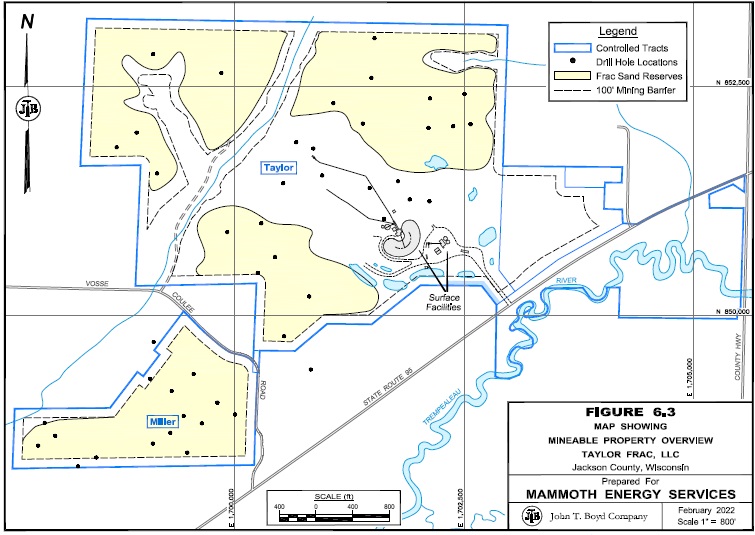
The site contains a mine with 22.1 million tons of proven recoverable proppant sand reserves as of December 31, 2025, based on estimates prepared by John T. Boyd. Our Taylor wet plant can currently process up to 2.6 million tons of wet frac sand per year. Our Taylor dry plant is adjacent to our Taylor wet plant and wash facilities. As of December 31, 2025, the dry plant had a rated production capacity of 2.2 million tons per year. Our current air permit allows us to produce up to 2.2 million tons per year of finished product. The Taylor facility includes a 150 ton per hour natural gas fluid bed dryer and a 100 ton per hour natural gas fluid bed dryer as well as nine high-capacity screeners that are capable of producing 2.2 million tons of frac sand per year. During the year ended December 31, 2025, our Taylor facility produced 0.5 million tons of finished sand product. Our finished product is transported via truck to our transloading facility with rail access.
We estimate an overall product yield (after mining and processing losses) of approximately 73% for the Taylor mine. John T. Boyd utilized post December 31, 2017 production data we provided, along with the John T. Boyd January 2019 Report amending the resource tons as of December 31, 2017, to reconcile the amended estimate from the December 31, 2017 estimate to December 31, 2025. The following table presents a summary of our mineral reserves for the Taylor mine as of December 31, 2025, together with a comparison to the reserves as of the end of the preceding fiscal year and an explanation of any material changes.
Taylor Mine – Summary of Reserves(1)(2) (Thousands of Tons)
| | | | | | | | | | | | | | | | | | | | | | | |
| | Amount as of | | | |
| Reserves Category | | December 31, 2025 | | December 31, 2024 | | Change | % Change |
| Proven | | 22,113 | | | 22,633 | | | (520) | | (2) | % |
1.Pricing data based on the weighted average projected sales price for sand of $20.84 per ton.
2.John T. Boyd has determined that all reportable mineral resources for the Taylor mine are categorized as proven reserves as the area is well explored and exhibit acceptable drill hole data spacing to be classified as a measured resource.
3.
The decrease from 2024 to 2025 is primarily attributed to depletion by mining 0.5 million tons of sand.
Muskie. Our Muskie facility is located in Plum City, Wisconsin and encompass a total of approximately 40 acres. Although this plant is currently idled, our Muskie wet plant can process up to 1.3 million tons of wet sand per year. The site includes an indoor facility capable of washing sand year-round and an enclosed dry plant facility that has a rated production capacity of 2,400 tons per day. Our current air permit allows us to produce up to 0.9 million tons per year of finished product. The facility has a 100 ton per hour natural gas fired fluid bed dryer as well as six high-capacity screeners that are capable of producing 0.9 million tons per year. As a result of adverse market conditions, production at our Muskie facility has been idled since September 2018 and was subsequently sold in January 2026. When operating, our finished product is transported via truck to a third-party facility with rail access. The site does not contain any proppant sand reserves. Our Muskie facility commenced operations in 2012. Muskie was contributed to Mammoth in November 2014. As of December 31, 2025, the real property and fixed assets associated with the Muskie operation had no remaining carrying value.
Headquarters
Our corporate headquarters are located at 14201 Caliber Drive, Suite 300, Oklahoma City, Oklahoma 73134. We currently own 5 properties, one located in Wisconsin, three located in Ohio and one located in Texas, which are used for field offices, yards, production plants or housing. In addition to our headquarters, we also lease 6 properties that are used for field offices, yards or transloading facilities for frac sand. We believe that our facilities are adequate for our current operations.
Item 3. Legal Proceedings
We are a party to, or the subject of, certain investigations and legal proceedings discussed elsewhere in this annual report. For a description of such investigations and legal proceedings, see Note 18. “Commitments and Contingencies” to our consolidated financial statements included elsewhere in this annual report.
In addition, due to the nature of our business, we are, from time to time, involved in routine litigation or subject to disputes or claims related to our business activities, including workers’ compensation claims and employment related disputes.
Except as described in Note 18. “Commitments and Contingencies” to our consolidated financial statements included elsewhere in this annual report, and in Item 1A. “Risk Factors”, in the opinion of our management, none of the pending litigation, disputes or claims against us, if decided adversely, will have a material adverse effect on our business, financial condition, results of operations or cash flows.
Item 4. Mine Safety Disclosures
Our operations are subject to the Federal Mine Safety and Health Act of 1977, as amended by the Mine Improvement and New Emergency Response Act of 2006, which imposes stringent health and safety standards on numerous aspects of mineral extraction and processing operations, including the training of personnel, operating procedures, operating equipment and other matters. Our failure to comply with such standards, or changes in such standards or the interpretation or enforcement thereof, could have a material adverse effect on our business and financial condition or otherwise impose significant restrictions on our ability to conduct mineral extraction and processing operations. Following passage of The Mine Improvement and New Emergency Response Act of 2006, MSHA significantly increased the numbers of citations and orders charged against mining operations. The dollar penalties assessed for citations issued has also increased in recent years. Information concerning mine safety violations or other regulatory matters required by Section 1503(a) of the Dodd-Frank Wall Street Reform and Consumer Protection Act and Item 104 of Regulation S-K (17 CFR 229.104) is included in Exhibit 95.1 to this Report.
PART II. OTHER INFORMATION
Item 5. Market for Registrant’s Common Equity, Related Stockholder Matters and Issuer Purchases of Equity Securities.
Market Information and Holders of Record
Our common stock is traded on the Nasdaq Global Select Market under the symbol “TUSK.” As of the close of business on March 3, 2026, there were 106 holders of record of our common stock. The number of holders of record of our common stock is not representative of the number of beneficial holders because many of the shares are held by depositories, brokers or nominees.
Unregistered Sales of Equity Securities
None.
Issuer Purchases of Equity Securities
On August 10, 2023, our board of directors approved a stock repurchase program pursuant to which we would be authorized to repurchase up to the lesser of $55 million or 10 million shares of its common stock, subject to the factors discussed below. Following the completion of the refinancing transactions discussed in this report, any stock repurchases under this program may be made opportunistically from time to time in open market or privately negotiated transactions in compliance with Rule 10b-18 under the Securities Act of 1934, as amended, including any 10b5-1 plan, and will be subject to market conditions, applicable legal and contractual restrictions, liquidity requirements and other factors. The repurchase program has no time limit, does not require us to repurchase any specific number of shares and may be suspended from time to time, modified or discontinued by our board of directors at any time. Any common stock repurchased as part of such stock repurchase program will be cancelled and retired. We have not repurchased any shares of our common stock under the stock repurchase program as of December 31, 2025 or to date. See also Item 1A. “Risk Factors--Our ability to repurchase stock may be limited and no assurance can be given that we will be able to effectuate our stock repurchase program in the future at indicated levels or at all.”
Dividends
Our board of directors’ determination with respect to any future dividends will depend upon our profitability and financial condition, contractual restrictions, restrictions imposed by applicable law and other factors that the board deems relevant at the time of such determination. Based on its evaluation of these factors, the board of directors may determine not to declare a dividend, or declare dividends at rates that are less than currently anticipated.
Item 6. [Reserved]
Item 7. Management’s Discussion and Analysis of Financial Condition and Results of Operations
The following discussion and analysis should be read in conjunction with the consolidated financial statements and related notes included elsewhere in this Annual Report on Form 10-K. This discussion contains forward-looking statements reflecting our current expectations, estimates and assumptions concerning events and financial trends that may affect our future operating results or financial position. Actual results and the timing of events may differ materially from those contained in these forward-looking statements due to a number of factors, including those discussed in Item 1A. “Risk Factors” and the section entitled “Forward-Looking Statements” appearing elsewhere in this annual report.
Overview
We are an integrated, growth-oriented services company focused on providing products and services to our customers primarily in the oil and natural gas, aviation and utility infrastructure industries. Our primary business objective is to drive returns through improved execution by prioritizing asset utilization, margin expansion, and capital efficiency across the portfolio. Our suite of services includes rental services, infrastructure services, natural sand proppant services, accommodation services and drilling services. Our rental services segment provides a wide range of equipment used in oilfield, construction and aviation activities. Our infrastructure services division provides engineering, design, construction, upgrade, maintenance and repair services to the fiber industry. Our natural sand proppant services division mines, processes and sells natural sand proppant used for hydraulic fracturing. Our drilling services provides directional drilling to oilfield operators. We believe that the services we offer play a critical role in increasing the ultimate recovery and present value of production streams from unconventional resources as well as in constructing and improving fiber networks. Our complementary suite of services provides us with the opportunity to cross-sell our services and expand our customer base and geographic positioning.
We continue to focus on growing our rental business. We believe our portfolio of aviation assets provides an attractive form of aviation asset financing for operators that allows capital deployment and fleet flexibility while eliminating residual value risk for the operators.
Our revenues, operating (loss) income and identifiable assets are attributable to five reportable segments: rental services; infrastructure services; natural sand proppant services; accommodation services; and drilling services. Following changes to our reportable segments resulting from divestitures completed in 2025, prior‑year segment information for the year ended December 31, 2024 has been recast to align with the current period segment presentation. Since the dates presented below, we have conducted our operations through the following entities:
Rental Services Segment
•Mammoth Equipment Leasing LLC—November 2016
•Stingray Energy Services LLC, or Stingray Energy Services—June 2017
•Dire Wolf Energy Services LLC—January 2018
•Cobra Aviation Services LLC—January 2018
•Predator Aviation LLC—April 2019
•Leopard Aviation LLC—April 2019
Infrastructure Services Segment
•Falcon Fiber Solutions LLC—May 2021
Natural Sand Proppant Services Segment
•Muskie Proppant LLC—September 2011
•Piranha Proppant LLC—May 2017
•Sturgeon Acquisitions LLC—June 2017
•Taylor Frac, LLC—June 2017
•Taylor Real Estate Investments, LLC—June 2017
•South River Road, LLC—June 2017
Accommodation Services Segment
•Great White Sand Tiger Lodging Ltd.—October 2007
Drilling Services Segment
•Panther Drilling Systems LLC—December 2012
Other
•Bison Drilling and Field Services, LLC—November 2010
•Bison Trucking—August 2013
•Mammoth Energy Services Inc.—June 2016
•Mammoth Energy Partners, LLC—October 2016
•Cobra Acquisitions LLC, or Cobra—January 2017
•Mako Acquisitions LLC—March 2017
•Tiger Shark Logistics LLC—October 2017
•Black Mamba Energy LLC—March 2018
•Stingray Cementing and Acidizing LLC, formerly RTS Energy Services LLC—June 2018
•Orca Energy Services LLC—December 2024
2025 Financial Overview and Highlights
•Net loss from continuing operations of $63.8 million, or $1.32 per diluted share, for the year ended December 31, 2025 as compared to net loss from continuing operations of $183.1 million, or $3.81 per diluted share, for the year ended December 31, 2024. Net loss for the year ended December 31, 2024 includes a non-cash, pre-tax charge of approximately $170.7 million, of which $89.2 million was charged to credit loss expense and $81.5 million was charged to interest on delinquent accounts receivable in relation to the Settlement Agreement with PREPA.
•Adjusted EBITDA from continuing operations of ($17.4) million for the year ended December 31, 2025 as compared to ($171.2) million for the year ended December 31, 2024. See “Non-GAAP Financial Measures” below for a reconciliation of net loss from continuing operations to Adjusted EBITDA from continuing operations. Adjusted EBITDA from continuing operations for the year ended December 31, 2024 includes a non-cash, pre-tax charge of approximately $170.7 million, of which $89.2 million was charged to credit loss expense and $81.5 million was charged to interest on delinquent accounts receivable in relation to the Settlement Agreement with PREPA.
Overview of Our Industries
Aircraft Industry
The operating environment for the lease of aircraft and aircraft assets is currently favorable. Factors such as population growth as well as improved global economic health and development are positively influencing both passenger and freight demand. In addition, factors and trends including OEM supply chain challenges and backlogs, the financing needs of airlines and the availability of maintenance facilities as well as repair timelines may increase the demand for our aircraft and aircraft assets.
Oil and Natural Gas Industry
The oil and natural gas industry has traditionally been volatile and is influenced by a combination of long-term, short-term and cyclical trends, including the domestic and international supply and demand for oil and natural gas, current and expected future prices for oil and natural gas and the perceived stability and sustainability of those prices, production depletion rates and the resultant levels of cash flows generated and allocated by exploration and production companies to their drilling, completion and related services and products budgets. The oil and natural gas industry is also impacted by general domestic and international economic conditions, political instability in oil producing countries, government regulations (both in the United States and elsewhere), levels of customer demand, the availability of pipeline capacity, storage capacity, shortages of equipment and materials and other conditions and factors that are beyond our control.
Demand for most of our oil and natural gas products and services depends substantially on the level of expenditures by companies in the oil and natural gas industry. The levels of capital expenditures of our customers are driven by many factors, including the prices of oil and natural gas. Throughout 2025 and 2024, we experienced challenges in our oil and gas businesses as a result of a generally declining rig count combined with elevated oil and natural gas production in the U.S. We expect 2026 activity to remain steady during the first half of the year with potential for upside in the back half of the year. Positive trends that may contribute to increased activity will come from LNG export capacity coming online and general electricity and power demand enhancements. We will be strategically positioned to capitalize on this anticipated demand if and when it ramps up.
Natural Sand Proppant Industry
Increased demand from oil and gas companies in 2022 resulted in higher demand and pricing for our sand compared to 2021, which continued throughout the first quarter of 2023. Demand for our natural sand proppant was adversely impacted in the second quarter of 2023 by the wildfires in Canada, which hindered our ability to transport sand. As discussed above, pricing for crude oil and natural gas declined from levels seen in 2022, which slowed down completion activities and adversely impacted demand for our sand proppant services in the second half of 2023. Activity remained suppressed throughout 2024 and 2025. As discussed above, we expect 2026 activity to be relatively steady, with the potential for moderate upside compared to 2025 driven by increases in natural gas demand to support power demand and LNG exports.
Our proppant sand reserves consist of Northern White silica sand, giving us access to a range of high-quality sand grades meeting or exceeding all API specifications, including a mix between concentrations of coarse grades (20/40 and 30/50 mesh size) and finer grades (40/70 and 100 mesh size). Our sample boring data and our historical production data have indicated that our reserves contain deposits of approximately 60% 40 mesh size or finer substrate. The coarseness and conductivity of Northern White frac sand significantly enhances recovery of oil and liquids-rich gas by allowing hydrocarbons to flow more freely than is sometimes possible with native sand. The low acid-solubility increases the integrity of Northern White frac sand relative to other proppants with higher acid-solubility, especially in shales where hydrogen sulfide and other acidic chemicals are co-mingled with the targeted hydrocarbons. In addition, its crush resistant properties enable Northern White frac sand to be used in deeper drilling applications than the frac sand produced from many native mineral deposits.
We believe that the coarseness, conductivity, sphericity, acid-solubility, and crush-resistant properties of our Northern White sand reserves and our facilities’ connectivity to rail and other transportation infrastructure afford us a cost advantage over many of our competitors and make us one of a select group of sand producers capable of delivering high volumes of frac sand that is optimal for oil and natural gas production to all major unconventional resource basins currently producing throughout North America.
Infrastructure Industry
The infrastructure industry involves the construction and maintenance of fiber networks. Demand for our services is driven by artificial intelligence (“AI”) and data center projects.
Certain barriers to entry exist in the markets in which we operate, including adequate financial resources, technical expertise, high safety ratings and a proven track record of operational success. We compete based upon our industry experience, technical expertise, financial and operational resources, geographic presence, industry reputation, safety record and customer service. While we believe our customers consider a number of factors when selecting a service provider, they generally award most of their work through a bid process. Consequently, price is often a principal factor in determining which service provider is selected.
We believe that AI and high-performance computing will drive the upgrade and overbuild of fiber networks in order to increase data capacity. Funding for projects in the infrastructure space remains strong with added opportunities since the Infrastructure Investment and Jobs Act ("IIJA") was signed into law on November 15, 2021. Federal and state agencies continue to implement multi‑year funding programs established under the IIJA, including substantial investments through Broadband Equity, Access and Deployment ("BEAD") program. These programs continue to support planned investment in broadband, utility, transportation, and clean‑energy projects. Although these programs were enacted several years ago, the implementation and distribution of funds remain ongoing and are expected to continue well into the latter half of the decade. Market participants across telecommunications, power, and energy‑transition sectors have announced substantial capital plans aligned with these programs, supported by federal incentives and growing private‑sector investment in areas such as fiber deployment, grid modernization, electrification, and data‑center‑related power demand.
Settlement Agreement with PREPA
Since we commenced operations in this line of business, a substantial portion of our infrastructure revenue has been generated from storm restoration work, primarily from the Puerto Rico Electric Power Authority, or PREPA, due to damage caused by Hurricane Maria. On October 19, 2017, Cobra Acquisitions LLC, or Cobra, and PREPA entered into an emergency master services agreement for repairs to PREPA’s electrical grid. The one-year contract, as amended, provided for payments of up to $945 million. On May 26, 2018, Cobra and PREPA entered into a second one-year, $900 million master services agreement to provide additional repair services and begin the initial phase of reconstruction of the electrical power system in Puerto Rico. Our work under each of the contracts with PREPA ended on March 31, 2019. PREPA is currently subject to
bankruptcy proceedings, which were filed in July 2017 and are currently pending in the United States District Court for the District of Puerto Rico (the “Title III Court”). As a result, PREPA’s ability to meet its payment obligations under the above-referenced agreements was largely dependent upon funding from the Federal Emergency Management Agency (“FEMA”) or other sources. Since September 30, 2019, Cobra has been pursuing litigation in the Title III Court and other dispute resolution efforts seeking recovery of the amounts owed to Cobra by PREPA for restoration services in Puerto Rico, which proceedings are discussed in more detail in the Company’s prior reports filed with the SEC. PREPA was holding approximately $18.4 million in funds (the “Withheld FEMA Funds”) received from FEMA and considered payable to Cobra but had been withheld due to garnishments asserted by three Puerto Rican municipalities (the “Specified Municipalities”) for certain municipal tax claims discussed in Mammoth’s filings with the SEC (the “Specified Municipal Tax Claims”) and for which Cobra disputed any valid garnishment.
On July 22, 2024, Cobra entered into a release and settlement agreement with PREPA and the FOMB, in its capacity as Title III representative for PREPA, to settle all outstanding matters between Cobra and PREPA (the “Settlement Agreement”). Under the terms of the Settlement Agreement, Cobra was allowed an administrative expense claim against PREPA of $170.0 million, plus the $18.4 million in the Withheld FEMA Funds. Cobra’s allowed claim will be paid through three installments: (i) $150.0 million on the later of (A) ten business days following approval of the Settlement Agreement by the Title III Court and (B) August 31, 2024; (ii) $20.0 million within seven days following the effective date of PREPA’s plan of adjustment; and (iii) $18.4 million (subject to providing one or more indemnity letters of credit) in the Withheld FEMA Funds within either (A) ten business days after the deadline for appealing the entry of the settlement order by the Title III Court under the applicable bankruptcy rules of procedure if no such appeal is filed, or (B) if the provisions of the settlement order allowing PREPA to release the Withheld FEMA Funds to Cobra without retaining any liability to the Specified Municipalities are appealed by the Specified Municipalities, within ten business days of the filing of the notice of such appeal.
The Settlement Agreement was approved by the Company’s Board of Directors on July 22, 2024, and was also approved by the PREPA Board and by the FOMB. On September 18, 2024, the Settlement Agreement was approved by the Title III Court overruling all objections thereto and an order was entered the same day (the “Settlement Order”). On October 1, 2024, Cobra received the first installment payment of $150.0 million from the Commonwealth of Puerto Rico in connection with the Settlement Agreement with PREPA. Also on October 1, 2024, certain Puerto Rico municipalities and Foreman Electric Services Inc. that had objected to approval of the Settlement Order each filed timely notices of appeal of the Settlement Order to the United States Court of Appeals for the First Circuit. None of the foregoing parties have sought a stay of the Settlement Order pending such appeals. Although the ultimate outcome of these appeals cannot be predicted with certainty, Cobra believes that the appeals are without merit.
On October 18, 2024, Cobra received a payment from PREPA totaling $18.4 million under the terms of the Settlement Agreement. In connection with the receipt of the $18.4 million from PREPA, Cobra instructed Fifth Third Bank, National Association (“Fifth Third Bank”) to issue a letter of credit to PREPA under the Reimbursement Agreement in the amount of $18.4 million and transferred a total of $19.3 million to a restricted cash account maintained by Fifth Third Bank as collateral for the letter of credit.
As a result of the Settlement Agreement, the Company recorded a non-cash, pre-tax charge of approximately $170.7 million in the second quarter of 2024 to reduce its accounts receivable balance from PREPA of $359.1 million, representing the amount owed to Cobra by PREPA in relation to these agreements as of June 30, 2024, including the accrued but unpaid interest, prior to the Settlement Agreement, to the amount expected to be received from the Settlement Agreement. Of the $170.7 million, $89.2 million was charged to credit loss expense, which is included in “selling, general and administrative” on the consolidated statements of comprehensive income (loss), and $81.5 million was charged to interest on delinquent accounts receivable, which is included in “other (expense) income, net” on the consolidated statements of comprehensive income (loss). As of December 31, 2025, $20.0 million remained outstanding from PREPA. See Note 2. “Summary of Significant Accounting Policies—Accounts Receivable” and Note 18. “Commitments and Contingencies—Litigation” to our consolidated financial statements included elsewhere in this annual report for more information.
Results of Operations
The following discussion focuses on a comparison of the results of operations between the years ended December 31, 2025 and 2024.
| | | | | | | | | | | |
| Years Ended |
| December 31, 2025 | | December 31, 2024 |
| Revenue: | (in thousands) |
| Rental services | $ | 11,098 | | | $ | 7,105 | |
| Infrastructure services | 4,086 | | | 1,476 | |
| Natural sand proppant services | 16,552 | | | 19,057 | |
| Accommodation services | 8,954 | | | 10,851 | |
| Drilling services | 3,675 | | | 3,558 | |
| Other services | — | | | 3,950 | |
| Eliminations | (73) | | | (398) | |
| Total revenue | 44,292 | | | 45,599 | |
| | | |
| Cost of revenue: | | | |
| Rental services (exclusive of depreciation and amortization of $3,738 and $1,155, respectively, for 2025 and 2024) | 6,701 | | | 4,955 | |
| Infrastructure services (exclusive of depreciation and amortization of $221 and $170, respectively, for 2025 and 2024) | 5,893 | | | 2,280 | |
| Natural sand proppant services (exclusive of depreciation, depletion and accretion of $4,106 and $5,228, respectively, for 2025 and 2024) | 18,117 | | | 17,791 | |
| Accommodation services (exclusive of depreciation and amortization of $1,072 and $1,134, respectively, for 2025 and 2024) | 5,951 | | | 6,397 | |
| Drilling services (exclusive of depreciation and amortization of $91 and $145, respectively, for 2025 and 2024) | 3,765 | | | 4,373 | |
| Other services (exclusive of depreciation and amortization of $1,064 and $3,883, respectively, for 2025 and 2024) | 2,209 | | | 7,137 | |
| Eliminations | (73) | | | (398) | |
| Total cost of revenue | 42,563 | | | 42,535 | |
| Selling, general and administrative expenses | 19,572 | | | 114,468 | |
| Depreciation, depletion, amortization and accretion | 10,292 | | | 11,715 | |
| Gains on disposal of assets, net | (2,371) | | | (2,762) | |
| | | |
| Impairment of long-lived assets | 31,669 | | | — | |
| Operating loss | (57,433) | | | (120,357) | |
| Interest income (expense and financing charges), net, inclusive of related parties | 1,670 | | | (9,497) | |
| Other expense, net | (3,906) | | | (64,564) | |
| Loss before income taxes | (59,669) | | | (194,418) | |
| (Benefit) provision for income taxes | 4,087 | | | (11,306) | |
| Net loss from continuing operations | $ | (63,756) | | | $ | (183,112) | |
| Net income (loss) from discontinued operations, net of income taxes | $ | 68,353 | | | $ | (24,214) | |
| Net income (loss) | $ | 4,597 | | | $ | (207,326) | |
Revenue. Revenue for 2025 decreased $1.3 million, or 3%, to $44.3 million from $45.6 million for 2024. The decline in total revenue is primarily attributable to decreases in revenue for other services, natural sand proppant services, and accommodation services, which was partially offset by an increase in revenue for rental services, infrastructure services, and
drilling services. Revenue derived from related parties was $1.6 million for 2025 compared to $1.5 million for 2024. Revenue by division was as follows:
Rental Services. Rental services division revenue increased $4.0 million, or 56%, to $11.1 million for 2025 from $7.1 million for 2024. The increase in our rental services revenue was primarily driven by a $2.5 million increase in aviation rental revenue, combined with a 29% increase in equipment rental revenue.
Infrastructure Services. Infrastructure services division revenue increased $2.6 million or 173%, to $4.1 million for 2025 from $1.5 million for 2024 primarily due to an increase in fiber optic revenue related to increased activity.
Natural Sand Proppant Services. Natural sand proppant services division revenue decreased $2.5 million, or 13%, to $16.6 million for 2025, from $19.1 million for 2024. The decrease in our natural sand proppant services revenue was primarily attributable to a 12% decrease in average price per ton of sand sold from $23.15 in 2024 to $20.43 in 2025 primarily driven by lower completions activity by our customers, which was offset by a 12% increase in sand volumes sold.
Accommodation Services. Accommodation services revenue decreased $1.9 million, or 17%, to $9.0 million for 2025 from $10.9 million for 2024, primarily due to a decline in utilization. On average, 186 rooms were utilized in 2025 as compared to 216 in 2024 for our accommodation services.
Drilling Services. Drilling services revenue marginally increased $0.1 million or 3% to $3.7 million for 2025 from $3.6 million for 2024, primarily due to a favorable shift in job mix toward higher value horizontal drilling activity, which offset decreased directional drilling activity.
Other Services. Other services revenue declined $3.9 million in 2025. This decrease was primarily related to our water transfer services, which were shut down during the third quarter of 2024, and our crude oil hauling services, which were idled at the beginning of 2025.
Cost of Revenue (exclusive of depreciation, depletion, amortization and accretion expense). Cost of revenue, exclusive of depreciation, depletion, amortization and accretion expense, marginally increased from $42.5 million, or 93% of total revenue, for 2024 to $42.6 million, or 96% of total revenue, for 2025. Cost of revenue by operating division was as follows:
Rental Services. Rental services division cost of revenue, exclusive of depreciation and amortization expense, increased $1.7 million, or 34%, from $5.0 million for 2024 to $6.7 million for 2025 primarily due to an increase in average equipment utilization. As a percentage of revenue, our rental services division cost of revenue, exclusive of depreciation and amortization expense of $3.7 million in 2025 and $1.2 million in 2024, was 60% and 70%, for 2025 and 2024, respectively. The decrease as a percentage of revenue is primarily due to higher equipment utilization as well as higher margins associated with aviation rentals as compared to equipment rentals, resulting in improved absorption of fixed operating costs.
Infrastructure Services. Infrastructure services division cost of revenue, exclusive of depreciation and amortization expense, increased $3.6 million from $2.3 million for 2024 to $5.9 million for 2025. As a percentage of revenue, cost of revenue, exclusive of depreciation and amortization expense of $0.2 million in 2025 and 2024, was 144% and 153% for 2025 and 2024, respectively. The decrease as a percentage of revenue is primarily due to an increase in contract labor costs as a percentage of revenue.
Natural Sand Proppant Services. Natural sand proppant services division cost of revenue, exclusive of depreciation, depletion and accretion expense, increased $0.3 million, or 2%, from $17.8 million for 2024 to $18.1 million for 2025. As a percentage of revenue, cost of revenue, exclusive of depreciation, depletion and accretion expense of $4.1 million in 2025 and $5.2 million in 2024, was 109% and 93%, for 2025 and 2024, respectively. The increase in cost as a percentage of revenue is primarily due to a 12% decrease in average sales price and a 12% increase in tons of sand sold.
Accommodation Services. Accommodation services cost of revenue, exclusive of depreciation and accretion, decreased $0.4 million, or 6%, to $6.0 million for 2025 from $6.4 million in 2024. As a percentage of revenue, cost of revenue, exclusive of depreciation and accretion of $1.1 million for 2025 and 2024, was 67% and 59% for 2025 and
2024, respectively. The increase as a percentage of revenue is primarily due to a decline in utilization, resulting in a higher ratio of fixed costs to variable costs.
Drilling Services. Drilling services cost of revenue, exclusive of depreciation, decreased $0.6 million, or 14%, to $3.8 million for 2025 from $4.4 million for 2024. As a percentage of revenue, cost of revenue, exclusive of depreciation of $0.1 million for 2025 and 2024, was 103% and 122% for 2025 and 2024, respectively. The decrease as a percentage of revenue is primarily due to an improvement in pricing.
Other Services. Other services cost of revenue, exclusive of depreciation and amortization expense, was $2.2 million for 2025 and $7.1 million in 2024, respectively. In 2024, cost of revenue, exclusive of depreciation and amortization, was 182% of revenue, and depreciation and amortization expense was $3.9 million. In 2025, no revenue was generated and depreciation and amortization expense was $1.1 million; the cost decrease was primarily due to decreased utilization, resulting in a higher proportion of fixed operating costs.
Selling, General and Administrative Expenses. Selling, general and administrative expenses, or SG&A, represent the costs associated with managing and supporting our operations. SG&A expense decreased $94.9 million, or 83%, to $19.6 million for the year ended December 31, 2025, from $114.5 million for the year ended December 31, 2024 primarily due to a decrease in the provision for expected credit losses in connection with the Settlement Agreement with PREPA that was recognized in 2024.
Depreciation, Depletion, Amortization and Accretion. Depreciation, depletion, amortization and accretion decreased $1.4 million, or 12%, to $10.3 million for 2025 from $11.7 million in 2024. The decrease is primarily due to a decline in property and equipment depreciation expense as a result of lower capital expenditures and existing assets being fully depreciated.
Gains on Disposal of Assets, Net. Gains on the disposal of assets decreased $0.4 million, or 14%, to $2.4 million for 2025 from $2.8 million in 2024. Gains on the disposal of assets are primarily related to the sale of down-hole tools, trucks, and field equipment for the year ended December 31, 2025, and primarily related to the sale of dormitories, trucks and field equipment for the year ended December 31, 2024.
Impairment of long-lived assets. The Company’s management made the decision to market assets related to is natural sand proppant operations at its Piranha Proppant LLC and Muskie Proppant LLC processing plants. As a result, the Company recognized impairment expense on these assets totaling $31.7 million in 2025. There was no similar activity for the year ended December 31, 2024.
Operating Loss. We reported an operating loss of $57.4 million for 2025 compared to $120.4 million for 2024. The decreased operating loss was primarily due to an $89.2 million charge to selling, general and administrative expenses recognized during the year ended December 31, 2024 in relation to the Settlement Agreement with PREPA. The decreased loss was coupled with increased utilization in our rental services divisions and reduction in total cash selling, general and administrative expense.
Interest income (expense and financing charges), net. Interest income, net of interest expense and financing charges was $1.7 million for the year ended December 31, 2025 compared to interest expense and financing charges, net of $9.5 million for the year ended December 31, 2024. The increase is primarily due to a $5.5 million financing charge incurred during the year ended December 31, 2024, in relation to the Assignment Agreement with SPCP Group coupled with a decline in interest expense on long term debt. See “—Liquidity and Capital Resources—Cobra Assignment Agreement” for additional information.
Other (Expense) Income, net. We recognized other expense, net of $3.9 million during the year ended December 31, 2025 compared to other income, net of $64.6 million for the year ended December 31, 2024. During the year ended December 31, 2024, we recognized interest on delinquent accounts receivable totaling $20.8 million in relation to our outstanding receivable with PREPA. In July 2024, Cobra entered into the Settlement Agreement with PREPA resulting in a charge to interest on delinquent accounts receivable totaling $81.5 million during the year ended December 31, 2024 to reduce its accounts receivable balance to the amount expected to be collected in relation to interest charged to PREPA.
Income Taxes. During 2025, we recorded income tax benefit of $4.1 million on pre-tax loss of $59.7 million compared to income tax expense of $11.3 million on pre-tax income of $194.4 million for 2024. Our effective tax rate was (6.8)% for 2025 compared to 5.8% for 2024. The effective tax rates for the years ended December 31, 2025 and 2024 differed from the statutory rate of 21% primarily due to the mix of earnings between the United States and Puerto Rico, changes in the
valuation allowance and interest and penalties. See Note 12. “Income Taxes” to our consolidated financial statements included elsewhere in this annual report for additional detail regarding our change in tax expense.
Discontinued Operations. We recorded net income from discontinued operations, net of income taxes totaling $68.4 million during the year ended December 31, 2025 compared to a net loss from discontinued operations, net of income taxes of $24.2 million for the year ended December 31, 2024. See Note 3 of the notes to our consolidated financial statements for a breakout of the results of operations for our discontinued operations.
Non-GAAP Financial Measures
Adjusted EBITDA from Continuing Operations
Adjusted EBITDA from continuing operations is a supplemental non-GAAP financial measure that is used by management and external users of our financial statements, such as industry analysts, investors, lenders and rating agencies. We define Adjusted EBITDA from continuing operations as net loss from continuing operations before depreciation, depletion, amortization and accretion, gains on disposal of assets, net, impairment of goodwill, stock based compensation, interest expense and financing charges, net, other expense (income), net (which is comprised of interest on trade accounts receivable and certain legal expenses) and (benefit) provision for income taxes, further adjusted to add back interest on trade accounts receivable. We exclude the items listed above from net loss from continuing operations in arriving at Adjusted EBITDA from continuing operations because these amounts can vary substantially from company to company within our industries depending upon accounting methods and book values of assets, capital structures and the method by which the assets were acquired. Adjusted EBITDA from continuing operations should not be considered as an alternative to, or more meaningful than, net loss from continuing operations or cash flows from operating activities as determined in accordance with GAAP or as an indicator of our operating performance or liquidity. Certain items excluded from Adjusted EBITDA from continuing operations are significant components in understanding and assessing a company’s financial performance, such as a company’s cost of capital and tax structure, as well as the historic costs of depreciable assets, none of which are components of Adjusted EBITDA from continuing operations. Our computations of Adjusted EBITDA from continuing operations may not be comparable to other similarly titled measures of other companies. We believe that Adjusted EBITDA from continuing operations is a widely followed measure of operating performance and may also be used by investors to measure our ability to meet debt service requirements.
The following tables provide a reconciliation of Adjusted EBITDA from continuing operations to net loss from continuing operations, the most directly comparable GAAP financial measure for the specified periods (in thousands):
Consolidated
| | | | | | | | | | | |
| Years Ended December 31, |
| Reconciliation of net loss from continuing operations to Adjusted EBITDA from continuing operations: | 2025 | | 2024 |
| Net loss from continuing operations | $ | (63,756) | | | $ | (183,112) | |
| Depreciation, depletion, amortization and accretion | 10,292 | | | 11,715 | |
| Gains on disposal of assets, net | (2,371) | | | (2,762) | |
| | | |
| Impairment of long-lived assets | 31,669 | | | — | |
| | | |
| | | |
| | | |
| | | |
| Stock based compensation | 412 | | | 875 | |
| Interest expense and financing charges, net | (1,670) | | | 9,497 | |
| Other expense, net | 3,906 | | | 64,564 | |
| (Benefit) provision for income taxes | 4,087 | | | (11,306) | |
| Interest on trade accounts receivable | — | | | (60,686) | |
| Adjusted EBITDA from continuing operations | $ | (17,431) | | | $ | (171,215) | |
Adjusted Net Loss from Continuing Operations and Adjusted Loss per Share from Continuing Operations
Adjusted net loss from continuing operations and adjusted basic and diluted loss per share from continuing operations are supplemental non-GAAP financial measures that are used by management to evaluate our operating and financial performance. Management believes these measures provide meaningful information about the Company’s performance by excluding certain non-cash charges, such as impairment of long-lived assets, which may not be indicative of the Company’s ongoing operating results, from net loss from continuing operations. Adjusted net loss from continuing operations and adjusted loss per share from continuing operations should not be considered in isolation or as a substitute for net loss from continuing operations and loss per share from continuing operations prepared in accordance with GAAP and may not be comparable to other similarly titled measures of other companies. The following tables provide a reconciliation of adjusted net loss from continuing operations and adjusted loss per share from continuing operations to the GAAP financial measures of net loss from continuing operations and loss per share from continuing operations for the periods specified.
| | | | | | | | | | | | | |
| Years Ended December 31, |
| 2025 | | 2024 | | |
| (in thousands, except per share amounts) |
| Net loss from continuing operations, as reported | $ | (63,756) | | | $ | (183,112) | | | |
| | | | | |
| Impairment of long-lived assets | 31,669 | | | — | | | |
| | | | | |
| Adjusted net loss from continuing operations | $ | (32,087) | | | $ | (183,112) | | | |
| | | | | |
| Basic and diluted earnings per share from continuing operations, as reported | $ | (1.32) | | | $ | (3.81) | | | |
| | | | | |
| Impairment of long-lived assets | 0.66 | | — | | | |
| | | | | |
| Adjusted basic and diluted earnings per share from continuing operations | $ | (0.66) | | | $ | (3.81) | | | |
| | | | | |
| | | | | |
| | | | | |
| | | | | |
| | | | | |
| | | | | |
Liquidity and Capital Resources
We require capital to fund ongoing operations including maintenance expenditures on our existing fleet of equipment, organic growth initiatives, investments and acquisitions, and the litigation settlement obligations described in Note 18. “Commitments and Contingencies” to our consolidated financial statements included elsewhere in this annual report and under “Capital Requirements and Sources of Liquidity” below. Our primary sources of liquidity have been cash on hand, borrowings under our revolving credit facility and cash flows from operations, as well as the net proceeds received by Cobra under the assignment agreement with SPCP Group relating to the PREPA receivable. Our primary uses of capital have been for investing in property, plant and equipment used to provide our services and to acquire complementary businesses.
Liquidity
The following table summarizes our liquidity as of the dates indicated (in thousands): | | | | | | | | | | | |
| December 31, |
| 2025 | | 2024 |
| Cash and cash equivalents | $ | 101,987 | | | $ | 60,845 | |
| Revolving credit facility borrowing base | 50,000 | | | 25,162 | |
| | | |
| | | |
| | | |
| Less letter of credit facilities (environmental remediation) | (2,573) | | | (4,228) | |
| Less letter of credit facilities (insurance programs) | (2,400) | | | (3,300) | |
| | | |
| | | |
Net working capital (less cash and current portion of long-term debt)(a) | (6,940) | | | (6,124) | |
| Total | $ | 140,074 | | | $ | 72,355 | |
(a) Net working capital (less cash, cash equivalents and restricted cash) is calculated by subtracting total current liabilities, cash and cash equivalents and restricted cash from total current assets.
As of March 3, 2026, we had unrestricted cash on hand of $89.6 million, marketable securities of $28.8 million, no outstanding borrowings under our revolving credit facility and a borrowing base of $50.0 million, leaving an aggregate of $38.2
million of available borrowing capacity under this facility, after giving effect to $5.0 million of outstanding letters of credit. As of March 3, 2026, we had total liquidity of $156.6 million consisting of cash on hand and available borrowing capacity under our revolving credit facility.
Cash Flows
The following table sets forth our cash flows for the years indicated (in thousands):
| | | | | | | | | | | | | |
| December 31, | | |
| 2025 | | 2024 | | |
| Net cash (used in) provided by operating activities from continuing operations | $ | (19,575) | | | $ | 194,721 | | | |
| Net cash provided by (used in) operating activities from discontinued operations | 1,005 | | | (14,004) | | | |
| Net cash (used in) provided by investing activities from continuing operations | (82,504) | | | 3,847 | | | |
| Net cash provided by (used in) investing activities from discontinued operations | 137,050 | | | (14,279) | | | |
| Net cash used in financing activities from continuing operations | (433) | | | (98,231) | | | |
| Net cash used in financing activities from discontinued operations | (3,854) | | | (13,882) | | | |
| Effect of foreign exchange rate on cash | 109 | | | (144) | | | |
| Net increase in cash, cash equivalents and restricted cash | $ | 31,798 | | | $ | 58,028 | | | |
Operating Activities for Continuing Operations
Net cash (used in) provided by operating activities from continuing operations was ($19.6) million and $194.7 million, for the years ended December 31, 2025 and 2024, respectively. The change in operating cash flows from 2024 to 2025 was primarily due to decreased receipts on accounts receivable, including the receipt of $232.4 million from PREPA in 2024, which was partially offset by a decrease in net loss from continuing operations.
Operating Activities from Discontinued Operations
Net cash provided by (used in) operating activities from discontinued operations was $1.0 million and ($14) million, for the years ended December 31, 2025 and 2024, respectively. The change in operating cash flows from 2024 to 2025 was primarily attributable to the receipt of outstanding receivables of the discontinued entities and pressure pumping equipment.
Investing Activities from Continuing Operations
Net cash (used in) provided by investing activities from continuing operations was ($82.5) million and $3.8 million, for the years ended December 31, 2025 and 2024, respectively. Cash used in investing activities is primarily comprised of purchases of property, plant and equipment, purchases of marketable securities and proceeds from the disposal of property, plant and equipment.
The following table summarizes our capital expenditures by operating division for the periods indicated (in thousands): | | | | | | | | | |
| Years Ended December 31, |
| 2025 | 2024 | |
Rental services(a) | $ | 69,953 | | $ | 351 | | |
Infrastructure services(b) | 128 | | 299 | | |
| | | |
Accommodation services(c) | 343 | | 161 | | |
Drilling services(c) | 128 | | 184 | | |
Other(d) | — | | 219 | | |
| | | |
| Total capital expenditures | $ | 70,552 | | $ | 1,214 | | |
a. Capital expenditures primarily for purchasing aircraft and equipment to be used by our equipment rental businesses for the year ended December 31, 2025 and maintenance for the year ended December 31, 2024.
b. Capital expenditures primarily for trailer purchases for fiber optic crews for the year ended December 31, 2025 and an utility directional drill for the year ended December 31, 2024.
c. Capital expenditures primarily for maintenance and equipment for the years ended December 31, 2025 and 2024.
d. Capital expenditures primarily for maintenance for the year ended December 31, 2024.
Investing Activities from Discontinued Operations
Net cash provided by (used in) investing activities from discontinued operations was $137.1 million and $(14.3) million for the years ended December 31, 2025 and 2024, respectively. The change in net cash provided by investing activities from discontinued operations for the periods is primarily due to the sale of a portion of our infrastructure services entities and pressure pumping equipment.
Financing Activities from Continuing Operations
Net cash used in financing activities from continuing operations was $0.4 million and $98.2 million for the years ended December 31, 2025 and 2024, respectively. The decrease in net cash used in financing activities from continuing operations is primarily attributable to repayments on long-term debt - related parties of $50.9 million and payments on financing transactions of $46.8 million incurred during the year ended December 31, 2024. There was no similar activity for the year ended December 31, 2025.
Financing Activities from Discontinued Operations
Net cash used in financing activities from discontinued operations was $3.9 million and $13.9 million for the years ended December 31, 2025 and 2024, respectively. The decrease in net cash provided by investing activities from discontinued operations is primarily attributable to principal payments on financing leases and equipment financing notes and payments on sale leaseback arrangements.
Effect of Foreign Exchange Rate on Cash
The effect of foreign exchange rate on cash was $0.1 million for the year ended December 31, 2025, and ($0.1) million for the year ended December 31, 2024. The year-over-year effect was driven primarily by a favorable (unfavorable) shift in the weakness (strength) of the Canadian dollar relative to the U.S. dollar for the cash held in Canadian accounts.
Net Working Capital
Our net working capital totaled $107.1 million and $74.1 million, respectively, at December 31, 2025 and 2024. Our unrestricted cash balances totaled $102.0 million and $60.8 million, respectively, at December 31, 2025 and 2024.
Revolving Credit Facility and Term Credit Facility
On October 16, 2023, we entered into a revolving credit facility and a term credit facility (each as defined below), which refinanced in full our indebtedness outstanding under, and terminated, the amended and restated revolving credit facility, dated as of October 19, 2018, as amended (the “previous revolving credit facility”), with us and certain of our direct and indirect subsidiaries, as borrowers, the lenders party thereto from time to time, and PNC Bank, National Association, as a lender and as administrative agent for the lenders.
On October 16, 2023, we, as borrower, and certain of our direct and indirect subsidiaries, as guarantors, entered into a revolving credit agreement with the lenders party thereto and Fifth Third Bank, National Association, as a lender and as administrative agent for the lenders (“Fifth Third Bank”), as may be subsequently amended (the “revolving credit facility”). The revolving credit facility provides for revolving commitments in an aggregate amount of up to $75 million. Borrowings under the revolving credit facility are secured by our assets, inclusive of the subsidiary companies, and are subject to a borrowing base calculation prepared monthly which includes a requirement to maintain certain reserves as specified in the revolving credit facility. The revolving credit facility also contains various affirmative and restrictive covenants. Interest under the revolving credit facility equals the Tranche Rate (as defined in the revolving credit facility) plus (i) 1.75%, if the Average Excess Availability Percentage (as defined in the revolving credit facility) is greater than 66 2/3%, (ii) 2.00% if the Average Excess Availability Percentage is greater than 33 1/3% and less than or equal to 66 2/3%, and (iii) 2.25% if the Average Excess Availability Percentage is less than or equal to 33 1/3%.
As of December 31, 2025 and December 31, 2024, the financial covenant under the revolving credit facility was the fixed charge coverage ratio of 1.0 to 1.0 which applies only during the period from the date that excess availability under the revolving credit facility is less than the greater of (i) 10% of total availability under the revolving credit facility and (ii) $5 million until the date in which the excess availability is equal to the greater of (i) 10% of excess availability and (ii) $5 million
for 30 consecutive days (such period, a “Financial Covenant Period”). A Financial Covenant Period was not in effect as of each of December 31, 2025 and the filing date of this report.
On October 16, 2024, the Company entered into (i) an amendment to the revolving credit agreement (the “Credit Agreement Amendment”) and (ii) a letter of credit reimbursement agreement (the “Reimbursement Agreement”), each with Fifth Third Bank. The Credit Agreement Amendment, among other things, permits the transactions contemplated by the Reimbursement Agreement, including the issuance of one or more letters of credit to satisfy Cobra’s obligations under the Settlement Agreement relating to one or more indemnity letters of credit. The aggregate amount of all such letters of credit shall not exceed $18.4 million. Under the terms of the Reimbursement Agreement, the Company agreed to hold cash funds totaling at least 105% of the stated amount of all letters of credit in an account maintained by Fifth Third Bank and to which Fifth Third Bank has a first priority security interest.
On October 18, 2024, Cobra received a payment from PREPA totaling $18.4 million under the terms of the Settlement Agreement. In connection with the receipt of the $18.4 million from PREPA, Cobra instructed Fifth Third Bank to issue a letter of credit to PREPA under the Reimbursement Agreement in the amount of $18.4 million and transferred a total of $19.3 million to a restricted cash account maintained by Fifth Third Bank as collateral for the letter of credit.
On April 11, 2025, we entered into a second amendment to our revolving credit agreement to, among other things, do the following:
i.receive consent from Fifth Third Bank to effectuate the sale of 5 Star Electric, LLC, Higher Power Electric, LLC and Python Equipment LLC;
ii.permit the Company to repurchase up to the lesser of $50 million or 10 million shares of its common stock on or before March 31, 2026, so long as the aggregate amount of the Company’s unrestricted cash is greater than $50 million after each such repurchase;
iii.expand the Company’s investment opportunities to include equity securities and private investments; and
iv.add certain investments and qualified cash to the borrowing base calculation.
On July 2, 2025, the Company entered into a letter agreement in relation to its revolving credit facility whereby the Revolving Loan Commitments are reduced from $75.0 million to $50.0 million.
On October 16, 2023, we, as borrower, and certain of our direct and indirect subsidiaries, as guarantors, also entered into a loan and security agreement with the lenders party thereto and Wexford Capital LP, an affiliate of the Company (the “term credit facility”). The term credit facility was approved by the audit committee of our board of directors, consisting entirely of independent directors, as a transaction with a related party.
The term credit facility provided for term commitments in an aggregate amount equal to $45 million. Borrowings under the term credit facility were secured by our assets, inclusive of the subsidiary companies. The term credit facility also contained various affirmative and restrictive covenants. Interest under the term credit facility equaled the SOFR Interest Rate (as defined in the term credit facility) plus 7.50%; provided that we may elect to pay all or a portion of the accrued interest due with respect to any Interest Period (as defined in the new term credit facility) ending on or before April 16, 2025, in kind by adding such accrued interest to the principal amount of the outstanding loans thereunder.
In particular, under the term credit facility, we were required, among other things, to mandatorily remit to Wexford up to 50% of all amounts that constitute PREPA Claim Proceeds, as such term is defined in the term credit facility, which were used to reduce outstanding borrowings under the term credit facility, as required under the terms thereof. Wexford waived this requirement in connection with the Assignment Agreement and the $9.6 million received by Cobra from PREPA in February 2024.
In connection with the receipt of the first installment amount under the Settlement Agreement on October 1, 2024, the Company paid, in full, all amounts owed under the term credit facility, including the accrued and unpaid interest, in the aggregate amount of $50.9 million, and terminated the facility on October 2, 2024. In connection with the payoff of the term credit facility, Wexford waived the 1% early termination penalty.
If an event of default occurs under the revolving credit facility and remains uncured, it could have a material adverse effect on the Company’s business, financial condition, liquidity and results of operations. The lenders, as applicable, (i) would not be required to lend any additional amounts to the Company, (ii) could elect to increase the interest rate by 200 basis points, (iii) could elect to declare all outstanding borrowings, together with accrued and unpaid interest and fees, to be due and payable, (iv) may have the ability to require the Company to apply all of its available cash to repay outstanding borrowings, and (v) may
foreclose on substantially all of the Company’s assets. The revolving credit facility is currently scheduled to mature on October 16, 2028.
There were no financial covenants applicable under the revolving credit facility as of December 31, 2025 and December 31, 2024.
As of March 3, 2026, our borrowing base was $50.0 million and we had no outstanding borrowings under our revolving credit facility, leaving an aggregate of $38.2 million of available borrowing capacity, after giving effect to $5.0 million of outstanding letters of credit and the requirement to maintain the reserves specified in the revolving credit facility out of the available borrowing capacity.
Cobra Assignment Agreement
On December 1, 2023, Cobra, as seller, and Mammoth, as guarantor, entered into an assignment agreement (the “Assignment Agreement”) with SPCP Group, LLC (“SPCP Group”), as purchaser. Under the terms and conditions of the Assignment Agreement, Cobra transferred to SPCP Group, at the purchase rate of 88.0% and free and clear of any liens and claims, all of its rights, title and interest in the first $63.0 million (the “Transferred Amount”) of the total outstanding accounts receivable that remained unpaid by PREPA as of October 6, 2023 (the “PREPA Claim”), received or to be received by Cobra on or after October 6, 2023. Between October 6, 2023 and December 1, 2023, Cobra received payments from PREPA with respect to the PREPA Claim totaling $8.6 million (the “Interim Payment Amount”), resulting in the net Transferred Amount of $54.4 million.
In connection with the entry into the Assignment Agreement, Mammoth and Cobra obtained the required consents from lenders under the Company’s revolving credit facility with Fifth Third Bank and the Company’s term loan and security agreement with Wexford. Further, under the term loan and security agreement with Wexford, Mammoth was required, among other things, to mandatorily remit to Wexford up to 50% of all amounts that constitute PREPA Claim proceeds, including the proceeds received by Cobra under the Assignment Agreement, to reduce outstanding borrowings under such term loan and security agreement. In connection with the Assignment Agreement, Wexford waived this requirement.
The net proceeds received by Cobra in connection with the Assignment Agreement were $46.1 million. During the three months ended March 31, 2024, PREPA paid $64.0 million with respect to the outstanding PREPA receivable. Of the $64.0 million, $54.4 million was paid to SPCP Group, as Cobra’s assignee under the Assignment Agreement, which fully extinguished Cobra’s and Mammoth’s obligations to SPCP Group, and the Assignment Agreement was terminated.
Repurchase Program Authorization
On August 10, 2023, our board of directors approved a stock repurchase program pursuant to which we would be authorized to repurchase up to the lesser of $55 million or 10 million shares of its common stock, subject to the factors discussed below. Following the completion of the refinancing transactions discussed in this report, any stock repurchases under this program may be made opportunistically from time to time in open market or privately negotiated transactions in compliance with Rule 10b-18 under the Securities Act of 1934, as amended, including any 10b5-1 plan, and will be subject to market conditions, applicable legal and contractual restrictions, liquidity requirements and other factors. The repurchase program has no time limit, does not require us to repurchase any specific number of shares and may be suspended from time to time, modified or discontinued by our board of directors at any time. Any common stock repurchased as part of such stock repurchase program will be cancelled and retired. We have not repurchased any shares of our common stock under the stock repurchase program as of December 31, 2025 or to date. See also Item 1A. “Risk Factors--Our ability to repurchase stock may be limited and no assurance can be given that we will be able to effectuate our stock repurchase program in the future at indicated levels or at all.”
Capital Requirements and Sources of Liquidity
As we pursue our business and financial strategy, we regularly consider which capital resources are available to meet our future financial obligations and liquidity requirement. We believe that our cash on hand, including the cash payments received to date under the Settlement Agreement with PREPA, operating cash flow and available borrowings under our currently undrawn credit facility will be sufficient to meet our short-term and long-term funding requirements, including funding our current operations, planned capital expenditures, debt service obligations and known contingencies.
During the year ended December 31, 2025, our capital expenditures totaled $70.6 million, including $70.0 million in our rental service segment primarily related to purchases of aircraft and equipment for our equipment rental business, $0.1 million in our infrastructure segment primarily related to trailer purchases for fiber optic crews and $0.5 million for our other divisions primarily related to equipment additions for our remote accommodations and drilling businesses.
During 2026, we currently estimate that our aggregate capital expenditures, excluding aviation equipment, will be approximately $11 million, depending upon industry conditions and our financial results. These capital expenditures include $4 million for equipment rentals in our rental services segment, $2 million for our infrastructure services segment, $3 million for our natural sand proppant services segment, $1 million for our accommodation services segment and $1 million for our drilling services segment. Additional growth in our infrastructure division is expected to be financed through leasing arrangements.
Also, as noted above in this report, in response to market conditions and reduced demand, we have (i) temporarily shut down certain of our oilfield service offerings, including crude oil hauling, cementing, acidizing and land drilling services, (ii) idled certain facilities, including our sand processing plant in Pierce County, Wisconsin and (iii) reduced our workforce across all of our operations. We continue to monitor market conditions to determine if and when we will recommence these services and operations and increase our workforce. Any such recommencement and expansion will further increase our liquidity requirements in advance of revenue generation.
In addition, while we regularly evaluate acquisition opportunities, we do not have a specific acquisition budget for 2026 since the timing and size of acquisitions cannot be accurately forecasted. We intend to continue to evaluate acquisition opportunities, including those in the renewable energy sector as well as transactions involving entities controlled by Wexford. Our acquisitions may be undertaken with cash, our common stock or a combination of cash, common stock and/or other consideration. In the event we make one or more acquisitions and the amount of capital required is greater than the amount we have available for acquisitions at that time, we could be required to reduce the expected level of capital expenditures and/or seek additional capital.
If we seek additional capital for any of the above or other reasons, we may do so through borrowings under the revolving credit facility, joint venture partnerships, sale-leaseback transactions, asset sales, including potential sales of accounts receivable or other financing transactions, offerings of debt or equity securities or other means. Although we expect that our sources of capital will be adequate to fund our short-term and long-term liquidity requirements, we cannot assure you that this additional capital will be available on acceptable terms or at all. If we are unable to obtain funds we need, our ability to conduct operations, make capital expenditures, satisfy debt services obligations, pay litigation settlement obligations, fund contingencies and/or complete acquisitions that may be favorable to us will be impaired, which would have a material adverse effect on our business, financial condition, results of operations and cash flows.
Contractual and Commercial Commitments
The following table summarizes our contractual obligations and commercial commitments as of December 31, 2025 (in thousands): | | | | | | | | | | | | | | | | | | | | | | | | | | | | | |
| Total | | Less than 1 year | | 1-3 Years | | 3-5 Years | | More than 5 Years |
| Contractual obligations: | | | | | | | | | |
| | | | | | | | | |
| | | | | | | | | |
Commitment fees on revolving credit facility(a) | $ | 318 | | | $ | 125 | | | $ | 193 | | | $ | — | | | $ | — | |
| | | | | | | | | |
| | | | | | | | | |
| | | | | | | | | |
Operating lease obligations(b) | 4,122 | | | 2,284 | | | 1,228 | | | 100 | | | 510 | |
Financing lease obligations(c) | 81 | | | 54 | | | 27 | | | — | | | — | |
| | | | | | | | | |
| | | | | | | | | |
| | | | | | | | | |
| $ | 4,521 | | | $ | 2,463 | | | $ | 1,448 | | | $ | 100 | | | $ | 510 | |
(a)Assumes no outstanding borrowings on the revolving credit facility.
(b)Operating lease obligations primarily relate to rail cars, real estate and other equipment.
(c)Financing lease obligations primarily relate to equipment for our infrastructure segment.
Critical Accounting Policies and Estimates
The preparation of financial statements requires the use of judgments and estimates. Our critical accounting policies are described below to provide a better understanding of how we develop our assumptions and judgments about future events and related estimates and how they can impact our financial statements. A critical accounting estimate is one that requires our most difficult, subjective, or complex judgments and assessments and is fundamental to our results of operations. We identified our most critical accounting estimates to be:
–allowance for expected credit losses;
–valuations of long-lived assets, including goodwill and intangible assets; and
–litigation and contingencies.
We base our estimates on historical experience and on various other assumptions we believe to be reasonable according to the current facts and circumstances, the results of which form the basis for making judgments about the carrying values of assets and liabilities that are not readily apparent from other sources. We believe the following are the critical accounting policies used in the preparation of our consolidated financial statements, as well as the significant estimates and judgments affecting the application of these policies. This discussion and analysis should be read in conjunction with our consolidated financial statements and related notes included in this report.
Allowance for Expected Credit Losses
We regularly review receivables and provide for estimated losses through an allowance for expected credit losses. In evaluating the level of established reserves, we make judgments regarding our customers’ ability to make required payments, economic events and other factors. As the financial condition of customers changes, circumstances develop, or additional information becomes available, adjustments to the allowance for expected credit losses may be required. This process involves judgment and estimation. Accordingly, our results of operations can be affected by adjustments to the allowance due to actual write-offs that differ from estimated amounts.
As of December 31, 2025 and 2024, our allowance for expected credit losses totaled $170.9 million and $171.3 million, respectively. During 2025 and 2024, we wrote-off accounts receivable totaling $0.4 million and $0.3 million, respectively.
PREPA Allowance for Expected Credit Losses
As of December 31, 2025, $20.0 million remained outstanding from PREPA. PREPA is currently subject to bankruptcy proceedings, which were filed in July 2017 and are currently pending in the United States District Court for the District of Puerto Rico (the “Title III Court”). As a result, PREPA’s ability to meet its payment obligations under the above-referenced agreements was largely dependent upon funding from the Federal Emergency Management Agency (“FEMA”) or other sources. Since September 30, 2019, Cobra has been pursuing litigation in the Title III Court and other dispute resolution efforts seeking recovery of the amounts owed to Cobra by PREPA for restoration services in Puerto Rico, which proceedings are discussed in more detail in the Company’s prior reports filed with the SEC. On July 22, 2024, Cobra entered into the Settlement Agreement with PREPA and the FOMB, in its capacity as Title III representative for PREPA, to settle all outstanding matters between Cobra and PREPA.
Under the terms of the Settlement Agreement, Cobra was allowed an administrative expense claim against PREPA of $170.0 million, plus the $18.4 million in the Withheld FEMA Funds, as defined herein. During October 2024, Cobra received the first installment payment of $150.0 million from the Commonwealth of Puerto Rico and the $18.4 million in the Withheld FEMA Funds. In October 2025, Fifth Third Bank released the $18.4 million letter of credit previously issued under the Reimbursement Agreement with PREPA. As of December 31, 2025, $20.0 million remained outstanding from PREPA. Under the terms of the Settlement Agreement, this amount is required to be paid to Cobra within seven days following the effective date of PREPA’s plan of adjustment.
As a result of the Settlement Agreement, the Company recorded a non-cash, pre-tax charge of approximately $170.7 million in the second quarter of 2024 to reduce its accounts receivable balance from PREPA of $359.1 million, representing the amount owed to Cobra by PREPA in relation to these agreements as of June 30, 2024, including the accrued but unpaid interest, prior to the Settlement Agreement, to the amount expected to be received from the Settlement Agreement. Of the $170.7 million, $89.2 million was charged to credit loss expense, which is included in “selling, general and
administrative” in the accompanying consolidated statements of comprehensive loss, and $81.5 million was charged to interest on delinquent accounts receivable, which is included in “other (expense) income, net” in the accompanying consolidated statement of operations and comprehensive income (loss). Complete performance of the Settlement Agreement is not met until PREPA satisfies the remaining $20.0 million payment. Therefore, the Company recorded the $170.7 million as an allowance for expected credit losses.
See Note 2. “Summary of Significant Accounting Policies” to our consolidated financial statements included elsewhere in this annual report for additional detail regarding our allowance for expected credit losses.
Valuation of Long-Lived Assets
Long-lived assets such as property, plant and equipment, operating lease right-of-use assets, sand reserves and intangible assets are evaluated for impairment whenever events or changes in circumstances indicate that their carrying value may not be recoverable. Possible indicators of impairment may include events or changes in circumstances affecting the manner in which the assets are being used, historical and estimated future profitability measures, and other adverse events or changes that could affect the value of the assets.
If a triggering event is identified, recoverability is assessed using undiscounted future net cash flows of assets grouped at the lowest level for which there are identifiable cash flows independent of the cash flows of other groups of assets. When alternative courses of action to recover the carrying amount of the asset group are under consideration, estimates of future undiscounted cash flows take into account possible outcomes and probabilities of their occurrence, which require us to apply judgment. If the carrying amount of the asset is not recoverable based on its estimated undiscounted cash flows expected to result from the use and eventual disposition, an impairment loss is recognized in an amount by which its carrying amount exceeds its estimated fair value. The assumptions used in the impairment evaluation of long-lived assets are inherently uncertain and require management’s judgment.
We recognized $31.7 million of impairment of long-lived assets for the year ended December 31, 2025. We did not recognize any impairment of long-lived assets for the year ended, December 31, 2024.
Litigation and Contingencies
As discussed in Note 18. “Commitments and Contingencies” to our consolidated financial statements included elsewhere in this annual report, we are involved in various litigation matters arising in the ordinary course of business. Accruals for litigation and contingencies are based on our assessment, including advice of legal counsel, of the expected outcome of litigation or other dispute resolution proceedings and/or the expected resolution of contingencies. For matters in which a liability is probable and reasonably estimable, we accrue an estimate for the resolution of the matter. For matters in which a liability is not probable and reasonably estimable, we do not accrue any amounts. Significant judgment is required in both the determination of probability of loss and the determination as to whether the amount is reasonably estimable. Accruals are based on information available at the time of the assessment due to the uncertain nature of such matters. As additional information becomes available, we reassess potential liabilities related to pending claims and litigation and may revise previous estimates, which could materially affect our results of operations in a given period.
Item 7A. Quantitative and Qualitative Disclosures About Market Risk
The demand, pricing and terms for our products and services are largely dependent upon the level of activity for the U.S. oil and natural gas industry, infrastructure industry and natural sand proppant industry. Industry conditions are influenced by numerous factors over which we have no control, including, but not limited to: the supply of and demand for oil and natural gas services, infrastructure services and natural sand proppant; demand for improvement and construction of fiber networks, fiber optic networks in the infrastructure industry and the level of expenditures of utility companies; the level of prices of, and expectations about future prices for, oil and natural gas and natural sand proppant, as well as infrastructure services; the cost of exploring for, developing, producing and delivering oil and natural gas; the expected rates of declining current production; the discovery rates of new oil and natural gas reserves and frac sand reserves meeting industry specifications and consisting of the mesh size in demand; access to pipeline, transloading and other transportation facilities and their capacity; weather conditions; domestic and worldwide economic conditions; political instability in oil-producing countries; environmental regulations; technical advances affecting energy consumption; the price and availability of alternative fuels; the ability of oil and natural gas producers and other users of our services to raise equity capital and debt financing; and merger and divestiture activity in industries in which we operate.
Throughout 2025 and 2024, we experienced challenges in our oil and gas businesses as a results of generally declining rig count combined with elevated oil and natural gas production in the U.S. We expect 2026 activity to remain relatively steady for the first half of the year with potential for upside in the back half of the year. Positive trends that may contribute to increased activity will come from LNG export capacity coming online and general electricity and power demand enhancements.
Although the levels of activity in the U.S. oil and natural gas exploration and production, infrastructure and natural sand proppant industries continue to improve, they have historically been and continue to be volatile. We are unable to predict the ultimate impact of the volatility in commodity prices, any changes in the near-term or long-term outlook for our industries or overall macroeconomic conditions on our business, financial condition, results of operations, cash flows and stock price.
Interest Rate Risk
We had a cash and cash equivalents balance of $102.0 million at December 31, 2025. Currently, we do not enter into derivative instruments to hedge our interest rate exposure. However, we may enter into these types of investments in the future.
Interest under our revolving credit facility equals the Tranche Rate (as defined in the revolving credit facility) plus an applicable margin, which can fluctuate based on multiple facts, including rates set by the U.S. Federal Reserve, the supply and demand for credit and general economic conditions, plus an applicable margin. At December 31, 2025, we had no outstanding borrowings under our revolving credit facility. We do not currently hedge our interest rate exposure.
Foreign Currency Risk
Our remote accommodation business, which is included in our other services division, generates revenue and incurs expenses that are denominated in the Canadian dollar. These transactions could be materially affected by currency fluctuations. Changes in currency exchange rates could adversely affect our consolidated results of operations or financial position. We also maintain cash balances denominated in the Canadian dollar. At December 31, 2025, we had $4.1 million of cash in Canadian accounts. A 10% increase in the strength of the Canadian dollar versus the U.S. dollar would have resulted in an increase in pre-tax income of approximately ($0.1) million as of December 31, 2025. Conversely, a corresponding decrease in the strength of the Canadian dollar would have resulted in a comparable increase in pre-tax income. We have not hedged our exposure to changes in foreign currency exchange rates and, as a result, could incur unanticipated translation gains and losses.
Marketable Securities Risk
As of December 31, 2025, the recorded fair value of our equity investments in publicly traded companies was $19.6 million. These investments are subject to market price volatility, and current global economic conditions add further uncertainty. However, our holdings are concentrated in financially stable companies. Accordingly, we believe that a meaningful sensitivity analysis is not practicable.
Customer Credit Risk
We are also subject to credit risk due to concentration of our receivables from several significant customers. We generally do not require our customers to post collateral. The inability, delay or failure of our customers to meet their obligations to us due to customer liquidity issues or their insolvency or liquidation may adversely affect our business, financial condition, results of operations and cash flows. This risk may be further enhanced by the volatility in commodity prices, the reduction in demand for our services and challenging macroeconomic conditions.
Specifically, we had receivables due from PREPA totaling $20.0 million as of December 31, 2025. PREPA is currently subject to bankruptcy proceedings pending in the U.S. District Court for the District of Puerto Rico. See Note 2. “Summary of Significant Accounting Policies—Accounts Receivable” and “—Concentrations of Credit Risk and Significant Customers” and Note 18. “Commitments and Contingencies—Litigation” to our consolidated financial statements included elsewhere in this annual report for additional information.
Seasonality
We provide infrastructure services in the southwestern and midwestern portions of the United States. We provide drilling services primarily in the Permian Basin, Eagle Ford, Granite Wash, Cana Woodford and Cleveland sand resource plays located in the continental U.S. We provide remote accommodation services in the oil sands in Alberta, Canada. We serve these markets through our facilities and service centers that are strategically located to serve our customers in Ohio, Texas, Oklahoma, Wisconsin and Alberta, Canada. For the years ended December 31, 2025 and 2024, we generated approximately 38% and 77%, respectively, of our revenue from our operations in Ohio, Wisconsin, Minnesota, Pennsylvania, West Virginia and Canada where weather conditions may be severe. As a result, our operations may be limited or disrupted, particularly during winter and spring months, in these geographic regions, which would have a material adverse effect on our financial condition and results of operations. Our operations in Oklahoma and Texas are generally not affected by seasonal weather conditions.
Inflation
During 2024, inflation in the U.S. reached some of the highest levels in over 40 years, creating inflationary pressure on the cost of services, equipment and other goods in our industries and other sectors and contributing to labor and materials shortages across the supply-chain. Although inflation has recently moderated and the Federal Reserve has begun lowering interest rates, there can be no assurance regarding the timing of any such interest rate cuts or their impact on inflation or any future price changes. If the inflationary pressures on our operating costs and capital expenditures persist, our business, results of operations and financial condition may be adversely affected.
Item 8. Financial Statements and Supplementary Data
The information required by this item appears beginning on page F-1 following the signature pages of this report.
Item 9. Changes in and Disagreements with Accountants on Accounting and Financial Disclosure
Not applicable.
Item 9A. Controls and Procedures
Evaluation of Disclosure Control and Procedures
Under the direction of our Chief Operating Officer and Chief Financial Officer, we have established disclosure controls and procedures, as defined in Rule 13a-15(e) and 15d-15(e) under the Exchange Act, that are designed to ensure that information required to be disclosed by us in the reports that we file or submit under the Exchange Act is recorded, processed, summarized and reported within the time periods specified in the SEC’s rules and forms. The disclosure controls and procedures are also intended to ensure that such information is accumulated and communicated to management, including our Chief Operating Officer and Chief Financial Officer, as appropriate to allow timely decisions regarding required disclosures. In designing and evaluating the disclosure controls and procedures, management recognizes that any controls and procedures, no
matter how well designed and operated, can provide only reasonable assurance of achieving the desired control objectives. In addition, the design of disclosure controls and procedures must reflect the fact that there are resource constraints and that management is required to apply judgment in evaluating the benefits of possible controls and procedures relative to their costs.
As of December 31, 2025, an evaluation was performed under the supervision and with the participation of management, including our Chief Operating Officer and Chief Financial Officer, of the effectiveness of the design and operation of our disclosure controls and procedures pursuant to Rule 13a-15(b) under the Exchange Act. Based upon our evaluation, our Chief Operating Officer and Chief Financial Officer have concluded that as of December 31, 2025, our disclosure controls and procedures are effective.
Changes in Internal Controls Over Financial Reporting
There was no change in our internal control over financial reporting (as defined in Rules 13a-15(d) and 15d-15(d) under the Exchange Act) that occurred during the quarter ended December 31, 2025 that has materially affected, or is reasonably likely to materially affect, our internal control over financial reporting.
Management’s Annual Report on Internal Control Over Financial Reporting
Our management is responsible for establishing and maintaining adequate internal control over financial reporting as defined in Rule 13a-15(f) and 15d-15(f) under the Securities Exchange Act of 1934, as amended. Our internal control over financial reporting is a process designed under the supervision of our Chief Operating Officer and Chief Financial Officer to provide reasonable assurance regarding the reliability of financial reporting and the preparation of our financial statements for external purposes in accordance with generally accepted accounting principles.
As of December 31, 2025, management conducted an evaluation of the effectiveness of our internal control over financial reporting based on the framework in the 2013 Internal Control-Integrated Framework issued by the Committee of Sponsoring Organizations of the Treadway Commission. Based on its evaluation, management did not identify any material weaknesses in our internal control over financial reporting and determined that we maintained effective internal control over financial reporting as of December 31, 2025.
Because of its inherent limitations, internal control over financial reporting may not prevent or detect misstatements. Also, projections of any evaluation of effectiveness to future periods are subject to the risk that controls may become inadequate because of changes in conditions, or that the degree of compliance with the policies or procedures may deteriorate.
Deloitte & Touche LLP, the independent registered public accounting firm, has audited the consolidated financial statements of the Company included in this Annual Report on Form 10-K and, as part of their audit, has issued their report on the effectiveness of the Company’s internal control over financial reporting.
REPORT OF INDEPENDENT REGISTERED PUBLIC ACCOUNTING FIRM
To the stockholders and the Board of Directors of Mammoth Energy Services, Inc.
Opinion on Internal Control over Financial Reporting
We have audited the internal control over financial reporting of Mammoth Energy Services, Inc. and subsidiaries (the "Company") as of December 31, 2025, based on criteria established in Internal Control — Integrated Framework (2013) issued by the Committee of Sponsoring Organizations of the Treadway Commission (COSO). In our opinion, the Company maintained, in all material respects, effective internal control over financial reporting as of December 31, 2025, based on criteria established in Internal Control — Integrated Framework (2013) issued by COSO.
We have also audited, in accordance with the standards of the Public Company Accounting Oversight Board (United States) (PCAOB), the consolidated financial statements as of and for the year ended December 31, 2025, of the Company and our report dated March 6, 2026, expressed an unqualified opinion on those financial statements.
Basis for Opinion
The Company's management is responsible for maintaining effective internal control over financial reporting and for its assessment of the effectiveness of internal control over financial reporting, included in the accompanying Management's Annual Report on Internal Control Over Financial Reporting. Our responsibility is to express an opinion on the Company's internal control over financial reporting based on our audit. We are a public accounting firm registered with the PCAOB and are required to be independent with respect to the Company in accordance with the U.S. federal securities laws and the applicable rules and regulations of the Securities and Exchange Commission and the PCAOB.
We conducted our audit in accordance with the standards of the PCAOB. Those standards require that we plan and perform the audit to obtain reasonable assurance about whether effective internal control over financial reporting was maintained in all material respects. Our audit included obtaining an understanding of internal control over financial reporting, assessing the risk that a material weakness exists, testing and evaluating the design and operating effectiveness of internal control based on the assessed risk, and performing such other procedures as we considered necessary in the circumstances. We believe that our audit provides a reasonable basis for our opinion.
Definition and Limitations of Internal Control over Financial Reporting
A company's internal control over financial reporting is a process designed to provide reasonable assurance regarding the reliability of financial reporting and the preparation of financial statements for external purposes in accordance with generally accepted accounting principles. A company's internal control over financial reporting includes those policies and procedures that (1) pertain to the maintenance of records that, in reasonable detail, accurately and fairly reflect the transactions and dispositions of the assets of the company; (2) provide reasonable assurance that transactions are recorded as necessary to permit preparation of financial statements in accordance with generally accepted accounting principles, and that receipts and expenditures of the company are being made only in accordance with authorizations of management and directors of the company; and (3) provide reasonable assurance regarding prevention or timely detection of unauthorized acquisition, use, or disposition of the company's assets that could have a material effect on the financial statements.
Because of its inherent limitations, internal control over financial reporting may not prevent or detect misstatements. Also, projections of any evaluation of effectiveness to future periods are subject to the risk that controls may become inadequate because of changes in conditions, or that the degree of compliance with the policies or procedures may deteriorate.
/s/ DELOITTE & TOUCHE LLP
Oklahoma City, Oklahoma
March 6, 2026
Item 9B. Other Information
During the three months ended December 31, 2025, no director or officer of the Company adopted or terminated a “Rule 10b5-1 trading arrangement” or “non-Rule 10b5-1 trading arrangement,” as each term is defined in Item 408 of Regulation S-K.
Item 9C. Disclosure Regarding Foreign Jurisdictions that Prevent Inspections
Not applicable.
PART III.
Item 10. Directors, Executive Officers and Corporate Governance
Information required by Item 10 of Part III is incorporated herein by reference to the definitive Proxy Statement to be filed by us pursuant to Regulation 14A of the General Rules and Regulations under the Securities Exchange Act of 1934 within 120 days after the close of the year ended December 31, 2025.
We have adopted a Code of Business Conduct and Ethics that applies to directors and employees, including the Chief Operating Officer, the Chief Financial Officer, controller and persons performing similar functions. The Code of Business Conduct and Ethics is posted on our website at http://ir.mammothenergy.com/corporate-governance.cfm. We intend to satisfy the disclosure requirements under Item 5.05 of Form 8-K regarding an amendment to, or waiver from, a provision of the Code of Business Conduct and Ethics by posting such information on our website at the address specified above.
Item 11. Executive Compensation
The information required by Item 11 of Part III is incorporated by reference to our definitive Proxy Statement to be filed by us pursuant to Regulation 14A of the General Rules and Regulations under the Securities Exchange Act of 1934 within 120 days after the close of the year ended December 31, 2025.
Item 12. Security Ownership of Certain Beneficial Owners and Management and Related Stockholder Matters
The information required by Item 12 of Part III is incorporated by reference to our definitive Proxy Statement to be filed by us pursuant to Regulation 14A of the General Rules and Regulations under the Securities Exchange Act of 1934 within 120 days after the close of the year ended December 31, 2025.
Item 13. Certain Relationships and Related Transactions and Director Independence
The information required by Item 13 of Part III is incorporated by reference to our definitive Proxy Statement to be filed by us pursuant to Regulation 14A of the General Rules and Regulations under the Securities Exchange Act of 1934 within 120 days after the close of the year ended December 31, 2025.
Item 14. Principal Accounting Fees and Services
The information required by Item 14 of Part III is incorporated by reference to our definitive Proxy Statement to be filed by us pursuant to Regulation 14A of the General Rules and Regulations under the Securities Exchange Act of 1934 within 120 days after the close of the year ended December 31, 2025.
PART IV.
Item 15. Exhibits and Financial Statement Schedules
The following documents are filed as part of this report or incorporated by reference herein:
(2) Financial Statement Schedules
All financial statement schedules have been omitted because they are not applicable or the required disclosure is presented in the financial statements or notes thereto.
(3) Exhibits | | | | | | | | | | | | | | | | | |
| Exhibit Number | | Exhibit Description | |
| | | |
| | | |
| | | |
| | | |
| | | |
| | | |
| | | |
| | | |
| | | |
| | | |
| | | |
| | | |
| | | |
| | | |
| | | |
| | | | | | | | | | | | | | | | | |
| | | |
| | | |
| | | |
| | | |
| | | |
| | | |
| | | |
| | | |
| | Revolving Credit Agreement, dated as of October 16, 2023, by and among Mammoth Energy Services, Inc., as borrower, certain of its direct and indirect subsidiaries, as guarantors, the lenders from time to time party thereto, and Fifth Third Bank, National Association, as agent, letters of credit issuer and swing line lender. | |
| | | |
| | | |
| | Equity Interest Purchase Agreement, dated as of April 11, 2025, by and among Lion Power Services LLC, 5 Star Electric, LLC, Higher Power Electrical, LLC, Python Equipment LLC, Peak Utility Services Group, Inc. and Mammoth Energy Services, Inc. (incorporated by reference to Exhibit 10.1 to the Company's Current Report on Form 8-K (File No. 001-37917), filed with the SEC on April 17, 2025). | |
| | | |
| | | |
| | | |
| | | |
| | | |
| | | |
| | | |
| | | |
| | | |
| | | |
| | | |
| | | |
| | | |
| | | |
| | | |
| | | |
| | | |
| | | |
| | | | | | | | | | | | | | | | | |
| 101.INS* | | XBRL Instance Document. | |
| 101.SCH* | | XBRL Taxonomy Extension Schema Document. | |
| 101.CAL* | | XBRL Taxonomy Extension Calculation Linkbase Document. | |
| 101.DEF* | | XBRL Taxonomy Extension Definition Linkbase Document. | |
| 101.LAB* | | XBRL Taxonomy Extension Labels Linkbase Document. | |
| 101.PRE* | | XBRL Taxonomy Extension Presentation Linkbase Document. | |
| 104 | | Cover Page Interactive Data File - the cover page interactive data file does not appear in the Interactive Data File because its XBRL tags are embedded within the Inline XBRL document. | |
| | | |
| * | Filed herewith. | | |
| ** | Furnished herewith, not filed. | | |
| + | Management contract, compensatory plan or arrangement. | |
| | |
Item 16. Form 10-K Summary
None.
Signatures
Pursuant to the requirements of the Securities Exchange Act of 1934, the registrant has duly caused this report to be signed on its behalf by the undersigned thereunto duly authorized.
| | | | | | | | | | | | | | | | | |
| | | | | MAMMOTH ENERGY SERVICES, INC. |
| Date: | March 6, 2026 | | By: | | /s/ Mark Layton |
| | | | | Mark Layton |
| | | | | Chief Financial Officer |
| | | | | |
| | | | | |
Pursuant to the requirements of the Securities and Exchange Act of 1934, this report has been signed below by the following persons on behalf of the Registrant and in the capacities and on the dates indicated.
| | | | | | | | |
| Signature | Title | Date |
| | |
| /s/ Bernard Lancaster | Chief Operating Officer (principal executive officer) | March 6, 2026 |
| Bernard Lancaster | |
| | |
| /s/ Mark Layton | Chief Financial Officer (principal financial and accounting officer) | March 6, 2026 |
| Mark Layton | |
| | |
| /s/ Arthur Amron | Director (Chairman of the Board) | March 6, 2026 |
| Arthur Amron | | |
| | |
| /s/ Paul Jacobi | Director and Chief Business Officer | March 6, 2026 |
| Paul Jacobi | | |
| | |
| /s/ James D. Palm | Director | March 6, 2026 |
| James D. Palm | | |
| | |
| /s/ Phil Lancaster | Director | March 6, 2026 |
| Phil Lancaster | | |
| | |
| /s/ Corey Booker | Director | March 6, 2026 |
| Corey Booker | | |
| | |
| /s/ Mark Plaumann | Director | March 6, 2026 |
| Mark Plaumann | | |
REPORT OF INDEPENDENT REGISTERED PUBLIC ACCOUNTING FIRM
To the stockholders and the Board of Directors of Mammoth Energy Services, Inc.
Opinion on the Financial Statements
We have audited the accompanying consolidated balance sheet of Mammoth Energy Services, Inc. and subsidiaries (the "Company") as of December 31, 2025, the related consolidated statement of operations and comprehensive income (loss), changes in equity, and cash flows, for the year ended December 31, 2025, and the related notes (collectively referred to as the "financial statements"). In our opinion, the financial statements present fairly, in all material respects, the financial position of the Company as of December 31, 2025, and the results of its operations and its cash flows for the year ended December 31, 2025, in conformity with accounting principles generally accepted in the United States of America.
We have also audited, in accordance with the standards of the Public Company Accounting Oversight Board (United States) (PCAOB), the Company's internal control over financial reporting as of December 31, 2025, based on criteria established in Internal Control — Integrated Framework (2013) issued by the Committee of Sponsoring Organizations of the Treadway Commission and our report dated March 6, 2026, expressed an unqualified opinion on the Company's internal control over financial reporting.
Basis for Opinion
These financial statements are the responsibility of the Company's management. Our responsibility is to express an opinion on the Company's financial statements based on our audit. We are a public accounting firm registered with the PCAOB and are required to be independent with respect to the Company in accordance with the U.S. federal securities laws and the applicable rules and regulations of the Securities and Exchange Commission and the PCAOB.
We conducted our audit in accordance with the standards of the PCAOB. Those standards require that we plan and perform the audit to obtain reasonable assurance about whether the financial statements are free of material misstatement, whether due to error or fraud. Our audit included performing procedures to assess the risks of material misstatement of the financial statements, whether due to error or fraud, and performing procedures that respond to those risks. Such procedures included examining, on a test basis, evidence regarding the amounts and disclosures in the financial statements. Our audit also included evaluating the accounting principles used and significant estimates made by management, as well as evaluating the overall presentation of the financial statements. We believe that our audit provide a reasonable basis for our opinion.
Critical Audit Matter
The critical audit matter communicated below is a matter arising from the current-period audit of the financial statements that was communicated or required to be communicated to the audit committee and that (1) relates to accounts or disclosures that are material to the financial statements and (2) involved our especially challenging, subjective, or complex judgments. The communication of critical audit matters does not alter in any way our opinion on the financial statements, taken as a whole, and we are not, by communicating the critical audit matter below, providing a separate opinion on the critical audit matter or on the accounts or disclosures to which it relates.
Impairment of long-lived assets — Refer to Notes 2 and 6 to the financial statements
Critical Audit Matter Description
The Company assesses its long-lived assets for impairment whenever events or changes in circumstances indicate that the carrying value of an asset may not be recoverable, referred to as triggering events. Possible indications of impairment may include events or changes in circumstances affecting the manner in which the assets are being used, historical and estimated future profitability measures, and other adverse events or changes that could affect the value of the assets. If a triggering event is identified, recoverability is assessed using undiscounted future net cash flows of assets grouped at the lowest level for which there are identifiable cash flows independent of the cash flows of other groups of assets. If the carrying amount exceeds the undiscounted future cash flows, an analysis is performed to determine the fair value of the assets and the related impairment. The Company recorded $31.7 million related to the impairment of long-lived assets for the year ended December 31, 2025.
The Company makes significant assumptions to evaluate long-lived assets for possible indications of impairment. Changes in these assumptions could have a significant impact on the long-lived assets identified for further analysis. For those long-lived assets where indications of impairment have been identified, the Company makes significant estimates and assumptions to determine the fair value using either: (1) undiscounted future cash flows expected to be generated over the life of the asset, including estimates and assumptions related to the discount rate and profitability measures, or (2) external valuations or reasonable market indications of the underlying long-lived assets to approximate a relative fair market value. Assumptions made by the Company in preparing undiscounted cash flow analyses for long-lived assets are useful life of the underlying assets, forecasts of revenue growth and EBITDA.
We identified the Company’s process to identify impairment indicators for long-lived assets and the measurement of impairment of long-lived assets as a critical audit matter because of (1) the significant judgment management uses when determining whether events or changes in circumstances have occurred indicating that the carrying amounts of long-lived assets may not be recoverable and (2) for those long-lived assets where indications of impairment have been identified, the significant judgment used in determining assumptions to be used in the evaluation of the recoverability of long-lived assets. Audit procedures performed to evaluate (1) whether management appropriately identified impairment indicators and (2) the reasonableness of management’s assumptions to estimate future cash flows to conclude on the recoverability of the recorded value required a high degree of auditor judgment and an increased extent of audit effort.
How the Critical Audit Matter Was Addressed in the Audit
Our audit procedures related to impairment of long-lived assets included the following, among others:
•We tested the effectiveness of internal controls over financial reporting related to management’s evaluation of impairment. This included controls related to the Company’s process to identify and evaluate triggering events, including the consideration of market conditions in determining whether a triggering event exists;
•We evaluated the Company’s process for identifying qualitative and quantitative impairment indicators of long-lived assets and whether the Company appropriately considered such indicators;
•We developed an independent expectation of impairment indicators and compared such expectation to management’s analysis.
•We evaluated management’s determination of the long-lived asset’s estimated useful life as well as any factors impacting the useful life, such as plans to sell and any relevant purchase and sales agreements for assets sold or assets held for sale.
•We evaluated the reasonableness of the methodology and assumptions used in the Company’s forecasted undiscounted cash flows by:
–Inspecting minutes of the Board of Directors and committees to understand if there were factors that would represent potential impairment indicators for long-lived assets;
–Considering industry and analyst reports and the impact of macroeconomic factors, such as adverse changes in the regulatory environment, legislation or other factors that may represent impairment indicators not previously contemplated in management’s analysis;
–Comparing forecasts to historical financial results;
–Performing sensitivity analysis for the forecasts and revenue growth rate utilized.
/s/ DELOITTE & TOUCHE LLP
Oklahoma City, Oklahoma
March 6, 2026
We have served as the Company’s auditor since 2025.
REPORT OF INDEPENDENT REGISTERED PUBLIC ACCOUNTING FIRM
Board of Directors and Shareholders
Mammoth Energy Services, Inc.
Opinion on the financial statements
We have audited the accompanying consolidated balance sheet of Mammoth Energy Services, Inc. (a Delaware corporation) and subsidiaries (the “Company”) as of December 31, 2024, the related consolidated statements of operations and comprehensive income (loss), changes in equity, and cash flows for the year ended December 31, 2024, and the related notes (collectively referred to as the “consolidated financial statements”). In our opinion, the consolidated financial statements present fairly, in all material respects, the financial position of the Company as of December 31, 2024, and the results of its operations and its cash flows for the year ended December 31, 2024, in conformity with accounting principles generally accepted in the United States of America.
Basis for opinion
These consolidated financial statements are the responsibility of the Company’s management. Our responsibility is to express an opinion on the Company’s consolidated financial statements based on our audit. We are a public accounting firm registered with the PCAOB and are required to be independent with respect to the Company in accordance with the U.S. federal securities laws and the applicable rules and regulations of the Securities and Exchange Commission and the PCAOB.
We conducted our audit in accordance with the standards of the PCAOB. Those standards require that we plan and perform the audit to obtain reasonable assurance about whether the financial statements are free of material misstatement, whether due to error or fraud. Our audit included performing procedures to assess the risks of material misstatement of the financial statements, whether due to error or fraud, and performing procedures that respond to those risks. Such procedures included examining, on a test basis, evidence regarding the amounts and disclosures in the financial statements. Our audit also included evaluating the accounting principles used and significant estimates made by management, as well as evaluating the overall presentation of the financial statements. We believe that our audit provides a reasonable basis for our opinion.
/s/ GRANT THORNTON LLP
We served as the Company’s auditor from 2012 to 2024.
Oklahoma City, Oklahoma
March 7, 2025 (except for Note 3 and the effects thereof, Note 12, and Note 19 as to which the date is March 6, 2026)
MAMMOTH ENERGY SERVICES, INC.
CONSOLIDATED BALANCE SHEETS
| | | | | | | | | | | | | | |
| ASSETS | | December 31, |
| | 2025 | | 2024 |
| CURRENT ASSETS | | (in thousands, except share data) |
| Cash and cash equivalents | | $ | 101,987 | | | $ | 60,845 | |
| Marketable securities | | 19,635 | | | — | |
| Restricted cash | | 12,085 | | | 19,359 | |
| | | | |
| Accounts receivable, net | | 28,934 | | | 40,672 | |
| | | | |
| Inventories | | 4,083 | | | 6,848 | |
| Current assets held for sale | | 4,287 | | | — | |
| | | | |
| Other current assets | | 4,619 | | | 10,854 | |
| Current assets of discontinued operations | | 1,518 | | | 50,009 | |
| Total current assets | | 177,148 | | | 188,587 | |
| | | | |
| Property, plant and equipment, net | | 106,097 | | | 66,651 | |
| Sand reserves, net | | 39,613 | | | 57,273 | |
| Operating lease right-of-use assets | | 2,591 | | | 3,954 | |
| | | | |
| | | | |
| | | | |
| Other non-current assets | | 5,767 | | | 7,383 | |
| Noncurrent assets of discontinued operations | | 3,678 | | | 60,183 | |
| Total assets | | $ | 334,894 | | | $ | 384,031 | |
| | | | |
| LIABILITIES AND EQUITY | | | | |
| CURRENT LIABILITIES | | | | |
| Accounts payable | | $ | 9,327 | | | $ | 12,107 | |
| Accrued expenses and other current liabilities | | 18,336 | | | 25,650 | |
| | | | |
| | | | |
| Current operating lease liability | | 2,071 | | | 2,643 | |
| | | | |
| Income taxes payable | | 39,899 | | | 44,570 | |
| Current liabilities of discontinued operations | | 383 | | | 29,537 | |
| Total current liabilities | | 70,016 | | | 114,507 | |
| | | | |
| | | | |
| | | | |
| Deferred income tax liabilities | | 2,430 | | | 3,021 | |
| Long-term operating lease liability | | 1,375 | | | 1,316 | |
| Asset retirement obligations | | 2,759 | | | 4,234 | |
| Other long-term liabilities | | 26 | | | 213 | |
| Noncurrent liabilities of discontinued operations | | — | | | 7,922 | |
| Total liabilities | | 76,606 | | | 131,213 | |
| | | | |
COMMITMENTS AND CONTINGENCIES (Note 18) | | | | |
| | | | |
| EQUITY | | | | |
| Equity: | | | | |
Common stock, $0.01 par value, 200,000,000 shares authorized, 48,358,315 and 48,127,369 issued and outstanding at December 31, 2025 and 2024, respectively | | 483 | | | 481 | |
| Additional paid-in capital | | 540,841 | | | 540,431 | |
| Accumulated deficit | | (279,046) | | | (283,643) | |
| Accumulated other comprehensive loss | | (3,990) | | | (4,451) | |
| Total equity | | 258,288 | | | 252,818 | |
| Total liabilities and equity | | $ | 334,894 | | | $ | 384,031 | |
| | | | |
The accompanying notes are an integral part of these consolidated financial statements.
MAMMOTH ENERGY SERVICES, INC.
CONSOLIDATED STATEMENTS OF OPERATIONS AND COMPREHENSIVE INCOME (LOSS)
| | | | | | | | | | | | | |
| Years Ended December 31, |
| 2025 | | 2024 | | |
| REVENUE | (in thousands, except per share amounts) |
| Services revenue | $ | 26,187 | | | $ | 24,994 | | | |
| Services revenue - related parties | 1,553 | | | 1,548 | | | |
| Product revenue | 16,552 | | | 19,057 | | | |
| | | | | |
| Total revenue | 44,292 | | | 45,599 | | | |
| | | | | |
| COST, EXPENSES AND GAINS | | | | | |
Services cost of revenue (exclusive of depreciation, depletion, amortization and accretion of $6,186 and $6,486, respectively, for 2025 and 2024) | 24,158 | | | 24,378 | | | |
| Services cost of revenue - related parties | 288 | | | 366 | | | |
Product cost of revenue (exclusive of depreciation, depletion, amortization and accretion of $4,106 and $5,229, respectively, for 2025 and 2024) | 18,117 | | | 17,791 | | | |
| | | | | |
| Selling, general and administrative | 19,572 | | | 114,468 | | | |
| | | | | |
| Depreciation, depletion, amortization and accretion | 10,292 | | | 11,715 | | | |
| Gains on disposal of assets, net | (2,371) | | | (2,762) | | | |
| | | | | |
| Impairment of long-lived assets | 31,669 | | | — | | | |
| Total cost and expenses | 101,725 | | | 165,956 | | | |
| Operating loss | (57,433) | | | (120,357) | | | |
| | | | | |
| OTHER INCOME (EXPENSE) | | | | | |
| Interest income (expense and financing charges), net | 1,670 | | | (4,790) | | | |
| Interest income (expense and financing charges), net - related parties | — | | | (4,707) | | | |
| Other (expense) income, net | (3,906) | | | (64,564) | | | |
| | | | | |
| Total other (expense) income | (2,236) | | | (74,061) | | | |
| Loss from continuing operations before income taxes | (59,669) | | | (194,418) | | | |
| Provision (benefit) for income taxes from continuing operations | 4,087 | | | (11,306) | | | |
| Net loss from continuing operations | (63,756) | | | (183,112) | | | |
| Net income (loss) from discontinued operations, net of income taxes | $ | 68,353 | | | $ | (24,214) | | | |
| Net income (loss) | $ | 4,597 | | | $ | (207,326) | | | |
| | | | | |
| OTHER COMPREHENSIVE INCOME (LOSS) | | | | | |
| Foreign currency translation adjustment | $ | 461 | | | $ | (831) | | | |
| Other comprehensive income (loss) | 461 | | | (831) | | | |
| Comprehensive income (loss) | $ | 5,058 | | | $ | (208,157) | | | |
| | | | | |
Net loss per share from continuing operations, basic and diluted (Note 14) | $ | (1.32) | | | $ | (3.81) | | | |
Net income (loss) per share from discontinued operations, basic and diluted (Note 14) | 1.42 | | | (0.50) | | | |
Net income (loss) per share, basic and diluted (Note 14) | $ | 0.10 | | | $ | (4.31) | | | |
Weighted average number of shares outstanding, basic and diluted (Note 14) | 48,274 | | | 48,065 | | | |
| | | | | |
| | | | | |
| | | | | |
| | | | | |
| | | | | |
The accompanying notes are an integral part of these consolidated financial statements.
MAMMOTH ENERGY SERVICES, INC.
CONSOLIDATED STATEMENTS OF CHANGES IN EQUITY
| | | | | | | | | | | | | | | | | | | | |
| | | | | Accumulated | |
| | | Additional | | Other | |
| Common Stock | Paid-In | Accumulated | Comprehensive | |
| Shares | Amount | Capital | Deficit | Loss | Total Equity |
| (in thousands) |
| | | | | | |
| | | | | | |
| | | | | | |
| | | | | | |
| | | | | | |
| Balance at January 1, 2024 | 47,941 | $ | 479 | | $ | 539,558 | | $ | (76,317) | | $ | (3,620) | | $ | 460,100 | |
| Stock based compensation | 186 | | 2 | | 873 | | — | | — | | 875 | |
| | | | | | |
| Net loss | — | | — | | — | | (207,326) | | — | | (207,326) | |
| | | | | | |
| Other comprehensive loss | — | | — | | — | | — | | (831) | | (831) | |
| Balance at December 31, 2024 | 48,127 | $ | 481 | | $ | 540,431 | | $ | (283,643) | | $ | (4,451) | | $ | 252,818 | |
| Stock based compensation | 231 | | 2 | | 410 | | — | | — | | 412 | |
| | | | | | |
| Net income | — | | — | | — | | 4,597 | | — | | 4,597 | |
| | | | | | |
| Other comprehensive income | — | | — | | — | | — | | 461 | | 461 | |
| Balance at December 31, 2025 | 48,358 | $ | 483 | | $ | 540,841 | | $ | (279,046) | | $ | (3,990) | | $ | 258,288 | |
The accompanying notes are an integral part of these consolidated financial statements.
MAMMOTH ENERGY SERVICES, INC.
CONSOLIDATED STATEMENTS OF CASH FLOWS
| | | | | | | | | | | | | | | | | | | |
| Years Ended December 31, | | | | | | |
| 2025 | | 2024 | | | | | | | | |
| Cash flows from operating activities: | (in thousands) | | | | | | |
| Net income (loss) | $ | 4,597 | | | $ | (207,326) | | | | | | | | | |
| Less: Net income (loss) from discontinued operations, net of income taxes | 68,353 | | | (24,214) | | | | | | | | | |
| Net loss from continuing operations | (63,756) | | | (183,112) | | | | | | | | | |
| Adjustments to reconcile net loss from continuing operations to net cash (used in) provided by operating activities: | | | | | | | | | | | |
| | | | | | | | | | | |
| Stock based compensation | 412 | | | 875 | | | | | | | | | |
| Depreciation, depletion, amortization and accretion | 10,292 | | | 11,715 | | | | | | | | | |
| | | | | | | | | | | |
| Amortization of financing origination costs | 708 | | | 2,971 | | | | | | | | | |
| Change in provision for expected credit losses | 49 | | | 171,140 | | | | | | | | | |
| Gains on disposal of assets, net | (2,371) | | | (2,762) | | | | | | | | | |
| Gains from sales of equipment damaged or lost down-hole | (221) | | | (157) | | | | | | | | | |
| | | | | | | | | | | |
| Impairment of long-lived assets | 31,669 | | | — | | | | | | | | | |
| | | | | | | | | | | |
| Inventory obsolescence | — | | | 97 | | | | | | | | | |
| Deferred income taxes | (591) | | | 4,237 | | | | | | | | | |
| Other | 1,159 | | | 63 | | | | | | | | | |
| Changes in assets and liabilities: | | | | | | | | | | | |
| Accounts receivable, net | 11,756 | | | 206,129 | | | | | | | | | |
| | | | | | | | | | | |
| Inventories | 116 | | | 43 | | | | | | | | | |
| Other current assets | 6,200 | | | 590 | | | | | | | | | |
| Accounts payable | (2,843) | | | (1,643) | | | | | | | | | |
| Accrued expenses and other liabilities | (7,483) | | | (3,369) | | | | | | | | | |
| Accrued expenses and other liabilities - related parties | — | | | 4,647 | | | | | | | | | |
| Income taxes payable | (4,671) | | | (16,743) | | | | | | | | | |
| Net cash (used in) provided by operating activities from continuing operations | (19,575) | | | 194,721 | | | | | | | | | |
| Net cash provided by (used in) operating activities from discontinued operations | 1,005 | | | (14,004) | | | | | | | | | |
| Net cash provided by operating activities | (18,570) | | | 180,717 | | | | | | | | | |
| | | | | | | | | | | |
| Cash flows from investing activities: | | | | | | | | | | | |
| Purchases of property, plant and equipment | (70,552) | | | (1,214) | | | | | | | | | |
| | | | | | | | | | | |
| | | | | | | | | | | |
| | | | | | | | | | | |
| Contributions to equity investee | (368) | | | — | | | | | | | | | |
| Proceeds from disposal of property, plant and equipment | 7,950 | | | 5,061 | | | | | | | | | |
| Purchase of marketable securities | (19,534) | | | — | | | | | | | | | |
| | | | | | | | | | | |
| Net cash (used in) provided by investing activities from continuing operations | (82,504) | | | 3,847 | | | | | | | | | |
| Net cash provided by (used in) investing activities from discontinued operations | 137,050 | | | (14,279) | | | | | | | | | |
| Net cash provided by (used in) investing activities | 54,546 | | | (10,432) | | | | | | | | | |
| | | | | | | | | | | |
| Cash flows from financing activities: | | | | | | | | | | | |
| | | | | | | | | | | |
| Repayments on long-term debt - related parties | — | | | (50,888) | | | | | | | | | |
| | | | | | | | | | | |
| | | | | | | | | | | |
| | | | | | | | | | | |
| Payments on financing transaction | — | | | (46,837) | | | | | | | | | |
| | | | | | | | | | | |
| | | | | | | | | | | |
| | | | | | | | | | | |
| Principal payments on financing leases and equipment financing notes | (433) | | | (469) | | | | | | | | | |
| Debt issuance costs | — | | | (37) | | | | | | | | | |
| | | | | | | | | | | |
| Net cash used in financing activities from continuing operations | (433) | | | (98,231) | | | | | | | | | |
| Net cash used in financing activities from discontinued operations | (3,854) | | | (13,882) | | | | | | | | | |
| Net cash used in financing activities | (4,287) | | | (112,113) | | | | | | | | | |
| Effect of foreign exchange rate on cash | 109 | | | (144) | | | | | | | | | |
| Net increase in cash, cash equivalents and restricted cash | 31,798 | | | 58,028 | | | | | | | | | |
| Cash, cash equivalents and restricted cash at beginning of period | 82,326 | | | 24,298 | | | | | | | | | |
| Cash, cash equivalents and restricted cash at end of period | 114,124 | | | 82,326 | | | | | | | | | |
| Cash, cash equivalents and restricted cash of discontinued operations at end of period | 52 | | | 2,122 | | | | | | | | | |
| Cash, cash equivalents and restricted cash of continuing operations | $ | 114,072 | | | $ | 80,204 | | | | | | | | | |
The accompanying notes are an integral part of these consolidated financial statements.
MAMMOTH ENERGY SERVICES, INC.
CONSOLIDATED STATEMENTS OF CASH FLOWS
| | | | | | | | | | | | | |
| Years Ended December 31, |
| 2025 | | 2024 | | |
| Supplemental disclosure of cash flow information for continuing operations: | (in thousands) |
| Cash paid for interest | $ | 620 | | | $ | 6,407 | | | |
| Cash paid for income taxes, net of refunds received | $ | 817 | | | $ | 1,102 | | | |
| Supplemental disclosure of non-cash transactions for continuing operations: | | | | | |
| Interest paid in kind - related parties | $ | — | | | $ | 5,888 | | | |
| Purchases of property, plant and equipment included in accounts payable and accrued expenses | $ | 260 | | | $ | 231 | | | |
| Right-of-use assets obtained for financing lease liabilities | $ | — | | | $ | 150 | | | |
The accompanying notes are an integral part of these consolidated financial statements.
MAMMOTH ENERGY SERVICES, INC.
NOTES TO CONSOLIDATED FINANCIAL STATEMENTS
1. Organization and Basis of Presentation
The accompanying consolidated financial statements were prepared in accordance with the rules and regulations of the Securities and Exchange Commission, and reflect all adjustments, which in the opinion of management are necessary for the fair presentation of the results.
Mammoth Energy Services, Inc. (“Mammoth Inc.”, “Mammoth” or the “Company”), together with its subsidiaries, is an integrated, growth-oriented company focused on providing products and services to our customers primarily in the oil and natural gas, aviation and utility infrastructure industries in North America. Mammoth’s suite of services includes rental services, infrastructure services, natural sand proppant services, accommodation services and drilling services. The Company’s rental services include a wide range of equipment used in oilfield, construction and aviation activities. The Company’s infrastructure services include providing fiber optic services to the utility infrastructure industry. The Company’s natural sand proppant services include mining, processing and selling natural sand proppant used for hydraulic fracturing. The Company’s accommodation services include housing, kitchen and dining, and recreational service facilities for workers located in remote areas away from readily available lodging. The Company’s drilling services includes providing directional drilling to oilfield operators. The Company was incorporated in Delaware in June 2016.
The following companies are included in these consolidated financial statements: Bison Drilling and Field Services, LLC (“Bison Drilling”), formed November 2010; Bison Trucking LLC (“Bison Trucking”), formed August 2013; Mr. Inspections LLC (“MRI”), formed January 2015; Panther Drilling Systems LLC (“Panther”), formed December 2012; Muskie Proppant LLC (“Muskie”), formed September 2011; Stingray Pressure Pumping LLC (“Stingray Pressure Pumping”), acquired November 2014; Silverback Energy LLC (“Silverback”), formerly known as Stingray Logistics LLC, acquired November 2014; Great White Sand Tiger Lodging Ltd. (“Sand Tiger”), formed October 2007; Mammoth Energy Partners LLC, formed October 2016; Mammoth Equipment Leasing LLC, formed November 2016; Cobra Acquisitions LLC (“Cobra”), formed January 2017; Lion Power Services LLC (“Lion Power”), formerly known as Cobra Energy LLC, formed January 2017; Mako Acquisitions LLC (“Mako”), formed March 2017; Piranha Proppant LLC (“Piranha”), formed March 2017; Higher Power Electrical LLC (“Higher Power”), acquired April 2017 and sold April 2025; Stingray Energy Services LLC (“SR Energy”), acquired June 2017; Sturgeon Acquisitions LLC (“Sturgeon”), acquired June 2017; Taylor Frac, LLC (“Taylor Frac”), acquired June 2017; Taylor Real Estate Investments, LLC (“Taylor RE”), acquired June 2017; South River Road, LLC (“South River”), acquired June 2017; 5 Star Electric, LLC (“5 Star”), acquired July 2017 and sold April 2025; Tiger Shark Logistics LLC (“Tiger Shark”), formed October 2017; Cobra Aviation Services LLC (“Cobra Aviation”), formed January 2018; Dire Wolf Energy Services LLC (“Dire Wolf”), formed January 2018; Black Mamba Energy LLC (“Black Mamba”), formed March 2018; Stingray Cementing and Acidizing LLC (“Stingray Cementing and Acidizing”), formerly known as RTS Energy Services LLC (“RTS”), acquired June 2018; Orca Energy Services LLC (“Orca”), formed June 2018; Python Equipment LLC (“Python”), formed December 2018 and sold April 2025; Leopard Aviation LLC (“Leopard”), formed April 2019; Predator Aviation LLC (“Predator Aviation”), formed April 2019; Anaconda Manufacturing LLC (“Anaconda”), formed July 2019; Aquawolf LLC (“Aquawolf”), formed September 2019 and sold December 2025; and Falcon Fiber Solutions LLC (“Falcon”), formed March 2021.
On December 13, 2024, the following entities were merged into Orca: Anaconda Rentals LLC, formerly known as White Wing Tubular Services LLC; Barracuda Logistics LLC (“Barracuda”); Redback Energy Services, LLC (“Redback Energy”); Redback Coil Tubing, LLC (“Coil Tubing”); Redback Pumpdown Services LLC (“Pumpdown”); WTL Oil LLC (“WTL”), formerly known as Silverback Energy Services LLC; Stingray Cementing LLC (“Cementing”); Bison Sand Logistics LLC (“Bison Sand”); Aquahawk Energy LLC (“Aquahawk”); Ivory Freight Solutions LLC (“Ivory Freight”); and IFX Transport LLC (“IFX”).
On April 11, 2025, the Company completed a transaction to sell a portion of its infrastructure services entities, including its distribution, transmission and substation operations, for aggregate proceeds of $108.7 million, subject to customary post-closing adjustments. On June 16, 2025, the Company sold all of the equipment previously used in its hydraulic fracturing services for $15.0 million. Additionally, on December 2, 2025, the Company completed a transaction to sell its engineering business for $30.0 million. These transactions reflect a strategic shift in the Company’s business. Results of operations, financial position and cash flows for these services are reported as discontinued operations for all periods presented and discussed in this report. Refer to Note 3 for further information.
MAMMOTH ENERGY SERVICES, INC.
NOTES TO CONSOLIDATED FINANCIAL STATEMENTS
Operations
The Company’s rental services include a wide range of equipment used in oilfield, construction and aviation activities. The Company’s infrastructure services include providing design and fiber optic services to the utility infrastructure industry. The Company’s natural sand proppant services include the distribution and production of natural sand proppant that is used primarily for hydraulic fracturing in the oil and gas industry. The Company’s accommodation services include housing, kitchen and dining, and recreational service facilities for workers located in remote areas away from readily available lodging. The Company’s drilling services includes providing directional drilling to oilfield operators.
The Company’s operations are concentrated in North America. The Company operates its oil and natural gas businesses in the Permian Basin, the Utica Shale, the Eagle Ford Shale, the Marcellus Shale, the Granite Wash, the SCOOP, the STACK, the Cana-Woodford Shale, the Cleveland Sand and the oil sands located in Northern Alberta, Canada. The Company’s oil and natural gas business depends in large part on the conditions in the oil and natural gas industry and, specifically, on the amount of capital spending by its customers. Any prolonged increase or decrease in oil and natural gas prices affects the levels of exploration, development and production activity, as well as the entire health of the oil and natural gas industry. Decreases in the commodity prices for oil and natural gas would have a material adverse effect on the Company’s results of operations and financial condition. During the periods presented in this report, the Company provided its infrastructure services primarily in the southwestern and midwestern portions of the United States.
2. Summary of Significant Accounting Policies
Principles of Consolidation
The accompanying consolidated financial statements are prepared in accordance with GAAP and include the accounts of the Company and its subsidiaries and the variable interest entities (“VIE”) for which the Company is the primary beneficiary. All intercompany accounts and transactions have been eliminated. Unless otherwise indicated, information in these notes to our consolidated financial statements relates to continuing operations. Certain of our operations have been presented as discontinued. See Note 3 for further information.
Variable Interest Entities
The Company consolidates a VIE when it is determined to be the primary beneficiary, which is the party that has both (i) the power to direct the activities that most significantly impact the VIE’s economic performance and (ii) through its interests in the VIE, the obligation to absorb losses or the right to receive benefits from the VIE that could potentially be significant to the VIE. See Note 11 for more information on the Company’s VIEs.
Use of Estimates
The preparation of financial statements in conformity with GAAP requires management to make estimates and assumptions that affect the reported amounts of assets and liabilities, the disclosure of contingent assets and liabilities at the date of the financial statements, and the reported amounts of revenues and expenses during the reporting period. Actual results could differ from those estimates. Significant estimates include, but are not limited to, the Company’s sand reserves and their impact on calculating depletion expense, allowance for expected credit losses, fair values used to assess recoverability and impairment of long-lived assets, including goodwill, estimates of income taxes and the estimated effects of litigation and other contingencies.
Reclassifications
Certain reclassifications have been made to prior period amounts to conform to the current period financial statement presentation. On December 13, 2024, Anaconda Rentals, Aquahawk, Barracuda, Bison Sand, IFX, Ivory Freight, Coil Tubing, Redback Energy, Pumpdown, Stingray Cementing and WTL were merged into Orca. Due to the merger of these entities into Orca, the results for Aquahawk, Bison Sand, Pumpdown and Barracuda are now included in Other Services. The results for the year ended December 31, 2024 have been retroactively adjusted to reflect these changes. There was no impact on previously reported total assets, total liabilities, net income (loss) or equity for the periods presented.
Change in Accounting Estimate
The Company is party to sale leaseback agreements whereby it has the option to purchase the assets at the end of the lease terms. During the year ended December 31, 2024, the Company changed its estimate of the purchase price at the end of the leases. The effect of this change in estimate for the year ended December 31, 2024 was a decrease to net income of $9.9 million, or $0.21 per both basic and diluted share.
MAMMOTH ENERGY SERVICES, INC.
NOTES TO CONSOLIDATED FINANCIAL STATEMENTS
Cash, Cash Equivalents and Restricted Cash
All highly liquid investments with an original maturity of three months or less are considered cash equivalents. Restricted cash at December 31, 2025 consisted of amounts held in escrow related to the sale of certain of our infrastructure subsidiaries as discussed in Note 3. Restricted cash as of December 31, 2024 consisted of amounts held by the Company’s lender as collateral for a letter of credit, which was subsequently released in October 2025. The Company maintains its cash accounts in financial institutions that are insured by the Federal Deposit Insurance Corporation, with the exception of cash held by Sand Tiger in a Canadian financial institution. At December 31, 2025, the Company had $4.1 million, in Canadian dollars, of cash in Canadian accounts. Cash balances from time to time may exceed the insured amounts; however, the Company has not experienced any losses in such accounts and does not believe it is exposed to any significant credit risks on such accounts.
The following table provides a reconciliation of cash, cash equivalents, and restricted cash reported within the statement of financial position that sums to the total of the same such amounts shown in the statement of cash flows.
| | | | | | | | | | | | | | |
| | December 31, |
| | 2025 | | 2024 |
| Cash and cash equivalents | | $ | 101,987 | | | $ | 60,845 | |
| Restricted cash | | 12,085 | | | 19,359 | |
| Total cash, cash equivalents and restricted cash shown in the statement of cash flows | | $ | 114,072 | | | $ | 80,204 | |
Marketable Securities
The Company considers all of its marketable publicly held securities as available for use in current operations, and therefore classifies these securities within current assets on the consolidated balance sheets. Securities are carried at fair value, with the change in unrealized gains and losses, net of tax, reported within “other (expense) income, net” on the consolidated statements of operations and comprehensive income (loss) until realized.
Accounts Receivable, net
Accounts receivable include amounts due from customers for services performed or goods sold. The Company grants credit to customers in the ordinary course of business and generally does not require collateral. Prior to granting credit to customers, the Company analyzes the potential customer’s risk profile by utilizing a credit report, analyzing macroeconomic factors and using its knowledge of the industry, among other factors. Most areas in the continental United States in which the Company operates provide for a mechanic’s lien against the property on which the service is performed if the lien is filed within the statutorily specified time frame. Customer balances are generally considered delinquent if unpaid by the due date, which generally ranges from 30 to 60 days following the invoice date, and credit privileges may be revoked if balances remain unpaid. Interest on delinquent trade accounts receivable is recognized in “other (expense) income, net” on the consolidated statement of comprehensive income (loss) when chargeable and collectability is reasonably assured.
During the period October 2017 through March 2019, the Company provided infrastructure services in Puerto Rico under master services agreements entered into by Cobra, one of the Company’s subsidiaries, with the Puerto Rico Electric Power Authority (“PREPA”) to perform repairs to PREPA’s electrical grid as a result of Hurricane Maria. During the year ended December 31, 2024, the Company charged interest on delinquent trade accounts receivable pursuant to the terms of its agreements with PREPA totaling $20.8 million. As discussed in more detail below, on July 22, 2024, Cobra entered into a release and settlement agreement with PREPA and the Financial Oversight and Management Board for Puerto Rico (the “FOMB”), in its capacity as Title III representative for PREPA, to settle all outstanding matters between Cobra and PREPA (the “Settlement Agreement”). As a result of the Settlement Agreement, Cobra recognized a charge to interest on delinquent accounts receivable totaling $81.5 million during the three months ended June 30, 2024 to reduce its accounts receivable balance to the amount expected to be collected in relation to interest charged to PREPA. These amounts are included in “other (expense) income, net” in the accompanying consolidated statement of comprehensive income (loss). See below for a full description of the Settlement Agreement and its impact on the Company’s financial statements for the year ended December 31, 2024.
As of December 31, 2025 and 2024, accounts receivable included receivables from contracts with customers totaling $28.1 million and $31.3 million, respectively. Included in accounts receivable at December 31, 2024, were receivables related to income taxes totaling $8.9 million.
MAMMOTH ENERGY SERVICES, INC.
NOTES TO CONSOLIDATED FINANCIAL STATEMENTS
Allowance for Current Expected Credit Losses
The Company regularly reviews receivables and provides for expected losses through an allowance for expected credit losses. In evaluating the level of established reserves, the Company makes judgments regarding its customers’ ability to make required payments, economic events and other factors. As the financial condition of customers changes, circumstances develop, or additional information becomes available, adjustments to the allowance for expected credit losses may be required. In the event the Company expects that a customer may not be able to make required payments, the Company would increase the allowance through a charge to income in the period in which that determination is made. If it is determined that previously reserved amounts are collectible, the Company would decrease the allowance through a credit to income in the period in which that determination is made. Uncollectible accounts receivable are periodically charged against the allowance for expected credit losses once a final determination is made regarding their collectability.
Following is a roll forward of the allowance for expected credit losses for the year ended December 31, 2025 (in thousands): | | | | | | | | |
| | |
| | |
| | |
| | |
| Balance, December 31, 2024 | | $ | 171,264 | |
| Change in provision for expected credit losses | | 133 | |
| Recoveries of receivables previously charged to credit loss expense | | (84) | |
| Write-offs charged against the provision | | (376) | |
| Balance, December 31, 2025 | | $ | 170,937 | |
The Company has made specific reserves consistent with Company policy which resulted in additions to allowance for expected credit losses totaling $0.1 million and $171.4 million respectively, for the years ended December 31, 2025 and 2024. These additions were charged to credit loss expense based on the factors described above.
PREPA
On October 19, 2017, one of our subsidiaries, Cobra, and PREPA entered into an emergency master services agreement for repairs to PREPA’s electrical grid as a result of Hurricane Maria. The one-year contract, as amended, provided for payments of up to $945 million (the “first contract”). On May 26, 2018, Cobra and PREPA entered into a second one-year, $900 million master services agreement to provide additional repair services and begin the initial phase of reconstruction of the electrical power system in Puerto Rico (the “second contract”). PREPA is currently subject to bankruptcy proceedings, which were filed in July 2017 and are currently pending in the United States District Court for the District of Puerto Rico (the “Title III Court”). As a result, PREPA’s ability to meet its payment obligations under the above-referenced agreements was largely dependent upon funding from the Federal Emergency Management Agency (“FEMA”) or other sources. Since September 30, 2019, Cobra has been pursuing litigation in the Title III Court and other dispute resolution efforts seeking recovery of the amounts owed to Cobra by PREPA for restoration services in Puerto Rico, which proceedings are discussed in more detail in the Company’s prior reports filed with the SEC. PREPA was holding approximately $18.4 million in funds (the “Withheld FEMA Funds”) received from FEMA and considered payable to Cobra but had been withheld due to garnishments asserted by three Puerto Rican municipalities (the “Specified Municipalities”) for certain municipal tax claims discussed in Mammoth’s filings with the SEC (the “Specified Municipal Tax Claims”) and for which Cobra disputed any valid garnishment.
On July 22, 2024, Cobra entered into a release and settlement agreement with PREPA and the FOMB, in its capacity as Title III representative for PREPA, to settle all outstanding matters between Cobra and PREPA.
Under the terms of the Settlement Agreement, Cobra was allowed an administrative expense claim against PREPA of $170.0 million, plus the $18.4 million in the Withheld FEMA Funds. Cobra’s allowed claim will be paid through three installments: (i) $150.0 million on the later of (A) ten business days following approval of the Settlement Agreement by the Title III Court and (B) August 31, 2024; (ii) $20.0 million within seven days following the effective date of PREPA’s plan of adjustment; and (iii) $18.4 million (subject to providing one or more indemnity letters of credit) in the Withheld FEMA Funds within either (A) ten business days after the deadline for appealing the entry of the settlement order by the Title III Court under the applicable bankruptcy rules of procedure if no such appeal is filed, or (B) if the provisions of the settlement order allowing PREPA to release the Withheld FEMA Funds to Cobra without retaining any liability to the Specified Municipalities are appealed by the Specified Municipalities, within ten business days of the filing of the notice of such appeal.
MAMMOTH ENERGY SERVICES, INC.
NOTES TO CONSOLIDATED FINANCIAL STATEMENTS
The Settlement Agreement was approved by the Company’s Board of Directors on July 22, 2024, and was also approved by the PREPA Board and by the FOMB. On September 18, 2024, the Settlement Agreement was approved by the Title III Court overruling all objections thereto and an order was entered the same day (the “Settlement Order”). On October 1, 2024, Cobra received the first installment payment of $150.0 million from the Commonwealth of Puerto Rico in connection with the Settlement Agreement with PREPA. Also on October 1, 2024, certain Puerto Rico municipalities and Foreman Electric Services Inc. that had objected to approval of the Settlement Order each filed timely notices of appeal of the Settlement Order to the United States Court of Appeals for the First Circuit. None of the foregoing parties have sought a stay of the Settlement Order pending such appeals. Although the ultimate outcome of these appeals cannot be predicted with certainty, Cobra believes that the appeals are without merit.
On October 18, 2024, Cobra received a payment from PREPA totaling $18.4 million under the terms of the Settlement Agreement. In connection with the receipt of the $18.4 million from PREPA, Cobra instructed Fifth Third Bank, National Association (“Fifth Third Bank”) to issue a letter of credit to PREPA under the Reimbursement Agreement in the amount of $18.4 million and transferred a total of $19.3 million to a restricted cash account maintained by Fifth Third Bank as collateral for the letter of credit.
As a result of the Settlement Agreement, the Company recorded a non-cash, pre-tax charge of approximately $170.7 million in the second quarter of 2024 to reduce its accounts receivable balance from PREPA of $359.1 million,
representing the amount owed to Cobra by PREPA in relation to these agreements as of June 30, 2024, including the
accrued but unpaid interest, prior to the Settlement Agreement, to the amount expected to be received from the Settlement Agreement. Of the $170.7 million, $89.2 million was charged to credit loss expense, which is included in “selling, general and administrative” in the accompanying consolidated statements of operation and comprehensive income (loss), and $81.5 million was charged to interest on delinquent accounts receivable, which is included in “other (expense) income, net” in the accompanying consolidated statements of operation and comprehensive income (loss). Complete performance of the Settlement Agreement is not met until PREPA satisfies the remaining $20.0 million payment. Therefore, the Company recorded the $170.7 million as an allowance for expected credit losses.
Inventory
Inventory consists of raw sand and processed sand available for sale and supplies used in performing services. Inventory is stated at the lower of cost or market (net realizable value) on an average cost basis. The Company assesses the valuation of its inventories based upon specific usage, future utility, obsolescence and other factors.
Inventory manufactured at the Company’s sand production facilities includes direct excavation costs, processing costs and overhead allocation. Stockpile tonnages are calculated by measuring the number of tons added and removed from the stockpile. Costs are calculated on a per ton basis and are applied to the stockpiles based on the number of tons in the stockpile. Inventory transported for sale at the Company’s terminal facility includes the cost of purchased or manufactured sand, plus transportation related charges.
See Note 5 for additional disclosure related to inventory.
Other Current Assets
Prepaid expenses primarily consist of insurance costs and lease expense. These costs are expensed over the periods that they benefit. Other current assets primarily consists of financed insurance premiums related to our insurance policies. These costs are expensed over the terms of the policies.
Property, Plant and Equipment, net
Property, plant and equipment, including renewals and betterments, are capitalized and stated at cost, while maintenance and repairs that do not increase the capacity, improve the efficiency or safety, or improve or extend the useful life are charged to operations as incurred. Disposals are removed at cost, less accumulated depreciation, and any resulting gain or loss is recorded in operations. Depreciation is calculated using the straight-line method over the shorter of the estimated useful life, or the remaining lease term, as applicable. Depreciation does not begin until property, plant and equipment is placed in service. Once placed in service, depreciation on property, plant and equipment continues while being repaired, refurbished, or between periods of deployment.
MAMMOTH ENERGY SERVICES, INC.
NOTES TO CONSOLIDATED FINANCIAL STATEMENTS
Sand Reserves, net
Sand reserve costs include engineering, mineralogical studies and other related costs to develop the mine, the removal of overburden to initially expose the mineral and building access ways. Exploration costs are expensed as incurred and classified as product cost of revenue. Capitalization of mine development project costs begins once the deposit is classified as proven and probable reserves. Drilling and related costs are capitalized for deposits where proven and probable reserves exist and the activities are directed at obtaining additional information on the deposit or converting non-reserve minerals to proven and probable reserves and the benefit is to be realized over a period greater than one year. Mining property and development costs are amortized using the units-of-production method on estimated measured tons in in-place reserves. The impact of revisions to reserve estimates is recognized on a prospective basis.
Impairment of Long-Lived Assets
The Company reviews long-lived assets for recoverability in accordance with the provisions of Financial Accounting Standards Board (“FASB”) Accounting Standard Codification (“ASC”) 360, Impairment or Disposal of Long-Lived Assets, which requires that long-lived assets be reviewed for impairment whenever events or changes in circumstances indicate that the carrying amount of the assets may not be recoverable. Possible indicators of impairment may include events or changes in circumstances affecting the manner in which the assets are being used, historical and estimated future profitability measures, and other adverse events or changes that could affect the value of the assets.
If a triggering event is identified, recoverability is assessed using undiscounted future net cash flows of assets grouped at the lowest level for which there are identifiable cash flows independent of the cash flows of other groups of assets. When alternative courses of action to recover the carrying amount of the asset group are under consideration, estimates of future undiscounted cash flows take into account possible outcomes and probabilities of their occurrence, which require us to apply judgment. If the carrying amount of the asset is not recoverable based on its estimated undiscounted cash flows expected to result from the use and eventual disposition, an impairment loss is recognized in an amount by which its carrying amount exceeds its estimated fair value. The assumptions used in the impairment evaluation of long-lived assets are inherently uncertain and require management’s judgment. See Note 6 for additional disclosure related to impairment of long-lived assets.
Other Non-Current Assets
Other non-current assets primarily consist of deferred financing costs on our revolving credit facility (see Note 10), our equity method investment (see Note 8) and capital contributions made to our group captive and protective cell captive insurance companies (see Note 18). Investments are accounted for under the equity method in circumstances where the Company has the ability to exercise significant influence over the operating and investing policies of the investee, but does not have control. Under the equity method, the Company recognizes its share of the investee’s earnings in its consolidated statements of operations and comprehensive income (loss). Investments are evaluated for impairment and a charge to earnings is recognized when any identified impairment is determined to be other than temporary.
Asset Retirement Obligations
Mine reclamation costs, future remediation costs for inactive mines and other contractual site remediation costs are accrued based on management’s best estimate at the end of each period of the costs expected to be incurred at a site. Such cost estimates include, where applicable, ongoing care, maintenance and monitoring costs. Changes in estimates are reflected in earnings in the period an estimate is revised.
Following is a rollforward of the Company’s asset retirement obligations for the years ended December 31, 2025 and 2024 (in thousands): | | | | | | | | | | | | | | | | |
| | December 31, | | |
| | 2025 | | 2024 | | |
| Balance as of beginning of period | | $ | 4,234 | | | $ | 4,140 | | | |
| | | | | | |
| Accretion expense | | 114 | | | 161 | | | |
| | | | | | |
| Impairment | | (1,629) | | | — | | | |
| Foreign currency translation adjustment | | 40 | | | (67) | | | |
| Asset retirement obligation as of end of period | | $ | 2,759 | | | $ | 4,234 | | | |
Amortizable Intangible Assets
Intangible assets subject to amortization include trade names, which are amortized over their estimated useful lives.
MAMMOTH ENERGY SERVICES, INC.
NOTES TO CONSOLIDATED FINANCIAL STATEMENTS
Fair Value of Financial Instruments
Fair value is defined as the price that would be received to sell an asset or paid to transfer a liability in an orderly transaction between market participants at the measurement date. Valuation techniques used to measure fair value must maximize the use of observable inputs and minimize the use of unobservable inputs.
The fair value hierarchy is based on three levels of inputs, of which the first two are considered observable and the last unobservable, that may be used to measure fair value. A financial instrument’s categorization within the valuation hierarchy is based upon the lowest level of input that is significant to the fair value measurement. The Company’s assessment of the significance of a particular input to the fair value measurements in its entirety requires judgment and may affect the valuation of the assets and liabilities being measured and their placement within the fair value hierarchy. The Company uses appropriate valuation techniques based on available inputs to measure the fair values of its assets and liabilities.
Level 1 - Observable inputs that reflect unadjusted quoted prices for identical assets or liabilities in active markets as of the reporting date.
Level 2 - Observable market-based inputs or unobservable inputs that are corroborated by market data. These are inputs other than quoted prices in active markets included in Level 1, which are either directly or indirectly observable as of the reporting date.
Level 3 - Unobservable inputs that are not corroborated by market data and may be used with internally developed methodologies that result in management’s best estimate of fair value.
A financial instrument’s categorization within the valuation hierarchy is based upon the lowest level of input that is significant to the fair value measurement. The Company’s assessment of the significance of a particular input to the fair value measurement in its entirety requires judgment and considers factors specific to the asset or liability. There were no transfers into, or out of, the three levels of fair value hierarchy for the years ended December 31, 2025 and 2024.
The Company’s financial instruments consist of cash and cash equivalents, marketable securities, restricted cash, accounts receivable, accounts payable as well as financing and operating lease obligations and financed insurance premium obligations. The carrying values of cash and cash equivalents, marketable securities, restricted cash, accounts receivable and accounts payable approximated fair value on December 31, 2025 and 2024 due to their short-term nature. The carrying values of amounts outstanding under financing and operating lease obligations and financed insurance premium obligations approximated fair value on December 31, 2025 and 2024, as the effective borrowing rates approximated market rates.
Recurring Measurements
The fair value of the Company’s cash equivalents and marketable securities are measured on a recurring basis and are carried at estimated fair value. Cash equivalents consist of money market accounts and treasury bills which the Company has classified as Level 1 given the active market for these assets. Marketable securities are presented and are also classified as Level 1 due to their quoted prices in active markets. At December 31, 2025 and 2024, the Company had cash equivalents and marketable securities measured at fair value of $113.6 million and $56.5 million, respectively.
Nonrecurring Measurements
The Company estimates fair value to perform impairment tests on long-lived assets including property, plant and equipment. The inputs used to determine such fair value may be based on internally developed cash flow models or market appraisals, both of which would generally be classified within Level 3 in the event that such assets were required to be measured and recorded at fair value.
As discussed in Note 6, the Company changed the classification of certain of its natural sand proppant assets from held for use to held for sale during the year ended December 31, 2025, which required the Company to estimate the fair value of such assets using Level 3 inputs described above. The Company determined that the carrying value of these natural sand proppant assets exceeded the fair value and, therefore, recognized impairment expense of $31.7 million during the year ended December 31, 2025.
MAMMOTH ENERGY SERVICES, INC.
NOTES TO CONSOLIDATED FINANCIAL STATEMENTS
As discussed in Note 6, the Company changed the classification of its drilling rig assets from held for use to held for sale during the year ended December 31, 2025, which required the Company to estimate the fair value of such assets. Cash flow models or market appraisals used to determine such fair value may be based on inputs that are classified within Level 3. The Company determined that the fair value of its drilling rig assets exceeding the carrying value and, therefore, no impairment was recognized.
At December 31, 2024, certain of the Company’s assets used in its other services were triggered for impairment based on their operating cash flows. The Company estimated the fair value of these assets and determined the fair value exceeded the carrying value and, therefore, no impairment was recognized at December 31, 2024.
Revenue Recognition
The timing of revenue recognition may differ from contract billing or payment schedules, resulting in revenues that have been earned but not billed (“unbilled revenue”) or amounts that have been billed, but not earned (“deferred revenue”). The Company had $1.9 million and $7.7 million, respectively, of unbilled revenue included in “accounts receivable, net” in the accompanying consolidated balance sheets at December 31, 2025 and 2024. The Company had $1.4 million and $1.6 million of deferred revenue included in “accrued expenses and other current liabilities” in the accompanying consolidated balance sheets at December 31, 2025 and 2024.
Earnings per Share
Basic and diluted loss per share from continuing operations is computed using net loss from continuing operations and the weighted‑average common shares outstanding. Net income (loss) from discontinued operations, net of income taxes, is presented separately, and net income (loss) per share is computed using consolidated net income (loss). Diluted EPS excludes securities that are anti‑dilutive. See Note 14.
Equity-based Compensation
The Company measures equity-based payments at fair value on the date of grant and expenses the value of these equity-based payments in compensation expense over the applicable vesting periods. See Note 15.
Stock-based Compensation
The Company’s stock-based compensation program consists of restricted stock units granted to employees and restricted stock units granted to non-employee directors under the Mammoth Energy Services, Inc. 2016 Equity Incentive Plan (the “2016 Plan”) and Mammoth Energy Services, Inc. 2024 Equity Incentive Plan (the “2024 Plan”). The Company recognizes in its financial statements the cost of employee services received in exchange for restricted stock based on the fair value of the equity instruments as of the grant date. In general, this value is amortized over the vesting period; for grants with a non-substantive service condition, this value is recognized immediately. Amounts are recognized in cost of revenue and selling, general and administrative expenses. See Note 16.
Income Taxes
The Company’s operations are included in a consolidated federal income tax return and other state returns. Accordingly, the Company has recognized deferred tax assets and liabilities for the future tax consequences attributable to differences between the financial statement carrying amounts of existing assets and liabilities and their respective tax bases for all our subsidiaries as if each entity were a corporation, regardless of its actual characterization for U.S. federal income tax purposes.
Under FASB ASC 740, Income Taxes, deferred tax assets and liabilities are recognized for the future tax consequences attributable to differences between the financial statement carrying amounts of existing assets and liabilities and their respective tax bases. Deferred tax assets and liabilities are measured using statutory tax rates expected to apply to taxable income in the years in which those temporary differences are expected to be recovered or settled. The effect of deferred tax assets and liabilities as a result of a change in tax rate are recognized in the period that includes the statutory enactment date. A valuation allowance for deferred tax assets is recognized when it is more likely than not that the benefit of deferred tax assets will not be realized. To assess that likelihood, the Company uses estimates and judgments regarding future taxable income, as well as the jurisdiction in which such taxable income is generated, to determine whether a valuation allowance is required. Certain income from our infrastructure services segment and income from our remote accommodations business is subject to foreign income taxes, and such taxes are provided in the financial statements pursuant to FASB ASC 740.
The Company evaluates tax positions taken or expected to be taken in preparation of its tax returns and disallows the recognition of tax positions that do not meet a “more likely than not” threshold of being sustained upon examination by
MAMMOTH ENERGY SERVICES, INC.
NOTES TO CONSOLIDATED FINANCIAL STATEMENTS
the taxing authorities. The Company has recorded interest and penalty payable of $12.5 million and $8.5 million at December 31, 2025 and 2024, related to the 2022, 2023 and 2024 tax year returns in Puerto Rico and the 2020 tax year return in the United States. It is the Company’s policy to recognize interest and applicable penalties in income tax expense.
Litigation and Contingencies
Accruals for litigation and contingencies are reflected in the consolidated financial statements based on management’s assessment, including advice of legal counsel, of the expected outcome of litigation or other dispute resolution proceedings and/or the expected resolution of contingencies. Liabilities for estimated losses are accrued if the potential loss from any claim or legal proceeding is considered probable and the amount can be reasonably estimated. Significant judgment is required in both the determination of probability of loss and the determination as to whether the amount is reasonably estimable. Accruals are based only on information available at the time of the assessment due to the uncertain nature of such matters. As additional information becomes available, management reassesses potential liabilities related to pending claims and litigation and may revise its previous estimates. See Note 18.
Foreign Currency Translation
For foreign operations, assets and liabilities are translated at the period-end exchange rate and income statement items are translated at the average exchange rate for the period. Resulting translation adjustments are recorded within accumulated other comprehensive loss. Assets and liabilities denominated in foreign currencies are re-measured at the balance sheet date. Transaction gains or losses are included as a component of current period earnings.
Environmental Matters
The Company is subject to various federal, state and local laws and regulations relating to the protection of the environment. Management has established procedures for the ongoing evaluation of the Company’s operations, to identify potential environmental exposures and to comply with regulatory policies and procedures. Environmental expenditures that relate to current operations are expensed or capitalized as appropriate. Expenditures that relate to an existing condition caused by past operations and do not contribute to current or future revenue generation are expensed as incurred. Liabilities are recorded when environmental costs are probable and the costs can be reasonably estimated. The Company maintains insurance which may cover in whole or in part certain environmental matters. As of December 31, 2025 and 2024, there were no probable environmental matters.
Other Comprehensive Income (Loss)
Comprehensive income (loss) consists of net income (loss) and other comprehensive loss. Other comprehensive income (loss) included certain changes in equity that are excluded from net income (loss). Specifically, cumulative foreign currency translation adjustments are included in accumulated other comprehensive loss.
Concentrations of Credit Risk and Significant Customers
Financial instruments that potentially subject the Company to concentrations of credit risk consist of cash and cash equivalents in excess of federally insured limits and trade receivables. Following is a summary of our significant customers based on accounts receivable balances at December 31, 2025 and 2024 and revenues derived for the years ended December 31, 2025 and 2024: | | | | | | | | | | | | | | | | | | |
| REVENUES | | ACCOUNTS RECEIVABLE |
| Years Ended December 31, | | At December 31, |
| 2025 | 2024 | | | 2025 | 2024 |
Customer A(a) | 18 | % | 18 | % | | | 4 | % | 3 | % |
Customer B(b) | 12 | % | 14 | % | | | 5 | % | 1 | % |
Customer C(c) | 10 | % | 10 | % | | | 2 | % | 2 | % |
Customer D(d) | 5 | % | 12 | % | | | — | % | 15 | % |
Customer E(e) | — | % | — | % | | | 69 | % | 49 | % |
(a)Revenues and the related accounts receivable balances earned from Customer A were derived from the Company’s natural sand proppant services segment.
(b)Revenues and the related accounts receivable balances earned from Customer B were derived from the Company’s accommodations services segment.
(c)Revenues and the related accounts receivable balances earned from Customer C were derived from the Company’s rental services segment.
(d)Revenues and the related accounts receivable balances earned from Customer D were derived from the Company’s natural sand proppant services segment.
(e)The accounts receivable balance with Customer E was derived from the Company’s other services.
MAMMOTH ENERGY SERVICES, INC.
NOTES TO CONSOLIDATED FINANCIAL STATEMENTS
New Accounting Pronouncements
In November 2024, the FASB issued ASU 2024-03, “Income Statement - Reporting Comprehensive Income - Expense Disaggregation Disclosures (Subtopic 220-40): Disaggregation of Income Statement Expenses”, which requires disclosure of specified information about certain costs and expenses. ASU 2024-03 is effective for fiscal years beginning after December 15, 2026 and interim periods beginning after December 15, 2027, with early adoption permitted, and should be applied either on a prospective basis or retrospective basis. The Company is currently assessing the impact of this ASU on the Company’s consolidated financial statements.
In July 2025, the FASB issued ASU 2025-05, “Financial Instruments - Credit Losses (Topic 326): Measurement of Credit Losses for Accounts Receivable and Contract Assets”, which amends ASC 326-20 to provide a practical expedient for all entities when estimating expected credit losses for current accounts receivable and current contract assets that arise from transactions accounted for under ASC 606. The practical expedient assumes that current conditions as of the balance sheet date do not change for the remaining life of the asset. ASU 2025-05 is effective for fiscal years beginning after December 15, 2025 and interim periods within those fiscal years, with early adoption permitted, and should be applied on a prospective basis. The Company is currently assessing the impact of this ASU on the Company’s consolidated financial statements.
In December 2025, the FASB issued ASU No. 2025-11, Interim Reporting (Topic 270): Narrow-Scope Improvements (“ASU 2025-11”). The amendments clarify and reorganize existing interim reporting guidance, including the scope of Topic 270 and interim disclosure requirements, and introduce a disclosure principle requiring entities to disclose material events or changes occurring since the most recent annual reporting period. ASU 2025-11 is effective for interim reporting periods within annual reporting periods beginning after December 15, 2027. Early adoption is permitted. The Company is currently evaluating the impact of ASU 2025-11 on its consolidated financial statements and related disclosures.
Recently Adopted Accounting Pronouncements
In December 2023, the FASB issued ASU 2023-09, Income Taxes (Topic 740): Improvements to Income Tax Disclosures (“ASU 2023-09”), which enhances income tax disclosures primarily through additional disaggregation and standardization of the effective tax rate reconciliation and disclosure of income taxes paid by jurisdiction.The Company adopted ASU 2023‑09 for the year ended December 31, 2025, and applied the amended disclosure requirements retrospectively to all periods presented. See Note 12, “Income Taxes” to our consolidated financial statements.
MAMMOTH ENERGY SERVICES, INC.
NOTES TO CONSOLIDATED FINANCIAL STATEMENTS
3. Discontinued Operations
T&D Transaction
On April 11, 2025, Lion Power Services LLC (“Lion”), a subsidiary of the Company, entered into an Equity Interest Purchase Agreement (the “T&D Agreement”), as the seller, with Peak Utility Services Group, Inc. (“Peak”), as the buyer, pursuant to which Lion sold all equity interests in its wholly-owned subsidiaries 5 Star Electric, LLC (“5 Star”), Higher Power Electrical, LLC (“Higher Power”) and Python Equipment LLC (“Python”) (the “T&D Transaction”). These subsidiaries provided transmission, distribution and substation services and were previously included in the Company’s Infrastructure segment, as defined in Note 19. The T&D Transaction was completed simultaneously with the signing of the T&D Agreement on April 11, 2025. The aggregate sales price in connection with the T&D Transaction was approximately $108.7 million, subject to customary post-closing adjustments. Of the $108.7 million, $98.3 million was paid to Lion and the remaining $10.4 million was deposited into an escrow account for the purposes of funding post-closing adjustments for at least ninety days and indemnified liabilities until at least May 15, 2026. The T&D Agreement includes customary representations, warranties and covenants by the parties. In addition, the T&D Agreement provides for customary indemnification rights with respect to a breach of a representation, warranty or covenant by either party, subject to customary thresholds and caps on liability.
Pressure Pumping Transaction
On June 16, 2025, Stingray Pressure Pumping LLC (“Stingray”) and Mammoth Equipment Leasing LLC (“Mammoth Equipment”), subsidiaries of the Company, entered into an Equipment Purchase Agreement (the “Pressure Pumping Agreement”), as the sellers, with MGB Manufacturing, LLC (“MGB”), as the buyer, pursuant to which Stingray and Mammoth Equipment sold all of the Company’s equipment used in its hydraulic fracturing services, which was included in the Company’s historical well completion segment, to MGB for $15.0 million (the “Pressure Pumping Transaction”) . The Pressure Pumping Transaction was completed simultaneously with the signing of the Pressure Pumping Agreement on June 16, 2025. In conjunction with the Pressure Pumping Transaction, the Company has ceased operations of its sand hauling and equipment manufacturing services, which operations primarily served Stingray and Mammoth Equipment. All assets and liabilities associated with the Company’s sand hauling and equipment manufacturing services are included in discontinued operations.
Engineering Transaction
On December 2, 2025, Mammoth Energy Partners LLC ("MEP"), a subsidiary of Mammoth Energy Services, Inc. (“Mammoth” or the “Company”), entered into an Equity Purchase Agreement (the “Agreement”), as the seller, with Qualus, LLC (“Qualus”), as the buyer, and Aquawolf LLC ("Aquawolf"), MEP's wholly-owned subsidiary and the subject of the sale, as a party to the Agreement. Pursuant to the Agreement, MEP sold all equity interests in Aquawolf, which was included in the Company’s Infrastructure segment, to Qualus for $30.0 million (the “Engineering Transaction” and collectively with the Pressure Pumping Transaction and T&D Transaction, the “Transactions”)). The Engineering Transaction was completed simultaneously with the signing of the Agreement on December 2, 2025.The aggregate sales price in connection with the Transaction was approximately $30.0 million, subject to customary post-closing adjustments, including reductions for closing indebtedness, working capital shortfall, and transaction expenses. Of the $30.0 million, $23.5 million was paid to MEP and $2.5 million was deposited into an escrow account for the purposes of funding post-closing adjustments for at least ninety days and indemnified liabilities until at least December 1, 2026. The Agreement includes customary representations, warranties and covenants by the parties. In addition, the Agreement provides for customary indemnification rights with respect to a breach of a representation, warranty or covenant by either party, subject to customary thresholds and caps on liability.
The Transactions and ceasing operations of the Company’s sand hauling and equipment manufacturing services reflect a strategic shift in the Company’s business. Therefore, the results of operations and cash flows of the services discussed above are classified as discontinued operations in the Company’s consolidated statements of operations and comprehensive income (loss) and consolidated statements of cash flows for all periods presented. The related assets and liabilities associated with the discontinued operations are included in the financial statement line items labeled discontinued operations in the consolidated balance sheets as of December 31, 2025 and December 31, 2024. Amounts presented in discontinued operations have been derived from our consolidated financial statements and accounting records using the historical basis of assets, liabilities, results of operations and cash flows of the services discussed above. The discontinued operations exclude general corporate allocations.
MAMMOTH ENERGY SERVICES, INC.
NOTES TO CONSOLIDATED FINANCIAL STATEMENTS
The following table presents the major classes of assets and liabilities of discontinued operations in the Company’s consolidated balance sheets (in thousands):
| | | | | | | | | | | | | | | | | | | | | | | | | | | | | | | | | | | |
| T&D Transaction | | Pressure Pumping Transaction | | Engineering Transaction |
| December 31, | | December 31, | | December 31, |
| 2025 | | 2024 | | 2025 | | 2024 | | 2025 | | 2024 |
| Carrying amounts of the major classes of assets included in discontinued operations: | | | | | | | | | | | |
| Cash and cash equivalents | $ | — | | | $ | — | | | $ | 50 | | | $ | 122 | | | $ | — | | | $ | — | |
| Restricted cash | — | | | 2,000 | | | — | | | — | | | — | | | — | |
| Accounts receivable, net | — | | | 22,408 | | | 1,036 | | | 12,843 | | | — | | | 3,097 | |
| Inventories | — | | | — | | | 264 | | | 8,271 | | | — | | | — | |
| Other current assets | — | | | 404 | | | 168 | | | 338 | | | — | | | 526 | |
| Total current assets of discontinued operations | — | | | 24,812 | | | 1,518 | | | 21,574 | | | — | | | 3,623 | |
| | | | | | | | | | | |
| Property, plant and equipment, net | — | | | 13,190 | | | 3,678 | | | 35,166 | | | — | | | 74 | |
| Operating lease right-of-use assets | — | | | 1,202 | | | — | | | 494 | | | — | | | 768 | |
| Goodwill | — | | | — | | | — | | | 9,214 | | | — | | | — | |
| Other non-current assets | — | | | 75 | | | — | | | — | | | — | | | — | |
| Total noncurrent assets of discontinued operations | — | | | 14,467 | | | 3,678 | | | 44,874 | | | — | | | 842 | |
| | | | | | | | | | | |
| Total assets of discontinued operations | $ | — | | | $ | 39,279 | | | $ | 5,196 | | | $ | 66,448 | | | $ | — | | | $ | 4,465 | |
| | | | | | | | | | | |
| Carrying amounts of the major classes of liabilities included in discontinued operations: | | | | | | | | | | | |
| Accounts payable | $ | — | | | $ | 4,673 | | | $ | 41 | | | $ | 14,346 | | | $ | — | | | $ | 1,333 | |
| Accrued expenses and other current liabilities | — | | | 6,621 | | | 342 | | | 784 | | | — | | | 972 | |
| Current operating lease liabilities | — | | | 248 | | | — | | | 302 | | | — | | | 258 | |
| | | | | | | | | | | |
| Total current liabilities of discontinued operations | — | | | 11,542 | | | 383 | | | 15,432 | | | — | | | 2,563 | |
| | | | | | | | | | | |
| Long-term operating lease liabilities | — | | | 954 | | | — | | | — | | | — | | | 522 | |
| Other long-term liabilities | — | | | 6,415 | | | — | | | — | | | — | | | 31 | |
| Total noncurrent liabilities of discontinued operations | — | | | 7,369 | | | — | | | — | | | — | | | 553 | |
| | | | | | | | | | | |
| Total liabilities of discontinued operations | $ | — | | | $ | 18,911 | | | $ | 383 | | | $ | 15,432 | | | $ | — | | | $ | 3,116 | |
| | | | | | | | | | | |
MAMMOTH ENERGY SERVICES, INC.
NOTES TO CONSOLIDATED FINANCIAL STATEMENTS
The following table presents the major components from discontinued operations in the Company’s consolidated statements of operations and comprehensive income (loss) (in thousands):
| | | | | | | | | | | | | | | | | | | | | | | | | | | | | | | | | | | |
| T&D Transaction | | Pressure Pumping Transaction | | Engineering Transaction |
| Years Ended December 31, | | Years Ended December 31, | | Years Ended December 31, |
| 2025 | | 2024 | | 2025 | | 2024 | | 2025 | | 2024 |
| | | | | | | | | | | |
| Services revenue | $ | 29,553 | | | $ | 91,644 | | | $ | 41,916 | | | $ | 33,425 | | | $ | 14,572 | | | $ | 17,263 | |
| | | | | | | | | | | |
| COST, EXPENSES AND GAINS | | | | | | | | | | | |
| Cost of revenue | 26,450 | | | 76,431 | | | 43,255 | | | 38,769 | | | 11,171 | | | 13,017 | |
| Selling, general and administrative | 1,910 | | | 6,245 | | | 1,728 | | | 2,339 | | | 1,489 | | | 1,769 | |
| Depreciation and amortization | 957 | | | 2,573 | | | 5,766 | | | 10,761 | | | 20 | | | 29 | |
| (Gains) losses on disposal of assets, net | (20) | | | (1,304) | | | (1,233) | | | 52 | | | — | | | — | |
| Impairment of goodwill | — | | | — | | | 9,214 | | | — | | | — | | | — | |
| Impairment of long-lived assets | — | | | — | | | 597 | | | — | | | — | | | — | |
| Total cost, expenses and gains, net | 29,297 | | | 83,945 | | | 59,327 | | | 51,921 | | | 12,680 | | | 14,815 | |
| Operating income (loss) | 256 | | | 7,699 | | | (17,411) | | | (18,496) | | | 1,892 | | | 2,448 | |
| | | | | | | | | | | |
| OTHER (INCOME) EXPENSE | | | | | | | | | | | |
| Interest expense (income), net | 59 | | | 13,942 | | | (348) | | | 1,769 | | | (470) | | | (6) | |
| Other (income) expense, net | (29) | | | 55 | | | 279 | | | 2 | | | (58) | | | — | |
| (Gain) loss on divestiture | (83,747) | | | — | | | 24,974 | | | — | | | (24,635) | | | — | |
| Total other (income) expense, net | (83,717) | | | 13,997 | | | 24,905 | | | 1,771 | | | (25,163) | | | (6) | |
| Income (loss) before income taxes | 83,973 | | | (6,298) | | | (42,316) | | | (20,267) | | | 27,055 | | | 2,454 | |
| Provision (benefit) for income taxes | 1,617 | | | 90 | | | (1,262) | | | — | | | 4 | | | 13 | |
| Net income (loss) from discontinued operations, net of income taxes | $ | 82,356 | | | $ | (6,388) | | | $ | (41,054) | | | $ | (20,267) | | | $ | 27,051 | | | $ | 2,441 | |
MAMMOTH ENERGY SERVICES, INC.
NOTES TO CONSOLIDATED FINANCIAL STATEMENTS
4. Revenues from Contracts with Customers
The Company’s primary revenue streams include rental services, infrastructure services, natural sand proppant services, accommodation services, drilling services and other services. See Note 19 for the Company’s revenue disaggregated by type.
Certain of the Company’s customer contracts include provisions entitling the Company to a termination penalty when the customer invokes its contractual right to terminate prior to the contract’s nominal end date. The termination penalties in the customer contracts vary, but are generally considered substantive for accounting purposes and create enforceable rights and obligations throughout the stated duration of the contract. The Company accounts for a contract cancellation as a contract modification in the period in which the customer invokes the termination provision. The determination of the contract termination penalty is based on the terms stated in the related customer agreement. As of the modification date, the Company updates its estimate of the transaction price using the expected value method, subject to constraints, and recognizes the amount over the remaining performance period.
Rental Services
Rental services are typically provided based upon a purchase order, contract or on a spot market basis. Services are provided on a day rate, contracted or hourly basis. Performance obligations for these services are satisfied over time and revenue is recognized as the work progresses based on the measure of output.
Infrastructure Services
Infrastructure services are typically provided pursuant to master service agreements, repair and maintenance contracts or fixed price and non-fixed price installation contracts. Pricing under these contracts may be unit priced, cost-plus/hourly (or time and materials basis) or fixed price (or lump sum basis). Generally, the Company accounts for infrastructure services as a single performance obligation satisfied over time. In certain circumstances, the Company supplies materials that are utilized during the jobs as part of the agreement with the customer. The Company accounts for these infrastructure agreements as multiple performance obligations satisfied over time. Revenue is recognized over time as work progresses based on the days completed or as the contract is completed. Under certain customer contracts in our infrastructure services segment, the Company warranties equipment and labor performed for a specified period following substantial completion of the work.
Natural Sand Proppant Services
The Company sells natural sand proppant through sand supply agreements with its customers. Under these agreements, sand is typically sold at a flat rate per ton or a flat rate per ton with an index-based adjustment. The Company recognizes revenue at the point in time when the customer obtains legal title to the product, which may occur at the production facility, rail origin or at the destination terminal.
Certain of the Company’s sand supply agreements contained a minimum volume commitment related to sand purchases whereby the Company charges a shortfall payment if the customer fails to meet the required minimum volume commitment. These agreements may also contain make-up provisions whereby shortfall payments can be applied in future periods against purchased volumes exceeding the minimum volume commitment. If a make-up right exists, the Company has future performance obligations to deliver excess volumes of product in subsequent months. In accordance with ASC 606, if the customer fails to meet the minimum volume commitment, the Company will assess whether it expects the customer to fulfill its unmet commitment during the contractually specified make-up period based on discussions with the customer and management’s knowledge of the business. If the Company expects the customer will make-up deficient volumes in future periods, revenue related to shortfall payments will be deferred and recognized on the earlier of the date on which the customer utilizes make-up volumes or the likelihood that the customer will exercise its right to make-up deficient volumes becomes remote. If the Company does not expect the customer will make-up deficient volumes in future periods, the breakage model will be applied and revenue related to shortfall payments will be recognized when the model indicates the customer’s inability to take delivery of excess volumes. As of December 31, 2024, the Company had deferred revenue totaling $1.6 million related to shortfall payments. The Company did not have any deferred revenue related to shortfall payments at December 31, 2025. The Company recognized shortfall revenue totaling $1.6 million and $4.5 million during the years ended December 31, 2025 and 2024, respectively.
In certain of the Company’s sand supply agreements, the customer obtains control of the product when it is loaded into rail cars and the customer reimburses the Company for all freight charges incurred. The Company has elected to account for shipping and handling as activities to fulfill the promise to transfer the sand. If revenue is recognized for the related
MAMMOTH ENERGY SERVICES, INC.
NOTES TO CONSOLIDATED FINANCIAL STATEMENTS
product before the shipping and handling activities occur, the Company accrues the related costs of those shipping and handling activities.
Accommodation Services
Accommodation services are typically provided based upon a purchase order, contract or on a spot market basis. Services are provided on a day rate or contracted basis. Performance obligations for these services are satisfied over time and revenue is recognized as the service is performed based on the measure of output.
Drilling Services
Drilling services are typically provided based upon a purchase order, contract or on a spot market basis. Services are provided on a day rate, contracted or hourly basis. Performance obligations for these services are satisfied over time and revenue is recognized as the work progresses based on the measure of output. Jobs for these services are typically short-term in nature and range from a few hours to multiple days.
Practical Expedients
The Company does not disclose the value of unsatisfied performance obligations for (i) contracts with an original expected length of one year or less and (ii) contracts in which variable consideration is allocated entirely to a wholly unsatisfied performance obligation or to a wholly unsatisfied distinct good or service that forms part of a single performance obligation.
Contract Balances
Following is a rollforward of the Company’s contract liabilities, which are included in “accrued expenses and other current liabilities” on the consolidated balance sheets (in thousands):
| | | | | | | | |
| | |
| | |
| | |
| | |
| Balance, December 31, 2024 | | 1,600 | |
| Deduction for recognition of revenue | | (1,600) | |
| | |
| | |
| Increase for deferral of customer prepayments | | 1,357 | |
| Balance, December 31, 2025 | | $ | 1,357 | |
The Company did not have any contract assets as of December 31, 2025 or December 31, 2024.
Performance Obligations
Revenue recognized in the current period from performance obligations satisfied in previous periods was a nominal amount for the years ended December 31, 2025 and 2024. As of December 31, 2025, the Company had unsatisfied performance obligations totaling $5.8 million, which are expected to be recognized over the next 13 months.
5. Inventories
Inventories consist of raw sand and processed sand available for sale and supplies used in performing services. Inventory is stated at the lower of cost or net realizable value on an average cost basis. The Company assesses the valuation of its inventories based upon specific usage, future utility, obsolescence and other factors. A summary of the Company’s inventories is shown below (in thousands): | | | | | | | | | | | | | | |
| | December 31, |
| | 2025 | | 2024 |
| Supplies | | $ | 1,913 | | | $ | 2,080 | |
| Raw materials | | — | | | 15 | |
| Work in process | | 1,482 | | | 4,081 | |
| Finished goods | | 688 | | | 672 | |
| Total inventory | | $ | 4,083 | | | $ | 6,848 | |
MAMMOTH ENERGY SERVICES, INC.
NOTES TO CONSOLIDATED FINANCIAL STATEMENTS
6. Long‑Lived Asset Impairment and Assets Held for Sale
During the first quarter of 2025, the Company reclassified its drilling rig assets from held for use to held for sale pursuant to a plan to divest of its contract drilling assets. There was no impairment related to the classification changes as the fair value, less estimated selling costs, of the disposal group exceeded its carrying value.
During the second quarter of 2025, management made the decision to market assets related to its natural sand proppant operations at its Piranha Proppant LLC and Muskie Proppant LLC processing plants. As a result, the Company recorded impairment expense of $31.7 million, representing the amount by which the carrying amounts exceeded estimated fair value less costs to sell at the time the assets were classified as held for sale.
In September 2025, we completed the sale of the Piranha Proppant LLC assets and recognized a loss of $2.4 million, calculated as the difference between the carrying amount and final sales proceeds. Following the sale, no natural sand proppant assets remained classified as held for sale, and related liabilities were nominal.
As of December 31, 2025, the carrying amount of assets classified as held for sale related solely to our contract drilling assets, totaling $4.3 million and recorded in current assets held for sale.
MAMMOTH ENERGY SERVICES, INC.
NOTES TO CONSOLIDATED FINANCIAL STATEMENTS
7. Property, Plant and Equipment, net
Property, plant and equipment, net include the following (in thousands): | | | | | | | | | | | | | | | | | |
| | | December 31, |
| Useful Life | | 2025 | | 2024 |
| Machinery and equipment | 7-20 years | | $ | 53,774 | | | $ | 114,366 | |
Aviation equipment(a) | 3-10 years | | 43,498 | | | 3,742 | |
| Buildings and leasehold improvements | 15-39 years | | 30,100 | | | 38,039 | |
| Drilling rigs and directional drilling equipment | 3-15 years | | 13,062 | | | 96,120 | |
| Vehicles, trucks and trailers | 5-10 years | | 13,044 | | | 19,716 | |
| | | | | |
| Rail improvements | 10-20 years | | 11,759 | | | 13,445 | |
| | | | | |
| Land | N/A | | 6,025 | | | 11,679 | |
| | | | | |
| Other property, plant and equipment | 3-15 years | | 6,721 | | | 17,305 | |
| | | 177,983 | | | 314,412 | |
| Equipment not yet placed in service | | | 25,970 | | | 3,094 | |
| | | 203,953 | | | 317,506 | |
Less: Accumulated depreciation(b) | | | 97,856 | | | 250,855 | |
| Total property, plant and equipment, net | | | $ | 106,097 | | | $ | 66,651 | |
a.This equipment relates to assets leased to customers under operating leases.
b.Includes accumulated depreciation of $5.7 million and $2.7 million at December 31, 2025 and 2024, respectively, related to assets under operating leases.
Depreciation, depletion, amortization and accretion
A summary of depreciation, depletion, amortization and accretion is shown below (in thousands): | | | | | | | | | | | | | | | | |
| | Years Ended December 31, |
| | 2025 | | 2024 | | |
| Depreciation expense | | $ | 8,669 | | | $ | 10,245 | | | |
| Depletion and accretion expense | | 1,568 | | | 1,415 | | | |
| Amortization expense | | 55 | | | 55 | | | |
| Depreciation, depletion, amortization and accretion | | $ | 10,292 | | | $ | 11,715 | | | |
8. Equity Method Investment
On December 21, 2018, Cobra Aviation and Wexford Partners Investment Co. LLC (“Wexford Investment”), a related party, formed a joint venture under the name of Brim Acquisitions LLC (“Brim Acquisitions”) to acquire all outstanding equity interest in Brim Equipment Leasing, Inc. (“Brim Equipment”) for a total purchase price of approximately $2.0 million. Cobra Aviation owns a 49% economic interest and Wexford Investment owns a 51% economic interest in Brim Acquisitions, and each member contributed its pro rata portion of Brim Acquisitions initial capital of $2.0 million. Brim Acquisitions, through Brim Equipment, owns three commercial helicopters and leases two commercial helicopters for operations, which it uses to provide a variety of services, including short haul, aerial ignition, hoist operations, aerial photography, fire suppression, construction services, animal/capture/survey, search and rescue, airborne law enforcement, power line construction, precision long line operations, pipeline construction and survey, mineral and seismic exploration, and aerial seeding and fertilization.
The Company uses the equity method of accounting to account for its investment in Brim Acquisitions, which had a carrying value of approximately $3.2 million and $4.1 million, respectively, at December 31, 2025 and 2024. The investment is included in “other non-current assets” in the accompanying consolidated balance sheets. The Company recorded equity method adjustments to its investment for its share of Brim Acquisitions’ loss of $1.3 million, and $0.1 million respectively, for the years ended December 31, 2025 and 2024, respectively, which is included in “other (loss) income, net” in the accompanying consolidated statements of comprehensive income (loss). The Company made additional equity contributions of $0.4 million during the year ended December 31, 2025 and no contributions were made during the year ended December 31, 2024.
MAMMOTH ENERGY SERVICES, INC.
NOTES TO CONSOLIDATED FINANCIAL STATEMENTS
9. Accrued Expenses and Other Current Liabilities
Accrued expenses and other current liabilities included the following (in thousands): | | | | | | | | | | | | | | |
| | December 31, |
| | 2025 | | 2024 |
Accrued Expenses and Other Current Liabilities | | | | |
| State and local taxes payable | | $ | 12,332 | | | $ | 12,630 | |
Financed insurance premiums(a) | | 1,936 | | | 8,409 | |
| Deferred revenue | | 1,357 | | | 1,600 | |
| Insurance reserves | | 1,166 | | | 1,507 | |
| Accrued compensation and benefits | | 821 | | | 469 | |
| | | | |
| | | | |
| | | | |
| | | | |
| | | | |
| Other | | 724 | | | 1,035 | |
| Total accrued expenses and other current liabilities | | $ | 18,336 | | | $ | 25,650 | |
| | | | |
| | | | |
| | | | |
| | | | |
| | | | |
| | | | |
| | | | |
| | | | |
| | | | |
| | | | |
(a)Financed insurance premiums are due in monthly installments, are unsecured and mature within the twelve-month period following the close of the year. As of December 31, 2025, the applicable interest rate associated with financed insurance premiums ranged from 5.49% to 6.49%. As of December 31, 2024, the applicable interest rate associated with financed insurance premiums was 6.49%.
10. Debt
Revolving Credit Facility
On October 16, 2023, the Company, as borrower, and certain of its direct and indirect subsidiaries, as guarantors, entered into a revolving credit agreement with the lenders party thereto and Fifth Third Bank, as may be subsequently amended (the “revolving credit facility”). The revolving credit facility provides for revolving commitments in an aggregate amount of up to $50 million. Borrowings under the revolving credit facility are secured by the Company’s assets, inclusive of the subsidiary companies, and are subject to a borrowing base calculation prepared monthly which includes a requirement to maintain certain reserves as specified in the revolving credit facility. The revolving credit facility also contains various affirmative and restrictive covenants. Interest under the revolving credit facility equals the Tranche Rate (as defined in the revolving credit facility) plus (i) 1.75%, if the Average Excess Availability Percentage (as defined in the revolving credit facility) is greater than 66 2/3%, (ii) 2.00% if the Average Excess Availability Percentage is greater than 33 1/3% and less than or equal to 66 2/3%, and (iii) 2.25% if the Average Excess Availability Percentage is less than or equal to 33 1/3%.
At December 31, 2025 and December 31, 2024, the financial covenant under the revolving credit facility was the fixed coverage ratio of 1.0 to 1.0 which applies only during the period from the date that excess availability under the revolving credit facility is less than the greater of (i) 10% of total availability under the revolving credit facility and (ii) $5 million until the date in which the excess availability is equal to the greater of (i) 10% of excess availability and (ii) $5 million for 30 consecutive days (such period, a “Financial Covenant Period”). A Financial Covenant Period was not in effect as of December 31, 2025, December 31, 2024 and the filing date of this report.
At December 31, 2025, the revolving credit facility was undrawn, the borrowing base was $50.0 million, and there was $36.7 million of borrowing capacity under the facility, after giving effect to $5.0 million of outstanding letters of credit. At December 31, 2024, the revolving credit facility was undrawn, the borrowing base was $25.2 million, and there was $17.7 million of borrowing capacity under the facility, after giving effect to $7.5 million of outstanding letters of credit.
On October 16, 2024, the Company entered into (i) an amendment to the revolving credit agreement (the “Credit Agreement Amendment”) and (ii) the Reimbursement Agreement, each with Fifth Third Bank. The Credit Agreement Amendment, among other things, permits the transactions contemplated by the Reimbursement Agreement, including the issuance of one or more letters of credit to satisfy Cobra’s obligations under the Settlement Agreement relating to one or more indemnity letters of credit. The aggregate amount of all such letters of credit shall not exceed $18.4 million. Under the terms of the Reimbursement Agreement, the Company agreed to hold cash funds totaling at least 105% of the stated amount of all letters of credit in an account maintained by Fifth Third Bank and to which Fifth Third Bank has a first priority security interest.
MAMMOTH ENERGY SERVICES, INC.
NOTES TO CONSOLIDATED FINANCIAL STATEMENTS
On October 18, 2024, Cobra received a payment from PREPA totaling $18.4 million under the terms of the Settlement Agreement. In connection with the receipt of the $18.4 million from PREPA, Cobra instructed Fifth Third Bank to issue a letter of credit to PREPA under the Reimbursement Agreement in the amount of $18.4 million and transferred a total of $19.3 million to a restricted cash account maintained by Fifth Third Bank as collateral for the letter of credit. In October 2025, Fifth Third Bank released the $18.4 million letter of credit previously issued under the Reimbursement Agreement with PREPA. As part of the release, the $19.3 million in cash collateral originally deposited on October 18, 2024 was returned to the Company. In addition, approximately $0.5 million of interest earned on the collateralized balance was transferred to the Company’s unrestricted cash account.
On April 11, 2025, the Company entered into an amendment to its revolving credit facility to, among other things, do the following:
i.receive consent from Fifth Third Bank to effectuate the sale of 5 Star Electric, LLC (“5 Star”), Higher Power Electrical, LLC (“Higher Power”) and Python Equipment LLC (“Python”);
ii.permit the Company to repurchase up to the lesser of $50 million or 10 million shares of its common stock on or before March 31, 2026, so long as the aggregate amount of the Company’s unrestricted cash is greater than $50 million after each such repurchase;
iii.expand the Company’s investment opportunities to include equity securities and private investments; and
iv.add certain investments and qualified cash to the borrowing base calculation.
On July 2, 2025, the Company entered into a letter agreement in relation to its revolving credit facility whereby the Revolving Loan Commitments are reduced from $75.0 million to $50.0 million.
If an event of default occurs under the revolving credit facility and remains uncured, it could have a material adverse effect on the Company’s business, financial condition, liquidity and results of operations. The lenders, as applicable, (i) would not be required to lend any additional amounts to the Company, (ii) could elect to increase the interest rate by 200 basis points, (iii) could elect to declare all outstanding borrowings, together with accrued and unpaid interest and fees, to be due and payable, (iv) may have the ability to require the Company to apply all of its available cash to repay outstanding borrowings, and (v) may foreclose on substantially all of the Company’s assets. The revolving credit facility is currently scheduled to mature on October 16, 2028.
Term Credit Facility
On October 16, 2023, the Company, as borrower, and certain of its direct and indirect subsidiaries, as guarantors, also entered into a loan and security agreement with the lenders party thereto and Wexford Capital LP, an affiliate of the Company (“Wexford”), as administrative agent for the lenders (the “term credit facility”). The term credit facility was approved by the audit committee of the Company’s board of directors, consisting entirely of independent directors, as a transaction with a related party. The term credit facility provided for term commitments in an aggregate amount equal to $45 million. Borrowings under the term credit facility were secured by the Company’s assets, inclusive of the subsidiary companies. The term credit facility contained various affirmative and restrictive covenants. Interest under the term credit facility equaled the SOFR Interest Rate (as defined in the term credit facility) plus 7.50%; provided that the Company may elect to pay all or a portion of the accrued interest due with respect to any Interest Period (as defined in the term credit facility).
In connection with the receipt of the first installment amount under the Settlement Agreement on October 1, 2024, the Company paid, in full, all amounts owed under the term credit facility, including the accrued and unpaid interest, in the aggregate amount of $50.9 million, and terminated the facility on October 2, 2024. In connection with the payoff of the term credit facility, Wexford waived the 1% early termination penalty.
MAMMOTH ENERGY SERVICES, INC.
NOTES TO CONSOLIDATED FINANCIAL STATEMENTS
11. Variable Interest Entities
Dire Wolf and Predator Aviation, wholly owned subsidiaries of the Company, are party to Voting Trust Agreements with TVPX Aircraft Solutions Inc. (the “Voting Trustee”). Under the Voting Trust Agreements, Dire Wolf transferred 100% of its membership interest in Cobra Aviation and Predator Aviation transferred 100% of its membership interest in Leopard Aviation LLC (“Leopard”) to the respective Voting Trustees in exchange for Voting Trust Certificates. Dire Wolf and Predator Aviation retained the obligation to absorb all expected returns or losses of Cobra Aviation and Leopard. Prior to the transfer of the membership interest to the Voting Trustee, Cobra Aviation was a wholly owned subsidiary of Dire Wolf and Leopard was a wholly owned subsidiary of Predator Aviation. Cobra Aviation owns aviation equipment, including ten aircraft that are owned through individual trusts that are each structured as separate legal entities, and 49% of the equity interest in Brim Acquisitions. Leopard owns aviation equipment. Dire Wolf and Predator Aviation entered into the Voting Trust Agreements in order to meet certain registration requirements.
Dire Wolf’s and Predator Aviation’s voting rights are not proportional to their respective obligations to absorb expected returns or losses of Cobra Aviation and Leopard, respectively, and all of Cobra Aviation’s and Leopard’s activities are conducted on behalf of Dire Wolf and Predator Aviation, which have disproportionately fewer voting rights; therefore, Cobra Aviation and Leopard meet the criteria of a VIE. Cobra Aviation and Leopard’s operational activities are directed by Dire Wolf’s and Predator Aviation’s officers and Dire Wolf and Predator Aviation have the option to terminate the Voting Trust Agreements at any time. Therefore, the Company, through Dire Wolf and Predator Aviation, is considered the primary beneficiary of the VIEs and consolidates Cobra Aviation and Leopard at December 31, 2025.
12. Income Taxes
Loss from continuing operations before incomes taxes for the United States and non-U.S. jurisdictions for the years ended December 31, 2025 and 2024 are as follows (in thousands):
| | | | | | | | | | | | | | | | |
| | Years Ended December 31, |
| | 2025 | | 2024 | | |
| Loss from continuing operations before income taxes: | | | | | | |
| United States | | (52,893) | | | (26,638) | | | |
| Non-U.S. | | (6,776) | | | (167,780) | | | |
| Total | | $ | (59,669) | | | $ | (194,418) | | | |
MAMMOTH ENERGY SERVICES, INC.
NOTES TO CONSOLIDATED FINANCIAL STATEMENTS
The components of income tax (benefit) provision applicable to federal, state and foreign income taxes for the years ended December 31, 2025 and 2024 are as follows (in thousands): | | | | | | | | | | | | | | | | |
| | Years Ended December 31, |
| | 2025 | | 2024 | | |
| Federal income tax expense (benefit): | | | | | | |
| Current | | 251 | | | 295 | | | |
| Deferred | | (358) | | | 2,500 | | | |
| Total | | $ | (107) | | | $ | 2,795 | | | |
| | | | | | |
| State income tax expense (benefit): | | | | | | |
| Current | | (65) | | | 75 | | | |
| Deferred | | — | | | — | | | |
| Total | | $ | (65) | | | $ | 75 | | | |
| | | | | | |
| Foreign income tax expense (benefit): | | | | | | |
| Current | | 4,491 | | | (15,913) | | | |
| Deferred | | (232) | | | 1,737 | | | |
| Total | | $ | 4,259 | | | $ | (14,176) | | | |
| | | | | | |
| Total income tax expense (benefit): | | | | | | |
| Current | | 4,677 | | | (15,543) | | | |
| Deferred | | (590) | | | 4,237 | | | |
| Total | | $ | 4,087 | | | $ | (11,306) | | | |
MAMMOTH ENERGY SERVICES, INC.
NOTES TO CONSOLIDATED FINANCIAL STATEMENTS
Effective January 1, 2025, we adopted ASU 2023-09, Income Taxes (Topic 740): Improvements to Income Tax Disclosures. The guidance has been applied retrospectively. Accordingly, the enhanced disaggregation of income tax rate reconciliation items is presented for the years ended December 31, 2025 and 2024 are as follows (in thousands):
The differences between the statutory U.S. federal income tax rate and the effective income tax rate for the years ended December 31, 2025 and 2024 are as follows (in thousands): | | | | | | | | | | | | | | | | | | | | | | | | | | | | |
| | Years Ended December 31, |
| | 2025 | | 2024 | |
| | Amount | | Percent | | Amount | | Percent | | |
| U.S. federal statutory tax rate | | $ | (12,531) | | | 21.0 | % | | $ | (40,828) | | | 21.0 | % | | |
State and local income taxes, net of federal income tax effect (a) | | 26 | | | — | | | 60 | | | — | | | |
| Foreign tax effects | | | | | | | | | | |
| Canada | | | | | | | | | | |
| Statutory tax rate difference between Canada and United States | | 14 | | | — | | | 61 | | | — | | | |
| Withholding taxes | | 376 | | | (0.6) | | | — | | | — | | | |
| | | | | | | | | | |
| Puerto Rico | | | | | | | | | | |
| Statutory tax rate difference between Puerto Rico and United States | | (1,230) | | | 2.1 | | | (28,352) | | | 14.6 | | | |
| Changes in valuation allowances | | 2,748 | | | (4.7) | | | 65,638 | | | (33.8) | | | |
| Interest and penalties | | 3,722 | | | (6.3) | | | 3,201 | | | (1.7) | | | |
| Withholding taxes | | — | | | — | | | (19,899) | | | 10.2 | | | |
| Effect of changes in tax laws or rates enacted in the current period | | | | | | | | | | |
| Effect of cross-border tax laws | | | | | | | | | | |
| Foreign branch inclusions | | (1,885) | | | 3.2 | | | (35,996) | | | 18.5 | | | |
| Tax credits | | | | | | | | | | |
| Foreign tax credits | | — | | | — | | | (166) | | | 0.1 | | | |
| Changes in valuation allowances | | 12,484 | | | (20.9) | | | 43,703 | | | (22.5) | | | |
| Nontaxable or nondeductible items | | | | | | | | | | |
| | | | | | | | | | |
| Other | | 113 | | | (0.2) | | | 981 | | | (0.5) | | | |
| | | | | | | | | | |
| Other adjustments | | 250 | | | (0.4) | | | 291 | | | (0.1) | | | |
| Effective tax rate | | $ | 4,087 | | | (6.8) | % | | $ | (11,306) | | | 5.8 | % | | |
(a) State taxes in Kentucky and West Virginia made up the majority (greater than 50 percent) of the tax effect in this category.
The Company’s effective tax rate was (6.8)% for the year ended December 31, 2025 compared to 5.8% for the year ended December 31, 2024.
The effective tax rate for the years ended December 31, 2025 and 2024 differed from the statutory rate of 21% primarily due to the mix of earnings between the United States and Puerto Rico, changes in the valuation allowance and Canadian withholding tax. Additionally, as a result of the Settlement Agreement with PREPA, during the year ended December 31, 2024, the Company reversed $19.9 million in withholding tax accruals related to undistributed earnings from Puerto Rico.
The Company recorded interest and penalties expense of $3.7 million and $3.2 million during the years ended December 31, 2025 and 2024, respectively, related to tax year returns from 2019 to 2023 in Puerto Rico. Additionally, the Company recorded interest expense of $0.3 million and $0.3 million during the years ended December 31, 2025 and 2024, respectively related to the 2020 tax year return in the United States.
MAMMOTH ENERGY SERVICES, INC.
NOTES TO CONSOLIDATED FINANCIAL STATEMENTS
The tax effect of temporary differences and tax attributes representing deferred tax assets and liabilities at December 31, 2025 and 2024 attributable to the Company consisted of the following (in thousands):
| | | | | | | | | | | | | | |
| | Year Ended December 31, |
| | 2025 | | 2024 |
| Deferred tax assets: | | | | |
| Allowance for doubtful accounts | | $ | 94 | | | $ | 167 | |
| Section 163(j) interest limitation | | 1,075 | | | 5,090 | |
| Lease asset | | 626 | | | 3,660 | |
| Intangible assets | | 810 | | | 1,050 | |
| Accrued liabilities | | 2,211 | | | 3,605 | |
| Net operating loss carryover | | 120,277 | | | 114,506 | |
| Foreign tax credits | | 76,570 | | | 76,570 | |
| Accumulated other comprehensive income | | 970 | | | 1,068 | |
| Other | | 296 | | | 207 | |
| Valuation allowance | | (188,361) | | | (187,087) | |
| Deferred tax assets | | 14,568 | | | 18,836 | |
| | | | |
| Deferred tax liabilities: | | | | |
| Property, plant and equipment | | $ | (14,571) | | | $ | (14,140) | |
| Lease liability | | (830) | | | (3,583) | |
| | | | |
| Other | | (1,597) | | | (4,134) | |
| Deferred tax liabilities | | (16,998) | | | (21,857) | |
| Net deferred tax (liability) asset | | $ | (2,430) | | | $ | (3,021) | |
| | | | |
| Reflected in accompanying balance sheet as: | | | | |
| Deferred income tax asset | | $ | — | | | $ | — | |
| Deferred income tax liability | | (2,430) | | | (3,021) | |
| Total | | $ | (2,430) | | | $ | (3,021) | |
During the years ended December 31, 2025 and 2024, the Company recorded changes in its valuation allowance of $1.3 million and $120.5 million, respectively, related to deferred tax assets that are not expected to be utilized. The Company has foreign tax credit carryforwards of $76.6 million as of December 31, 2025. These credits have a 10-year carryforward period and begin to expire in 2028. As of December 31, 2025, the Company has federal net operating loss and 163(j) interest limitation carryforwards of $199.0 million and $5.1 million, respectively, that have an indefinite life carryforward. The Company has state net operating loss carryforwards of $14.3 million which expire between 2040 and 2045. The Company has net operating loss carryforwards in Puerto Rico of $179.2 million that have a 10-year carryforward period and expire in 2035.
The Company maintains a full valuation allowance related to U.S. foreign tax credit carryforwards, as it cannot objectively assert that these deferred tax assets are more likely than not to be realized. The Company has a full valuation allowance on U.S. tax attribute carryforwards to the extent not supported by existing deferred tax liabilities. As result of the annual limitations for net operating loss carryforwards to offset only 80 percent of taxable income, the Company reflects the net deferred tax liability as of December 31, 2025. The Company recorded the full valuation allowance with respect to the Puerto Rico net operating loss carryforwards as they are not more likely than not to be realized. All available positive and negative evidence was weighed to determine whether a valuation allowance was necessary. The most significant evidential matter relates to recent cumulative loss position in the U.S. and no projected benefit related to losses generated in Puerto Rico as of December 31, 2025.
The income taxes paid, net of refunds received, disaggregated by jurisdiction for the years ended December 31, 2025 and 2024 are as follows (in thousands):
MAMMOTH ENERGY SERVICES, INC.
NOTES TO CONSOLIDATED FINANCIAL STATEMENTS
| | | | | | | | | | | | | | |
| | Years Ended December 31, |
| | 2025 | | 2024 |
| U.S. federal | | $ | — | | | $ | — | |
| | | | |
| U.S. state and local | | | | |
| Texas | | — | | | 58 | |
| Other jurisdictions | | 32 | | | 43 | |
| | | | |
| Foreign | | | | |
| Canada | | 785 | | | 1,001 | |
| Income taxes paid | | $ | 817 | | | $ | 1,102 | |
At December 31, 2025, Mammoth has a foreign subsidiary in Canada with undistributed earnings. These earnings may be distributed in the future. Although the Company would not be subject to U.S. income tax upon distribution, such amounts could be subject to Canadian withholding tax. Accordingly, the Company recognized a current income tax payable of $0.5 million. The Company continues to evaluate any remaining amounts for which the related tax effects cannot be reasonably estimated.
The Company has recorded interest and penalties payable of $12.5 million and $8.5 million at December 31, 2025 and 2024, respectively, related to the tax year returns from 2019 to 2023 in Puerto Rico and the 2020 tax year return in the United States. It is the Company’s policy to recognize interest and applicable penalties in income tax expense.
The Company did not have any uncertain tax positions for the years ended December 31, 2025 and 2024.
The Company’s U.S. federal tax returns for tax years 2020 through 2024 remain subject to examination by the tax authorities. The Company’s state and local income tax returns for tax years 2019 through 2024 remain subject to examination, with few exceptions, by the respective tax authorities. Puerto Rico tax returns for tax years 2019 through 2024 and Canada tax returns for the tax years 2018 through 2024 remain open to examination by the respective tax authorities.
13. Leases
Lessee Accounting
The Company recognizes a lease liability equal to the present value of the lease payments and a right-of-use asset representing its right to use the underlying asset for the lease term for all leases with a term in excess of 12 months. For operating leases, lease expense for lease payments is recognized on a straight-line basis over the lease term, while finance leases include both an operating expense and an interest expense component. For all leases with a term of 12 months or less, the Company has elected the practical expedient to not recognize lease assets and liabilities and recognizes lease expense for these short-term leases on a straight-line basis over the lease term.
The Company’s operating leases are primarily for rail cars, real estate, and equipment and its finance leases are primarily for machinery and equipment. Generally, the Company does not include renewal or termination options in its assessment of the leases unless extension or termination for certain assets is deemed to be reasonably certain. The accounting for some of the Company’s leases may require significant judgment, which includes determining whether a contract contains a lease, determining the incremental borrowing rates to utilize in the net present value calculation of lease payments for lease agreements which do not provide an implicit rate and assessing the likelihood of renewal or termination options. Lease agreements that contain a lease and non-lease component are generally accounted for as a single lease component.
The rate implicit in the Company’s leases is not readily determinable. Therefore, the Company uses its incremental borrowing rate based on information available at the commencement date of its leases in determining the present value of lease payments. The Company’s incremental borrowing rate reflects the estimated rate of interest that it would pay to borrow on a collateralized basis over a similar term an amount equal to the lease payments in a similar economic environment.
MAMMOTH ENERGY SERVICES, INC.
NOTES TO CONSOLIDATED FINANCIAL STATEMENTS
Lease expense consisted of the following for the years ended December 31, 2025 and 2024 (in thousands): | | | | | | | | | | | |
| Year Ended December 31, |
| 2025 | | 2024 |
| Operating lease expense | $ | 3,662 | | | $ | 5,642 | |
| Short-term lease expense | 890 | | | 139 | |
| Financing lease expense: | | | |
| Amortization of right-of-use assets | 110 | | | 200 | |
| Interest on lease liabilities | 13 | | | 51 | |
| Total lease expense | $ | 4,675 | | | $ | 6,032 | |
Right of use assets and liabilities related to financing leases are recorded in the following line items on the consolidated balance sheets at December 31, 2025 and 2024 is as follows (in thousands): | | | | | | | | | | | |
| Year Ended December 31, |
| 2025 | | 2024 |
| | | |
| | | |
| | | |
| | | |
| | | |
| Property, plant and equipment, net | $ | 102 | | | $ | 540 | |
| Accrued expenses and other current liabilities | 49 | | | 214 | |
| Other liabilities | 26 | | | 76 | |
Other supplemental information related to leases for the years ended December 31, 2025 and 2024 is as follows (in thousands): | | | | | | | | | | | |
| Year Ended December 31, |
| 2025 | | 2024 |
| Cash paid for amounts included in the measurement of lease liabilities: | | | |
| Operating cash flows from operating leases | $ | 4,172 | | | $ | 5,599 | |
| Operating cash flows from financing leases | 13 | | | 51 | |
| Financing cash flows from financing leases | 214 | | | 383 | |
| Right-of-use assets obtained in exchange for lease obligations: | | | |
| Operating leases | $ | 3,099 | | | $ | 779 | |
| Financing leases | — | | | 150 | |
| | | | | | | | | | | |
| Year Ended December 31, |
| 2025 | | 2024 |
| Weighted-average remaining lease term: | | | |
| Operating leases | 3.5 years | | 2.7 years |
| Financing leases | 1.5 years | | 1.5 years |
| Weighted-average discount rate: | | | |
| Operating leases | 9.8 | % | | 9.8 | % |
| Financing leases | 10.1 | % | | 7.7 | % |
MAMMOTH ENERGY SERVICES, INC.
NOTES TO CONSOLIDATED FINANCIAL STATEMENTS
Maturities of lease liabilities as of December 31, 2025 are as follows (in thousands): | | | | | | | | | | | |
| Operating Leases | | Finance Leases |
| 2026 | $ | 2,284 | | | $ | 54 | |
| 2027 | 977 | | | 27 | |
| 2028 | 251 | | | — | |
| 2029 | 50 | | | — | |
| 2030 | 50 | | | — | |
| Thereafter | 510 | | | — | |
| Total lease payments | 4,122 | | | 81 | |
| Less: Present value discount | 676 | | | 6 | |
| Present value of lease payments | $ | 3,446 | | | $ | 75 | |
Lessor Accounting
Certain of the Company’s agreements with its customers for equipment rentals, aviation services and remote accommodation services contain an operating lease component under FASB ASC 842, Leases, because (i) there are identified assets, (ii) the customer obtains substantially all of the economic benefits of the identified assets throughout the period of use and (iii) the customer directs the use of the identified assets throughout the period of use. The Company has elected to apply the practical expedient provided to lessors to combine the lease and non-lease components of a contract where the revenue recognition pattern is the same and where the lease component, when accounted for separately, would be considered an operating lease. The practical expedient also allows a lessor to account for the combined lease and non-lease components under FASB ASC 606, when the non-lease component is the predominant element of the combined component.
The Company’s lease agreements are generally short-term in nature and lease revenue is recognized over time based on a monthly, daily or hourly rate basis. The Company does not provide an option for the lessee to purchase the rented assets at the end of the lease and the lessees do not provide residual value guarantees on the rented assets. During the years ended December 31, 2025 and 2024, the Company recognized lease revenue, which is included in “services revenue” and “services revenue - related parties” in the accompanying consolidated statements of comprehensive loss of $3.2 million and $1.9 million, respectively.
Maturities of lease payments for the Company’s outstanding long-term leases at December 31, 2025 are as follows (in thousands):
| | | | | | | |
| | | |
| 2026 | $ | 7,169 | | | |
| 2027 | 3,504 | | | |
| 2028 | 2,802 | | | |
| 2029 | 1,365 | | | |
| 2030 | 302 | | | |
| Thereafter | — | | | |
| Total lease payments | $ | 15,142 | | | |
MAMMOTH ENERGY SERVICES, INC.
NOTES TO CONSOLIDATED FINANCIAL STATEMENTS
14. Earnings Per Share
| | | | | | | | | | | | | | | | |
| | Year Ended December 31, |
| | 2025 | | 2024 | | |
| | (in thousands, except per share data) |
| Basic and diluted earnings per share: | | | | | | |
| Net loss from continuing operations | | $ | (63,756) | | | $ | (183,112) | | | |
| Net income (loss) from discontinued operations, net of income taxes | | 68,353 | | | (24,214) | | | |
| Net income (loss) | | $ | 4,597 | | | $ | (207,326) | | | |
| | | | | | |
Weighted average common shares outstanding(a) | | 48,274 | | | 48,065 | | | |
| | | | | | |
| Basic and diluted loss per share from continuing operations | | $ | (1.32) | | | $ | (3.81) | | | |
| Basic and diluted earnings (loss) per share from discontinued operations | | 1.42 | | | (0.50) | | | |
| Basic and diluted earnings (loss) per share | | $ | 0.10 | | | $ | (4.31) | | | |
| | | | | | |
| | | | | | |
| | | | | | |
| | | | | | |
| | | | | | |
(a) Excludes 47 and 66 shares for the years ended December 31, 2025 and 2024, respectively, of potentially dilutive restricted stock awards as their effect was antidilutive under the treasury stock method.
15. Equity Based Compensation
Upon formation of certain operating entities by Wexford and Gulfport, specified members of management (the “Specified Members”) and certain non-employee members (the “Non-Employee Members”) were granted the right to receive distributions from the operating entities after the contribution member’s unreturned capital balance was recovered (referred to as “Payout” provision).
On November 24, 2014, the awards were modified in conjunction with the contribution of the operating entities to Mammoth. These awards were not granted in limited or general partner units. The awards are for interests in the distributable earnings of the members of MEH Sub, Mammoth’s majority equity holder.
On the closing date of Mammoth Inc.’s initial public offering (“IPO”), the unreturned capital balance of Mammoth’s majority equity holder was not fully recovered from its sale of common stock in the IPO. As a result, Payout did not occur and no compensation cost was recorded.
Payout for the remaining awards is expected to occur as the contribution member’s unreturned capital balance is recovered from additional sales by MEH Sub of its shares of the Company’s common stock or from dividend distributions, which is not considered probable until the event occurs. For the Specified Member awards, the unrecognized amount, which represents the fair value of the award as of the modification dates or grant date, was $5.6 million.
For the Company’s Non-Employee Member awards, the unrecognized amount, which represents the fair value of the awards as of the date of adoption of ASU 2018-07 was $18.9 million. There was no change to the unrecognized amount during the years ended December 31, 2025 and 2024.
16. Stock-Based Compensation
On April 29, 2024, the Board of Directors of Mammoth adopted the Mammoth Energy Services, Inc. 2024 Equity Incentive Plan (the “2024 Plan”). The 2024 Plan authorizes the Company’s Board of Directors or the compensation committee of the Company’s Board of Directors to grant restricted stock, restricted stock units, stock appreciation rights, stock options and performance awards. There are a maximum of 2.1 million shares of common stock reserved for issuance under the 2024 Plan, of which 2.0 million shares of common stock remain available for future grants under the 2024 Plan as of December 31, 2025.
Restricted Stock Units
The fair value of restricted stock unit awards was determined based on the fair market value of the Company’s common stock on the date of the grant. This value is amortized over the vesting period.
MAMMOTH ENERGY SERVICES, INC.
NOTES TO CONSOLIDATED FINANCIAL STATEMENTS
A summary of the status and changes of the unvested restricted stock units is presented below: | | | | | | | | | | | | | | |
| | Number of Unvested Restricted Shares | | Weighted Average Grant-Date Fair Value |
| Unvested restricted stock units as of January 1, 2024 | | 302,383 | | | 5.06 | |
| Granted | | 139,280 | | | 3.59 | |
| Vested | | (185,717) | | | 4.71 | |
| | | | |
| Unvested restricted stock units as of December 31, 2024 | | 255,946 | | | 4.52 | |
| | | | |
| Vested | | (230,946) | | | 4.40 | |
| Forfeited | | (25,000) | | | 5.63 | |
| Unvested restricted stock units as of December 31, 2025 | | — | | | — | |
As of December 31, 2025, there was no unrecognized compensation cost. The total fair value of shares vested was $0.6 million and $0.7 million, respectively, for the years ended December 31, 2025 and 2024. Included in cost of revenue and selling, general and administrative expenses is stock-based compensation expense of $0.4 million and $0.9 million, respectively, for the years ended December 31, 2025 and 2024.
17. Related Party Transactions
Transactions between the subsidiaries of the Company and the following companies are included in related party transactions: Wexford, El Toro Resources LLC (“El Toro”), Caliber Investment Group LLC (“Caliber”), Grizzly Oil Sands ULC and Brim Equipment. For the years ended December 31, 2025 and 2024, revenue from related party transactions was $1.6 million and $1.5 million, respectively, and costs of service revenue incurred from related party transactions was $0.3 million and $0.4 million, respectively. At December 31, 2025 and 2024, accounts receivable from related party transactions was $0.4 million, which is included in “accounts receivable, net”, on the accompanying consolidated balance sheets. There was no accounts payable for related party transactions at December 31, 2025, and 2024, respectively.
On December 21, 2018, Cobra Aviation purchased two commercial helicopters, spare parts, support equipment and aircraft documents from Brim Equipment. Following these transactions, and also on December 21, 2018, Cobra Aviation formed a joint venture with Wexford Investment named Brim Acquisitions to acquire all outstanding equity interests in Brim Equipment. Cobra Aviation owns a 49% economic interest and Wexford Investment owns a 51% economic interest in Brim Acquisitions, and each member contributed its pro rata portion of Brim Acquisitions’ initial capital of $2.0 million. Wexford Investment is an entity controlled by Wexford. Cobra Aviation and Leopard each lease one helicopter to Brim Equipment under the terms of aircraft lease and management agreements.
On October 16, 2023, the Company entered into a term credit facility with Wexford, an affiliate of Mammoth. The Company incurred interest expense under this agreement totaling $4.7 million for the year ended December 31, 2024. On October 2, 2024, the Company paid, in full, all amounts owed under the term credit facility and terminated the facility. See Note 10 for additional detail on the agreement with Wexford.
18. Commitments and Contingencies
Commitments
From time to time, the Company may enter into agreements with suppliers that contain minimum purchase obligations and agreements to purchase capital equipment. The Company did not have any unconditional purchase obligations as of December 31, 2025.
Letters of Credit
The Company had outstanding letters of credit related to environmental remediation and insurance programs that were issued under the Company’s revolving credit facility, which is collateralized by substantially all of the assets of the Company, totaling $5.0 million and $7.5 million as of December 31, 2025 and 2024, respectively.
MAMMOTH ENERGY SERVICES, INC.
NOTES TO CONSOLIDATED FINANCIAL STATEMENTS
Insurance
The Company has insurance coverage for physical partial loss to its assets, employer’s liability, automobile liability, commercial general liability, workers’ compensation and insurance for other specific risks. As of December 31, 2025 there was no deductible for the workers’ compensation policy. At December 31, 2024, the workers’ compensation policy required a deductible per occurrence of up to $0.3 million. At December 31, 2025 and 2024, the Company’s primary automobile liability policy required a deductible per occurrence of up to $0.1 million and $0.5 million, respectively. At December 31, 2025, there was no aggregate stop loss in place for the workers’ compensation and auto liability policies. At December 31, 2024, the workers’ compensation and auto liability policies contained an aggregate stop loss of $5.4 million.
Effective November 1, 2024, the Company became party to a deductible reimbursement insurance policy from a protected cell captive insurance company that covers losses between $0.1 million and the $0.5 million deductible under its primary auto liability policy. Also effective November 1, 2024, the Company became a member of a group captive insurance company that covers one layer of its auto liability coverage.
The Company establishes liabilities for the unpaid deductible portion of claims incurred based on estimates. At December 31, 2025 and 2024, total accrued claims for continuing and discontinued operations were $1.2 million and $1.5 million, respectively. Of these amounts, $0.4 million and $0.2 million at December 31, 2025 and 2024, respectively, relate to continuing operations.
The Company also has insurance coverage for directors and officers liability. As of December 31, 2025 and 2024, the directors and officers liability policy had a deductible per occurrence of $1.5 million and $1.0 million, respectively, and an aggregate deductible of $10.0 million for each year. As of December 31, 2025 and 2024, the Company did not have any accrued claims for directors and officers liability.
The Company also self-insures its employee health insurance. The Company has coverage on its self-insurance program in the form of a stop loss of $0.2 million per participant and an aggregate stop-loss of $9.1 million for the calendar year ending December 31, 2025. At December 31, 2025 and 2024, accrued claims for continuing and discontinued operations were $0.9 million and $2.3 million, respectively. Of these amounts, $0.3 million at December 31, 2025 and 2024, relate to continuing operations. These estimates may change in the near term as actual claims continue to develop.
Bonds
In the ordinary course of business, the Company is required to provide bid bonds to certain customers in the infrastructure services segment as part of the bidding process. These bonds provide a guarantee to the customer that the Company, if awarded the project, will perform under the terms of the contract. Bid bonds are typically provided for a percentage of the total contract value. Additionally, the Company may be required to provide performance and payment bonds for contractual commitments related to projects in process. These bonds provide a guarantee to the customer that the Company will perform under the terms of a contract and that the Company will pay subcontractors and vendors. If the Company fails to perform under a contract or to pay subcontractors and vendors, the customer may demand that the surety make payments or provide services under the bond. The Company must reimburse the surety for expenses or outlays it incurs. At December 31, 2025 and 2024, there were no outstanding performance and payment bonds and no outstanding bid bonds that related to the Company's continuing operations.
Litigation
Cobra and PREPA previously entered into two agreements to aid in the restoration and reconstruction of Puerto Rico’s power grid in response to damage caused by Hurricane Maria in 2017. PREPA is currently subject to bankruptcy proceedings, which were filed in July 2017 and are currently pending in the Title III Court. As a result, PREPA’s ability to meet its payment obligations under the above-referenced agreements was largely dependent upon funding from FEMA or other sources. Since September 30, 2019, Cobra has been pursuing litigation in the Title III Court and other dispute resolution efforts seeking recovery of the amounts owed to Cobra by PREPA for restoration services in Puerto Rico, which proceedings are discussed in more detail in the Company’s prior reports filed with the SEC. PREPA was holding approximately $18.4 million in Withheld FEMA Funds received from FEMA and considered payable to Cobra but had been withheld due to garnishments asserted by three Puerto Rican municipalities for certain municipal tax claims discussed below and for which Cobra disputed any valid garnishment.
On July 22, 2024, Cobra entered into a release and settlement agreement with PREPA and the FOMB, in its capacity as Title III representative for PREPA, to settle all outstanding matters between Cobra and PREPA.
MAMMOTH ENERGY SERVICES, INC.
NOTES TO CONSOLIDATED FINANCIAL STATEMENTS
Under the terms of the Settlement Agreement, Cobra was allowed an administrative expense claim against PREPA of $170.0 million, plus the $18.4 million in the Withheld FEMA Funds. Cobra’s allowed claim is payable through three installments: (i) $150.0 million on the later of (A) ten business days following approval of the Settlement Agreement by the Title III Court and (B) August 31, 2024; (ii) $20.0 million within seven days following the effective date of PREPA’s plan of adjustment; and (iii) $18.4 million in the Withheld FEMA Funds within either (A) ten business days after the deadline for appealing the entry of the settlement order by the Title III Court under the applicable bankruptcy rules of procedure if no such appeal is filed, or (B) if the provisions of the settlement order allowing PREPA to release the Withheld FEMA Funds to Cobra without retaining any liability to the Specified Municipalities are appealed by the Specified Municipalities, within ten business days of the filing of the notice of such appeal. In exchange for the settlement payments and conditioned upon the effectiveness and full implementation of the Settlement Agreement, Cobra has agreed to release and waive any further claim against PREPA under its two agreements with PREPA. Further, if PREPA pays the Withheld FEMA Funds to Cobra following the notice of appeal described above, Cobra agreed to indemnify and hold PREPA harmless, as well as to provide PREPA with one or more indemnity letters of credit, solely for any payment(s) PREPA is subsequently required to make pursuant to the Specified Municipalities on account of the Specified Municipal Tax Claims if such order is entered as a result of (i) any reversal on appeal of the settlement order with respect to the FEMA Withheld Funds and/or (ii) the Puerto Rico Court of First Instance or other court of competent jurisdiction enters such order after a diligent challenge by PREPA (including through enforcement of the order approving Settlement Agreement if in effect). Any such indemnity obligation will in no event exceed the amount of the Withheld FEMA Funds paid to and received by Cobra.
The Settlement Agreement was approved by the Company’s Board of Directors on July 22, 2024, and was also approved by the PREPA Board and by the FOMB. On September 18, 2024, the Settlement Agreement was approved by the Title III Court overruling all objections thereto and an order was entered the same day (the “Settlement Order”). On October 1, 2024, Cobra received the first installment payment of $150.0 million from the Commonwealth of Puerto Rico in connection with the Settlement Agreement with PREPA. Also on October 1, 2024, certain Puerto Rico municipalities and Foreman Electric Services Inc. that had objected to approval of the Settlement Order each filed timely notices of appeal of the Settlement Order to the United States Court of Appeals for the First Circuit. None of the foregoing parties have sought a stay of the Settlement Order pending such appeals. Although the ultimate outcome of these appeals cannot be predicted with certainty, Cobra believes that the appeals are without merit.
On October 18, 2024, Cobra received a payment from PREPA totaling $18.4 million under the terms of the Settlement Agreement. In connection with the receipt of the $18.4 million from PREPA, Cobra instructed Fifth Third Bank to issue a letter of credit to PREPA under the Reimbursement Agreement in the amount of $18.4 million and transferred a total of $19.3 million to a restricted cash account maintained by Fifth Third Bank as collateral for the letter of credit.
As a result of the Settlement Agreement, the Company recorded a non-cash, pre-tax charge of approximately $170.7 million in the second quarter of 2024 to reduce its accounts receivable balance from PREPA of $359.1 million, representing the amount owed to Cobra by PREPA in relation to these agreements as of June 30, 2024, including the accrued but unpaid interest, prior to the Settlement Agreement, to the amount expected to be received from the Settlement Agreement. Of the $170.7 million, $89.2 million was charged to credit loss expense, which is included in “selling, general and administrative” in the accompanying consolidated statement of comprehensive loss, and $81.5 million was charged to interest on delinquent accounts receivable, which is included in “other (expense) income, net” in the accompanying consolidated statement of comprehensive loss.
On May 13, 2021, Foreman Electric Services, Inc. (“Foreman”) filed a petition against Mammoth Inc. and Cobra in the Oklahoma County District Court (Oklahoma State Court). The petition asserted claims against the Company and Cobra under federal Racketeer Influenced and Corrupt Organizations Act (“RICO”) statutes and certain state-law causes of action. Foreman alleged that it sustained injuries to its business and property in the amount of $250 million due to the Company’s and Cobra’s alleged wrongful interference by means of inducements to a FEMA official. On May 18, 2021, the Company removed this action to the United States District Court for the Western District of Oklahoma and filed a motion to dismiss on July 8, 2021. On July 29, 2021, Foreman voluntarily dismissed the action without prejudice. On December 14, 2021, Foreman re-filed its petition against Mammoth Inc. and Cobra in the Oklahoma County District Court (Oklahoma State Court). On December 16, 2021, the Company again removed this action to the United States District Court for the Western District of Oklahoma. Foreman filed a motion to remand this action back to Oklahoma County District Court, which was granted on May 5, 2022. On September 28, 2023, the Company moved to dismiss the petition. On November 16, 2023, rather than respond to the motion, Foreman filed an Amended Petition naming Arty Straehla, Mark Layton and Wexford as additional defendants, added claims for fraudulent transfer arising out of the refinancing of certain debt and sought receivership over Mammoth and Cobra related to allegedly fraudulently transferred assets. The defendants moved to dismiss the Amended Petition, which was denied on March 12, 2024. On February 8,
MAMMOTH ENERGY SERVICES, INC.
NOTES TO CONSOLIDATED FINANCIAL STATEMENTS
2024, Foreman filed a Motion for Appointment of Receiver. On April 29, 2024, the Court denied that motion. Additionally, on February 6, 2023, Foreman moved to amend a complaint against the former president of Cobra filed in Florida State Court arising from facts similar to those in the pending Oklahoma action to add, as defendants, Arty Straehla and Mark Layton. On September 15, 2023, Straehla and Layton moved to dismiss the complaint. On January 18, 2024, Foreman voluntarily dismissed the Florida State Court action against Straehla and Layton. In a related matter, on January 12, 2022, a Derivative Complaint on behalf of nominal defendant Machine Learning Integration, LLC (“MLI”), which alleges it would have served as a sub-contractor to Foreman in Puerto Rico, was filed against the Company and Cobra in the U.S. District Court for the District of Puerto Rico alleging essentially the same facts as Foreman’s action and asserting violations of federal RICO statutes and certain non-federal claims. MLI alleges it sustained injuries to its business and property in an unspecified amount because the Company’s and Cobra’s wrongful interference by means of inducements to a FEMA official prevented Foreman from obtaining work, and thereby prevented MLI, as Foreman’s subcontractor, from obtaining work. During 2024, the Company recognized an estimated liability related to these complaints, which is included in “accounts payable” in the accompanying consolidated balance sheets. The settlement did not have a material adverse effect on the Company’s business, financial condition, results of operations or cash flows.
The Company is routinely involved in state and local tax audits. During 2015, the State of Ohio assessed taxes on the purchase of equipment the Company believes is exempt under state law. The Company appealed the assessment and a hearing was held in 2017. As a result of the hearing, the Company received a decision from the State of Ohio, which the Company appealed. On February 25, 2022, the Company received an unfavorable decision on the appeal. The Company appealed the decision. On August 2, 2023, the Ohio Supreme court affirmed the ruling in part and reversed the ruling in part. The Company received the final assessment in April 2025. It did not have a material adverse effect on the Company’s business, financial condition, results of operations or cash flows.
Cobra has been served with 14 lawsuits from municipalities in Puerto Rico alleging failure to pay construction excise and volume of business taxes. On November 14, 2022, the Court entered judgment against Cobra in connection with one of the lawsuits ordering payment of approximately $9.0 million. On January 9, 2023, Cobra appealed the judgment and, on March 20, 2023, the Court confirmed the imposition of approximately $8.5 million related to construction excise taxes. On April 10, 2023, Cobra appealed this judgment, which was denied on May 5, 2023. Cobra filed a motion for reconsideration on May 15, 2023, which was denied. Cobra filed a second motion for reconsideration on June 22, 2023 and is currently awaiting a decision. On December 18, 2023, the Humacao Superior Court issued an order to PREPA to withhold payment of approximately $9.0 million to Cobra. On January 17, 2024, Cobra filed a Writ of Certiorari requesting the Court of Appeals to reverse the order from the Humacao Superior Court. On February 15, 2024, Cobra’s request was granted by the Court of Appeals and the order instructing PREPA to withhold the $9.0 million payment from Cobra was revoked. The case was remanded to the lower Court for continuation of the proceedings in accordance with the Court of Appeals’ order. On May 16, 2025 and May 20, 2025, the Court entered judgment against Cobra in connection with two of the lawsuits in the amount of $5.1 million and $1.6 million, respectively, plus interest, penalties and attorneys’ fees. Separately, the Court entered judgment against Cobra in connection with another lawsuit on July 3, 2025, in the amount of $3.4 million. The May 16, 2025 and May 20, 2025 judgments were appealed to the Court of Appeals, which denied the appeals on June 30, 2025. In August 2025, Cobra appealed the Salinas and Humacao (and others) matters to the Supreme Court of Puerto Rico. Also in August 2025, Cobra filed a request for oral arguments. On October 24, 2025, Cobra received a notification from the Supreme Court accepting the cases as certiorari and denying to hear the appeal. Cobra filed a first motion for reconsideration, which was denied on December 18, 2025. A second motion for reconsideration was filed on December 19, 2025. In connection with the Settlement Agreement entered into with PREPA, PREPA (including through the Puerto Rico Fiscal Agency and Financial Advisory Authority, as fiscal agent for PREPA, and the FOMB) has agreed to cooperate with Cobra and assist in resolving the construction excise and volume of business taxes assessed against Cobra. There is no guarantee, however, that the Company, including with PREPA’s cooperation, will be successful in favorably resolving or mitigating these taxes. Accordingly, at this time, the amount of loss cannot be reasonably estimated. The Company intends to vigorously defend these lawsuits until full resolution. Accordingly, at this time, the Company is not able to predict the outcome of these matters or whether they will have a material impact on the Company’s business, financial condition, results of operations or cash flows.
On April 16, 2019, Christopher Williams, a former employee of Higher Power Electrical, LLC, filed a putative class and collective action complaint titled Christopher Williams, individually and on behalf of all others similarly situated v. Higher Power Electrical, LLC, Cobra Acquisitions LLC, and Cobra Energy LLC in the U.S. District Court for the District of Puerto Rico. On June 24, 2019, the complaint was amended to replace Mr. Williams with Matthew Zeisset as the named plaintiff. The plaintiff alleges the defendant failed to pay overtime wages to a class of workers in compliance with the Fair Labor Standards Act and Puerto Rico law. On August 21, 2019, upon request of the parties, the Court stayed proceedings in the lawsuit and administratively closed the case pending completion of individual arbitration proceedings initiated by Mr. Zeisset and opt-in plaintiffs. Other claimants have subsequently initiated additional individual arbitration proceedings asserting similar claims. During 2023, the Company agreed to settlements in principle with a portion of the claimants. Arbitrations remain pending for the remaining claimants. The Company will continue to vigorously defend the
MAMMOTH ENERGY SERVICES, INC.
NOTES TO CONSOLIDATED FINANCIAL STATEMENTS
arbitrations. During 2023 and 2024, the Company recognized an estimated liability related to these complaints, which is included in “accounts payable” in the accompanying consolidated balance sheets. The amount required to resolve these matters may ultimately increase or decrease from the Company’s estimated amount as the matters progress.
The Company is involved in various other legal proceedings in the ordinary course of business. Although the Company cannot predict the outcome of these proceedings, legal matters are subject to inherent uncertainties and there exists the possibility that the ultimate resolution of these matters could have a material impact on the Company’s business, financial condition, results of operations or cash flows.
Assignment Agreement
On December 1, 2023, Cobra, as seller and Mammoth, as guarantor, entered into the Assignment Agreement with SPCP Group, as purchaser.
Under the terms and conditions of the Assignment Agreement, Cobra transferred to SPCP Group, at the purchase rate of 88.0% and free and clear of any liens and claims, all of its rights, title and interest in the first $63.0 million (the “Transferred Amount”) of the total outstanding accounts receivable that remained unpaid by PREPA as of October 6, 2023 (the “PREPA Claim”), received or to be received by Cobra on or after October 6, 2023. Between October 6, 2023 and December 1, 2023, Cobra received payments from PREPA with respect to the PREPA Claim totaling $8.6 million (the “Interim Payment Amount”), resulting in the net Transferred Amount of $54.4 million.
The net proceeds received by Cobra in connection with the Assignment Agreement were $46.1 million. During the three months ended March 31, 2024, PREPA paid $64.0 million with respect to the outstanding PREPA receivable. Of the $64.0 million, $54.4 million was paid to SPCP Group, as Cobra’s assignee under the Assignment Agreement, which fully extinguished Cobra’s and Mammoth’s obligations to SPCP Group under the Assignment Agreement, and the Assignment Agreement was terminated. The Company recognized a financing charge totaling $5.5 million during the year ended December 31, 2024 related to the termination of the Assignment Agreement, which is included in “interest income (expense and financing charges), net” in the accompanying consolidated statements of operations and comprehensive income (loss).
Defined contribution plan
The Company sponsors a 401(k) defined contribution plan for the benefit of substantially all employees at their date of hire. The plan allows eligible employees to contribute up to 92% of their annual compensation, not to exceed annual limits established by the federal government. The Company makes discretionary matching contributions of up to 3% of an employee’s compensation and may make additional discretionary contributions for eligible employees. For the years ended December 31, 2025 and 2024, the Company paid $1.1 million and $2.1 million, respectively, in contributions to the plan. Of these amounts for the years ended December 31, 2025 and 2024, $0.3 million and $0.4 million, respectively, relates to continuing operations.
19. Reporting Segments and Geographic Areas
Reporting Segments
The Company’s Chief Business Officer, Chief Financial Officer and Chief Operating Officer comprise the Company’s CODM. Segment information is prepared on the same basis that the CODM manages the segments, evaluates the segment financial statements and makes key operating and resource utilization decisions. Segment evaluation is determined on a quantitative basis based on a function of Adjusted EBITDA, as well as a qualitative basis, such as nature of the product and service offerings and types of customers. The Company defines Adjusted EBITDA as net income (loss) from continuing operations before depreciation, depletion, amortization and accretion, gains or losses on disposal of assets, net, impairment of long-lived assets, stock based compensation, interest (income) expense and financing charges, net, other expense (income), net (which is comprised of interest on trade accounts receivable and certain legal expenses) and provision (benefit) for income taxes, further adjusted to add back interest on trade accounts receivable. The Company’s significant segment expenses include cost of revenue, exclusive of depreciation, depletion, amortization and accretion, and selling, general and administrative expense.
MAMMOTH ENERGY SERVICES, INC.
NOTES TO CONSOLIDATED FINANCIAL STATEMENTS
The Company principally provides products and services to our customers primarily in the oil and natural gas and utility infrastructure industries. As of December 31, 2025, the Company had five reportable segments, which includes rental services (“Rentals”), infrastructure services (“Infrastructure”) and natural sand proppant services (“Sand”), accommodation services (“Accommodations”) and drilling services (“Drilling”). The Rentals segment provides construction, oilfield and aviation rentals to operators primarily in the northeast and midwest regions of the United States as well as Hawaii. The Infrastructure segment provides design and fiber optic services to utility customers in the midwest region of the United States. The Sand segment provides sand mining, processing and selling services for use in hydraulic fracturing. The Sand segment primarily services the Utica Shale and Montney Shale in British Columbia and Alberta, Canada. The Accommodations segment provides housing, kitchen and dining, and recreational service facilities for oilfield workers located in remote areas away from readily available lodging in northern Alberta, Canada. The Drilling segment provides directional drilling services primarily in the Anadarko and Permian Basins.
Sales from one segment to another are generally priced at estimated equivalent commercial selling prices. All transactions conducted between segments are eliminated in consolidation. Transactions conducted by companies within the same reportable segment are eliminated within each reportable segment. Corporate selling, general and administrative costs are allocated to each segment based on forecasted revenue, expense and asset base. Corporate interest expense is allocated to each segment based on its intercompany payable position with the Company’s corporate entity. U.S. income tax expense is not allocated to each segment. Foreign income tax expense is realized in the segment in which the foreign operations occur.
To reflect how the CODM evaluates the business, prior period segment information has been recast to conform with our reportable segment composition as of December 31, 2025. The following tables set forth certain financial information with respect to the Company’s reportable segments (in thousands):
| | | | | | | | | | | | | | | | | | | | |
| Year Ended December 31, 2025 | Rentals | Infrastructure | Sand | Accommodations | Drilling | Total |
| Revenue from external and related party customers | $ | 11,025 | | $ | 4,086 | | $ | 16,552 | | $ | 8,954 | | $ | 3,675 | | $ | 44,292 | |
| Intersegment revenue | 73 | | — | | — | | — | | — | | 73 | |
| 11,098 | | 4,086 | | 16,552 | | 8,954 | | 3,675 | | 44,365 | |
| Reconciliation of Revenue | | | | | | |
Eliminations(a) | | | | | | (73) | |
| Total consolidated revenue | | | | | | $ | 44,292 | |
| | | | | | |
| Less segment expenses: | | | | | | |
| | | | | | |
| | | | | | |
| Cost of revenue, exclusive of depreciation, depletion, amortization and accretion, inclusive of related parties | $ | 6,701 | | $ | 5,893 | | $ | 18,117 | | $ | 5,951 | | $ | 3,765 | | |
| Selling, general and administrative, exclusive of stock based compensation | 4,155 | | 1,019 | | 5,131 | | 1,957 | | 944 | | |
| | | | | | |
| Segment Adjusted EBITDA | $ | 242 | | $ | (2,826) | | $ | (6,696) | | $ | 1,046 | | $ | (1,034) | | $ | (9,268) | |
| | | | | | |
| Reconciliation of total segment Adjusted EBITDA |
| Less: | | | | | | |
Other(b) | | | | | | $ | 8,163 | |
| Depreciation, depletion, amortization and accretion | | | | | | 10,292 | |
| Gains on disposal of assets, net | | | | | | (2,371) | |
| | | | | | |
| Impairment of long-lived assets | | | | | | 31,669 | |
| Stock based compensation | | | | | | 412 | |
| Interest expense and financing charges, net | | | | | | (1,670) | |
| Other expense, net | | | | | | 3,906 | |
| Loss from continuing operations before income taxes | | | | | $ | (59,669) | |
| | | | | | |
| | | | | | |
| | | | | | |
| | | | | | |
MAMMOTH ENERGY SERVICES, INC.
NOTES TO CONSOLIDATED FINANCIAL STATEMENTS
| | | | | | | | | | | | | | | | | | | | |
| Year Ended December 31, 2024 | Rentals | Infrastructure | Sand | Accommodations | Drilling | Total |
| Revenue from external customers | $ | 6,712 | | $ | 1,476 | | $ | 19,057 | | $ | 10,851 | | $ | 3,558 | | $ | 41,654 | |
| Intersegment revenue | 393 | | — | | — | | — | | — | | 393 | |
| 7,105 | | 1,476 | | 19,057 | | 10,851 | | 3,558 | | 42,047 | |
| Reconciliation of Revenue | | | | | | |
Other(b) | | | | | | 3,950 | |
Eliminations(a) | | | | | | (398) | |
| Total consolidated revenue | | | | | | $ | 45,599 | |
| | | | | | |
| Less segment expenses: | | | | | | |
| | | | | | |
| | | | | | |
| Cost of revenue, exclusive of depreciation, depletion, amortization and accretion, inclusive of related parties | 4,955 | | 2,280 | | 17,791 | | 6,397 | | 4,373 | | |
| Selling, general and administrative, exclusive of stock based compensation | 1,851 | | 880 | | 6,741 | | 2,361 | | 1,338 | | |
| | | | | | |
| Segment Adjusted EBITDA | $ | 299 | | $ | (1,684) | | $ | (5,475) | | $ | 2,093 | | $ | (2,153) | | $ | (6,920) | |
| | | | | | |
| Reconciliation of total segment Adjusted EBITDA |
| Less: | | | | | | |
Other(b) | | | | | | $ | 103,609 | |
| Depreciation, depletion, amortization and accretion | | | | | | 11,715 | |
| Gains on disposal of assets, net | | | | | | (2,762) | |
| | | | | | |
| | | | | | |
| Stock based compensation | | | | | | 875 | |
| Interest expense and financing charges, net | | | | | | 9,497 | |
| Other expense (income), net | | | | | | 64,564 | |
| Loss from continuing operations before income taxes | | | | | $ | (194,418) | |
| | | | | | |
(a) Includes eliminations for intersegment transactions. |
(b) Includes activity related to non-operating legacy services that are no longer active. |
| | | | | | | | | | | | | | | | | | | | |
| Rentals | Infrastructure | Sand | Accommodations | Drilling | Total |
| As of December 31, 2025: | | | | | | |
| Total assets for reportable segments | $ | 75,004 | | $ | 2,598 | | $ | 68,028 | | $ | 14,309 | | $ | 1,859 | | $ | 161,798 | |
Other assets(a) | | | | | | 167,900 | |
| Total consolidated assets, excluding discontinued operations | | | | $ | 329,698 | |
| | | | | | |
| As of December 31, 2024: | | | | | | |
| Total assets for reportable segments | $ | 8,451 | | $ | 1,803 | | $ | 118,855 | | $ | 12,811 | | $ | 1,870 | | $ | 143,790 | |
Other assets(a) | | | | | | 130,049 | |
| Total consolidated assets, excluding discontinued operations | | | | $ | 273,839 | |
| | | | | | |
(a) Includes assets related to non-operating legacy services that are no longer active as well as corporate related assets, which include cash and cash equivalents, marketable securities, restricted cash and other current assets. |
MAMMOTH ENERGY SERVICES, INC.
NOTES TO CONSOLIDATED FINANCIAL STATEMENTS
Following is a breakout of purchases of property, plant and equipment for the periods indicated (in thousands):
| | | | | | | | | | | | | | |
| | Year Ended December 31, |
| | 2025 | | 2024 |
| Rentals | | $ | 69,953 | | | $ | 351 | |
| Infrastructure | | 128 | | | 299 | |
| | | | |
| Accommodations | | 343 | | | 161 | |
| Drilling | | 128 | | | 184 | |
| Total segment purchases of property, plant and equipment | | 70,552 | | | 995 | |
Other(a) | | — | | | 219 | |
| Total consolidated purchases of property, plant and equipment, excluding discontinued operations | | $ | 70,552 | | | $ | 1,214 | |
| | | | |
(a) Includes purchases related to non-operating legacy services that are no longer active. |
Geographic Areas
The following table presents consolidated revenues by country based on sales destination of the products or services (in thousands): | | | | | | | | | | | | | | | | |
| | Year Ended December 31, |
| | 2025 | | 2024 | | |
| United States | | $ | 27,508 | | | $ | 23,550 | | | |
| | | | | | |
| Canada | | 16,708 | | | 22,033 | | | |
| Other | | 76 | | | 16 | | | |
| Total | | $ | 44,292 | | | $ | 45,599 | | | |
The following table presents long-lived assets, excluding deferred income tax assets, by country (in thousands): | | | | | | | | | | | | | | | | |
| | Year Ended December 31, |
| | 2025 | | 2024 | | |
| United States | | $ | 146,537 | | | $ | 127,712 | | | |
| | | | | | |
| Canada | | 7,531 | | | 7,549 | | | |
| Total | | $ | 154,068 | | | $ | 135,261 | | | |
20. Subsequent Events
APU Purchase Agreements
On January 30, 2026 and February 12, 2026, Cobra Aviation entered into an agreement with a third‑party seller whereby it purchased two APUs for approximately $3.3 million each, both of which are currently under lease to customers.
Sale of Ohio Yard Previously Utilized by Stingray Pressure Pumping
On March 2, 2026, the Company completed the sale of its Ohio yard previously utilized in the operations of its discontinued well completion services segment (the “Ohio Yard”). The Ohio Yard had historically supported operations conducted by the Company’s former pressure pumping business, including Stingray Pressure Pumping LLC and related discontinued activities. The transaction resulted in net cash proceeds of approximately $4.6 million.
Rentals Purchase Agreements
On March 3, 2026 Stingray Rentals entered into an agreement with a third‑party seller whereby it purchased rental equipment for approximately $3.3 million.